


This is a preview of my book, The Future Is Not For Profit: AI, Capitalism and the Economy We Could Build Instead. It’s a book of essays, and each one stands on its own. This is the first one I’m sharing, and the whole book will be free.

The world is waking up to the extremely serious threats posed by the arrival of digital superintelligence. Deepfakes so sophisticated we lose touch with reality. Super-tuned, micro-targeted propaganda and mass surveillance. AI super-hackers capable of scrambling critical infrastructure like banking systems or the power grid. Genetically engineered bioweapons built to spread fast and kill. Swarms of autonomous killer drones. Computer systems so smart, so capable, and so rapidly improving that we lose the ability to understand, let alone control them.1
There are smart, serious people working on every one of these problems, and I’m grateful for their dedication. A couple of these scenarios genuinely terrify me. But to me, the one that seems most obviously threatening is the potential for widespread, rapid, and permanent job loss caused by AI. It’s on the experts’ list too, filed under “systemic risks,” alongside the concentration of power and the erosion of privacy.2 But rising unemployment doesn’t make for much of a movie. Nobody is hunted by a drone or poisoned by a lab-grown virus. People just stop getting hired, and then they stop getting paid. So why does it scare me more than all the rest?
One thing stands out from the rest. All those other problems are ways in which AI could go wrong, while displacing human labor is actually the plan, it’s things going right. Unlike the other scenarios where people are working on ways to prevent something from happening, this is actually the outcome we’re aiming for, which makes it vastly more likely for a version of it to come true.
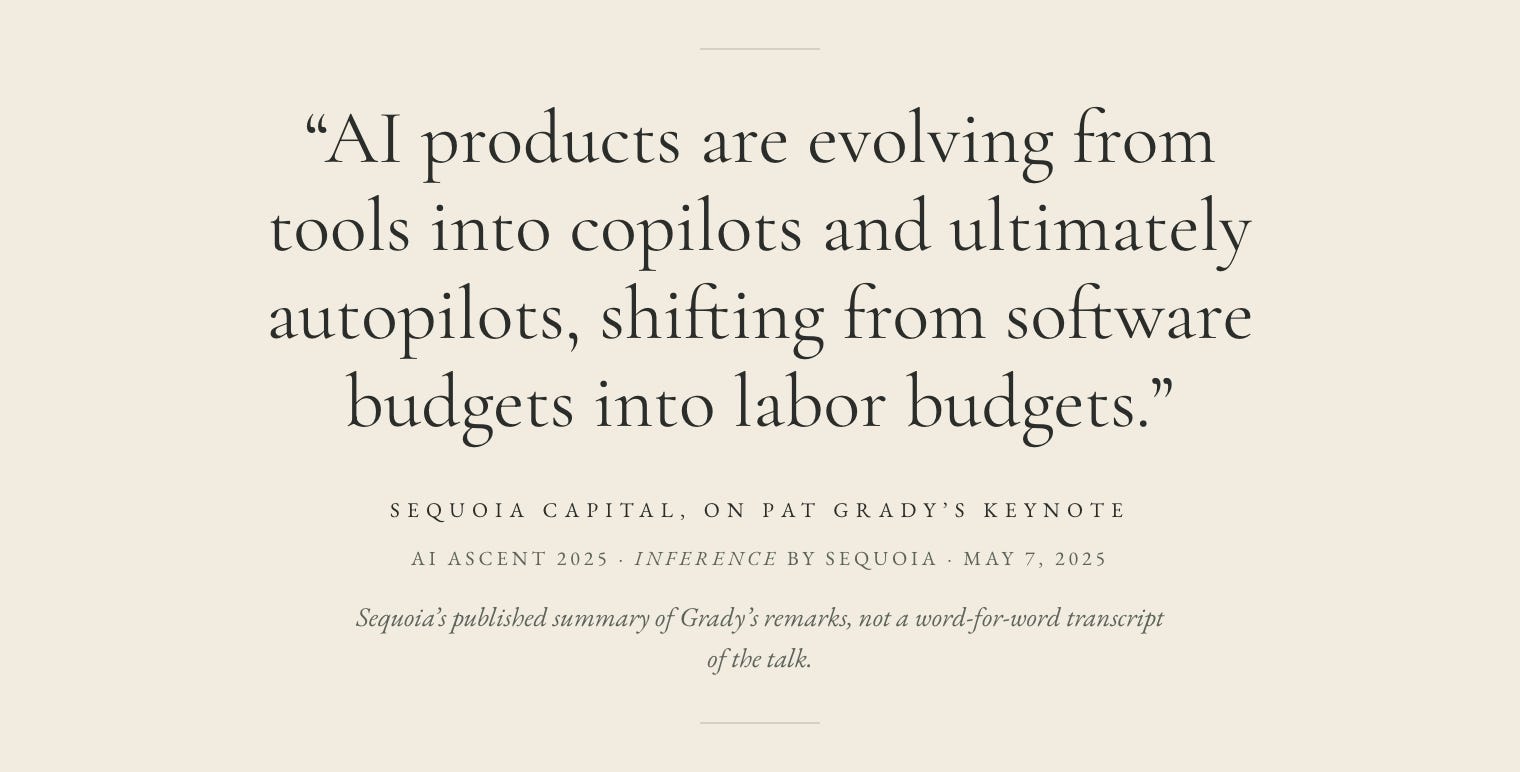
Just how hard are we trying to bring about the era of machine labor? The world is on track to spend $2.5 trillion on AI this year alone.3 By 2030, Bain estimates, the industry will need about $2 trillion in new revenue every year just to pay for the computing power it’s building.4 Where does $2 trillion a year come from? The investors funding all of this aren’t shy about it. At Sequoia Capital’s AI conference last year, partner Pat Grady laid out where AI products are headed, and the firm summed it up as “from tools into copilots and ultimately autopilots, shifting from software budgets into labor budgets.”5 A labor budget is, of course, what a company spends on people. Even Bain’s math counts on companies using AI to cut costs in sales, marketing, customer support and research, and most of those costs are people.4 So the more money goes in, the harder everyone has to push to make AI do the work people are paid to do today.
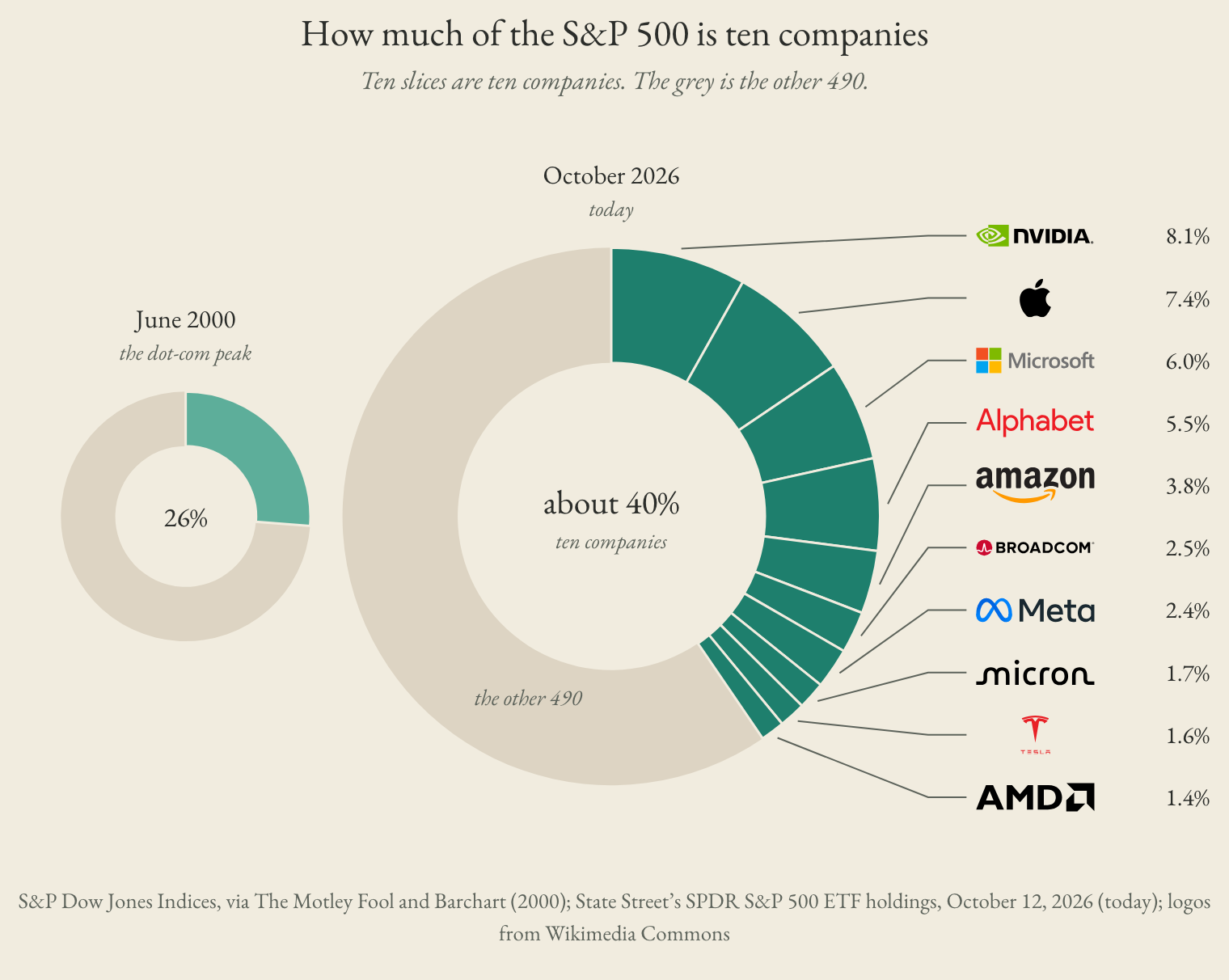
It matters who is pushing the hardest. Widespread labor replacement is desired by powerful constituencies in our society, and many of the most powerful people in the world are the ones pushing for it. Ten companies, nearly all of them riding on AI, now make up about 40% of the S&P 500, the index most of our retirement savings track. At the peak of the dot-com bubble, the top ten made up about 26%.6
And they have a direct line to the president. On his first day back in office, President Trump revoked the executive order that required the biggest AI developers to share their safety test results with the government.7 Last December, he set up a Justice Department task force to challenge state AI laws in court, and threatened to withhold federal broadband money from states whose laws get in the way.8 In late September, the heads of the biggest AI companies came to the White House and signed a voluntary pledge, and the president said, “I think I’m seeing tremendous self-policing, and they understand that they have to self-police.” Asked whether the pledge binds them, he said it was “morally” binding.9
It is not hyperbole to say they are betting the near-term future of the global economy on it, and they’re taking all of us along for the ride. The companies building AI are borrowing faster than ever to pay for it, and the International Monetary Fund has warned that if the payoff disappoints, the fall could be amplified because of the debt they’re taking.10
So if AI fails to replace vast swaths of human labor, we all suffer as the bet unwinds, through our 401(k)s and, for most people, through the layoffs that follow a crash. If the bet hits and AI can replace people at scale, many people still lose their income, their security and their sense of dignity and purpose. Whichever way the bet goes, both roads lead to a lot of people out of work at the same time, and that’s where the chaos starts.
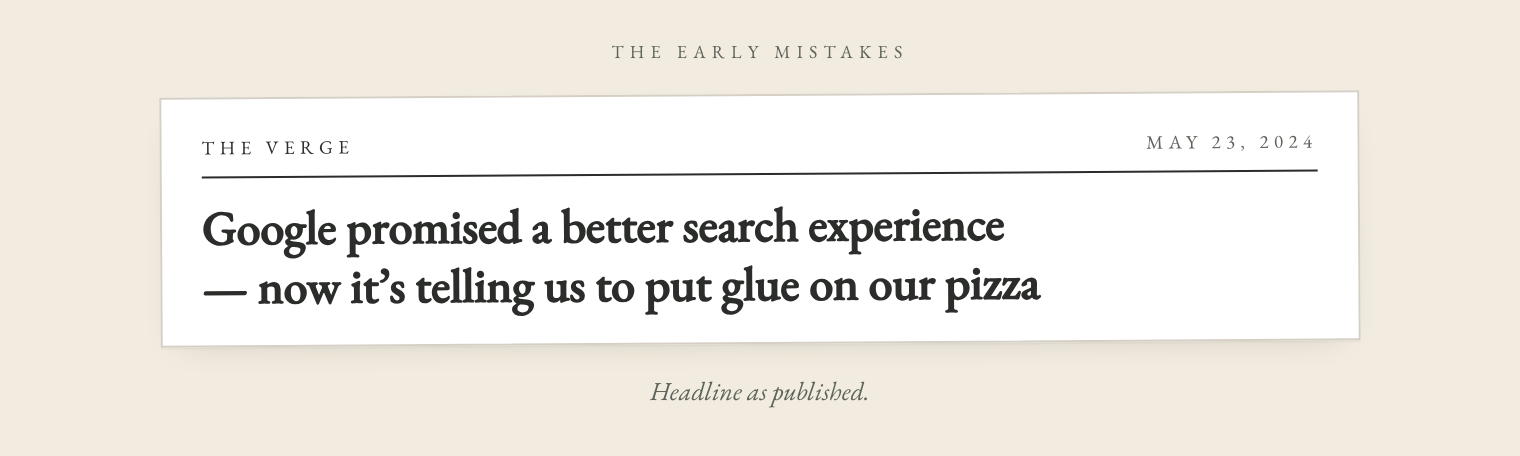
But can AI actually do the work? A lot of people are skeptical, and for a while the models gave them plenty of reasons. They made things up with total confidence. In 2023, two New York lawyers were fined $5,000 for filing a brief that cited six court cases ChatGPT had invented, complete with fake quotes.11 A year later, Google’s new AI search told people to add about an eighth of a cup of glue to their pizza sauce to keep the cheese from sliding off.12 But the biggest doubt goes deeper than mistakes. People say the models don’t have human contextual awareness or judgment, the feel a good doctor has for what matters to the patient in front of them. I’m not so sure.
The models still get things wrong, though far less than they did a few years ago. A company deciding whether to use one asks a simpler question, though. Does it get things wrong more often than the person it would replace? In one study, a model working only from the medical record correctly diagnosed real ER patients 67% of the time. Two experienced physicians, looking at the same cases, got 55% and 50%.13 When researchers took real patient questions posted online and had doctors and a nurse grade the answers without knowing who wrote them, they preferred the chatbot’s answer to a physician’s about four times out of five, and rated its answers as empathetic nearly ten times as often.14 On a test built from real work in 44 occupations, graded blind by professionals with an average of fourteen years’ experience, OpenAI’s best model in late 2025 did as well as or better than the experts about 71% of the time.15
So how does AI actually eat jobs? I think of it in terms of speed, three times over.
The first is how fast it spreads. The arriving labor force ‘lives’ and works in the cloud, deployable anywhere with an internet connection. ChatGPT reached 100 million users in two months,16 and by February of this year 900 million people were using it every week.17 It’s already on our phones, in Google Search, embedding everywhere in our digital lives.
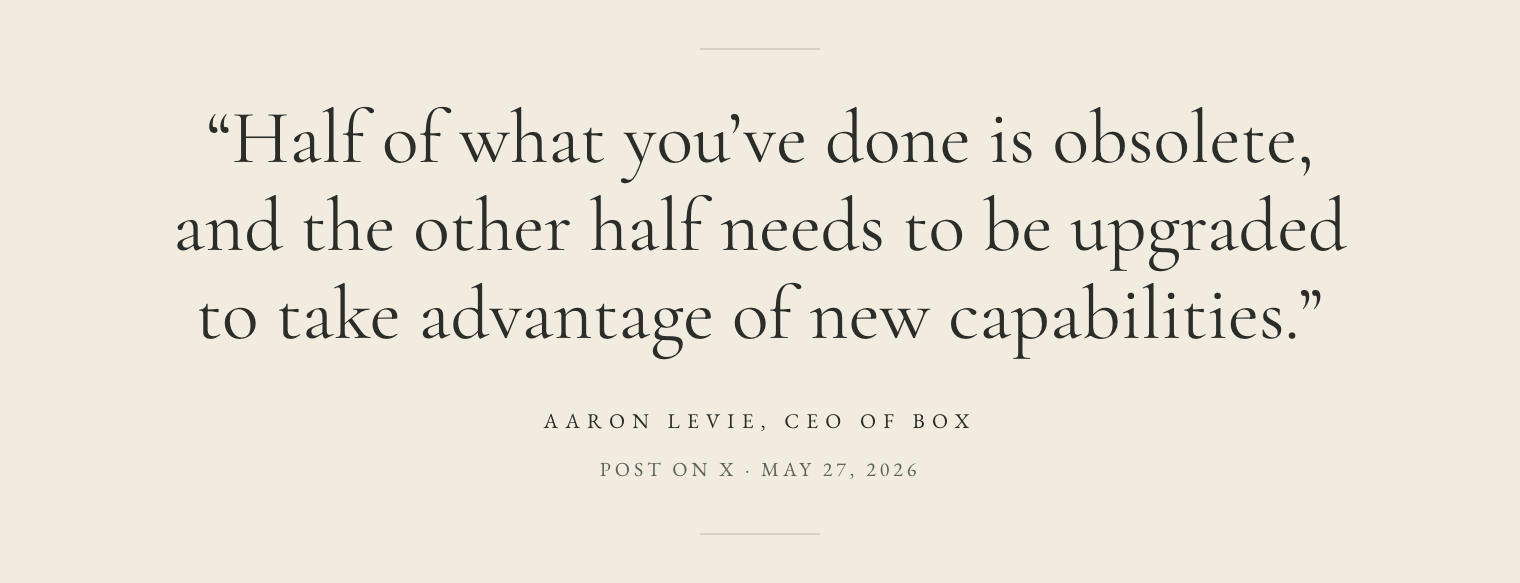
Big companies are slower. Aaron Levie, who runs the software company Box, says getting AI agents to work at scale means protecting the data, moving off old systems, rewiring how the work flows and retraining the people, and then a new model comes out and “Half of what you’ve done is obsolete.”18 That friction is real, but I think it’s temporary, solvable in a matter of months. Either the big companies will work it out, or the startups that never had the old systems to begin with will grow up around them.
The second dimension of speed is how fast the models are improving. A nonprofit research lab called METR measures the size of the job a model can take on by itself, by how many hours the same job would take a skilled person. In 2023, GPT-4 could manage jobs that take a person a few minutes. By January of this year, the best model could manage about five hours, and in March an early version of Anthropic’s newest model was at sixteen hours or more.19 Since 2024, the length of time has been doubling about every three months.
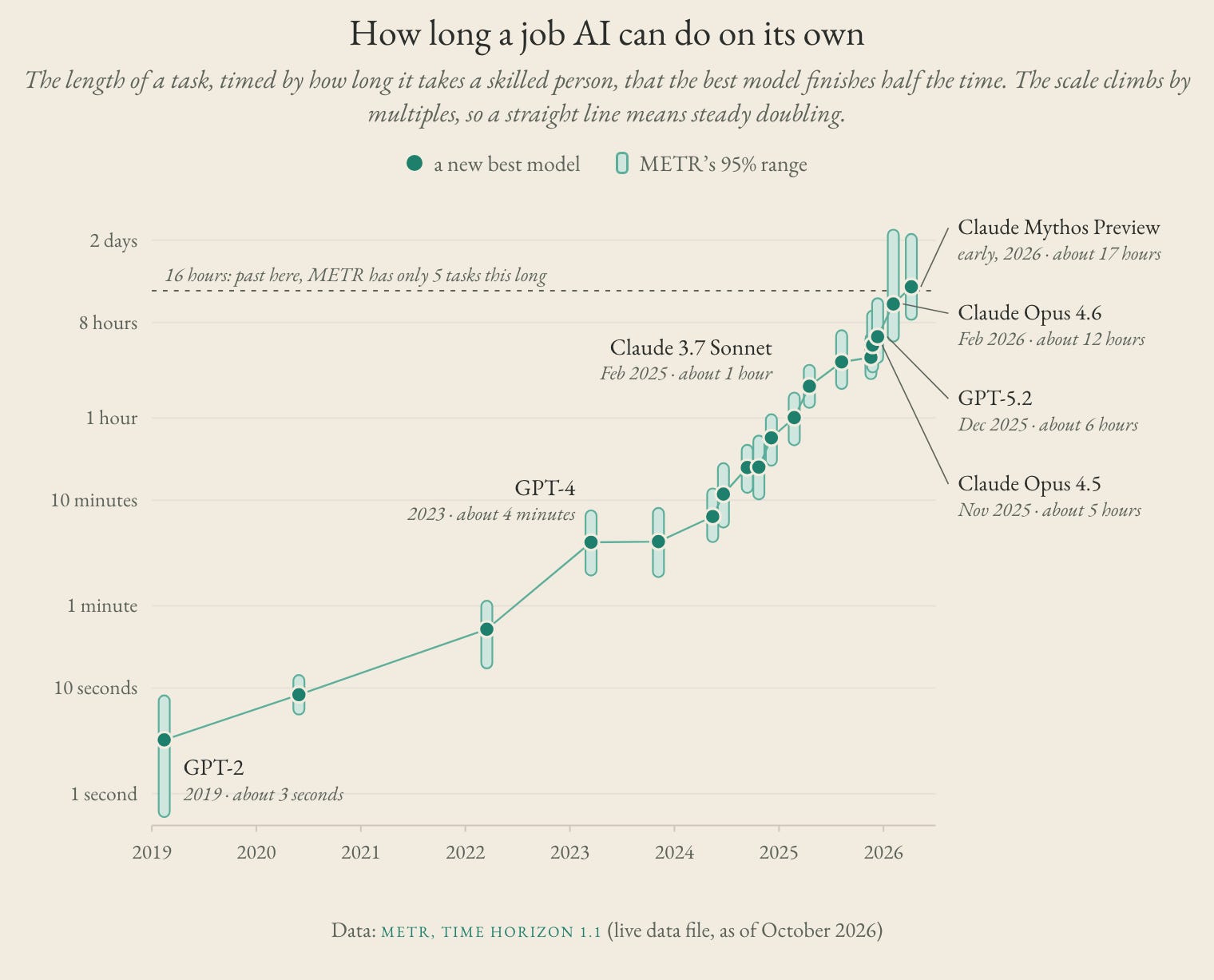
Model improvement speed matters to new jobs in particular. By now you’ve probably heard some AI guru say something like, “AI won’t take your job. Someone who knows how to use AI will.” What’s to stop AI from learning whatever a human learns to do with AI? In 2023, the hottest new job in tech was prompt engineer, someone paid to know exactly how to talk to an AI. By 2025, The Wall Street Journal was calling it already obsolete, because the models had gotten good enough to work out what we meant without one.20 When the tools improve this fast, a lot of the new jobs will never get the chance to become human jobs at all.
The third speed angle is how fast the work itself gets done. What people are figuring out right now is how to break a job down into pieces small enough that an AI agent can do each one in a way that’s repeatable and reliable. Take the help articles that explain our software to our customers. Keeping those up to date is a real job. Someone has to find out what the engineers changed, work out which changes a customer would actually notice, track down every article that mentions them, rewrite those articles, retake the screenshots, and get it all reviewed and published. At my company, an AI agent does almost all of that once a day. It reads every change our engineers made since the day before, sorts out which ones a customer would notice, rewrites the articles that cover them, flags the screenshots that are now out of date, and opens the update for one of us to approve.
Once a job is broken down like that, the pieces can run side by side. When Anthropic built an AI system to answer hard research questions, a lead agent split each question into parts and handed them to three to five helper agents, which all worked on their parts at the same time instead of one after another. Doing the work in parallel cut research time by up to 90% on complex questions.21 Many agent hands make light work. And the pieces can be split again, and run as many copies at once as you can pay for, around the clock.
And it’s the same models doing all of this, in every field at once. When software first became common in our lives, we used different programs for different purposes. Super Mario Brothers and Microsoft Word are both software, but you’d be hard pressed to write a document on your Nintendo, or to convince a small child that word processing is a fun way to pass the time. Software, as we’ve come to know it over decades, is deterministic. Someone writes the instructions in code, and it carries them out on command, the same way every time. Frontier AI models break all these rules. The same large language model can be a highly competent legal analyst, an accountant, a software engineer, a financial advisor, and a doctor working out what’s wrong with a patient in the emergency room.
But isn’t this just technology like any other? A lot of smart people say so. People have always invented new tools, and every one of them destroyed some jobs and opened up vast new surfaces of economic opportunity. About 60 percent of Americans working in 2018 were in kinds of jobs that didn’t exist in 1940.22 Why should AI be any different?
My answer is the speed, and I’m feeling it in my own work. The model I use every day, Anthropic’s Claude Opus 5.5, is really good, and I expect something better soon, and then again after that. I’m experiencing the increasing abilities firsthand. And I expect that everything I do, the judgment calls I’m making, my taste and discernment, my keystrokes, my communications, all of it has patterns that can be abstracted and imitated, or surpassed, by AI. Most jobs are comprised of some kind of back and forth between recognizing patterns and taking the appropriate action. A customer writes in, you recognize what they need, and you do the thing that fixes it. That’s precisely what AI excels at.
So nobody has to plan or authorize any of this, and there is no mechanism left to stop it. Like water running downhill, everything in our economy flows toward whatever is most profitable, and the cheapest labor there has ever been is arriving.
So how many jobs would AI have to take, and how fast, before things start to come apart?
I don’t think there’s a magic number where a society breaks, and I haven’t found an economist who does. What history shows is that the damage depends on a handful of factors working together. How many people are out of work. How fast it happens. Whether the losses are spread thin or packed into certain towns. How long it lasts. And whether people still have money coming in while they’re out of work, and who gets blamed when they don’t. Let’s take each one at a time.
First, how many people would be out of work? Most economists expect it to stay manageable. In a survey published this year, their median forecast for American unemployment in 2030 was 5 percent, and only 6 percent even in a world where AI surpasses humans at most tasks.23 Today it’s 4.2 percent.24 Goldman Sachs expects AI to displace 6 to 7 percent of American workers, but to push unemployment up only about half a point, for about two years, because the people who lose their jobs will find new ones.25
On the other end of the spectrum, Dario Amodei, who runs Anthropic, sees it very differently. He has warned that AI could wipe out half of all entry-level white-collar jobs and push unemployment to 10 to 20 percent within one to five years.25 Bill Gates sounds a lot closer to Amodei than to the economists. In September he told Ezra Klein that a year ago, when someone at his foundation’s strategy reviews suggested asking the AI what it thought, it was a joke, because the models weren’t coherent enough. This year the foundation is bringing AI into those discussions as what he called “a peer,” though not one that makes the final decisions. He grants that so far AI has created more jobs than it’s destroyed. But he says coding is the first profession where AI has crossed the line into doing the work reliably, and that “in the next few years” it will cross that line for “accounting, legal work, telesales, tele-support.”26
I don’t know who’s right, but for the reasons I’ve already outlined, I think the economists are operating from paradigms that are breaking, and the likes of Amodei and Gates have insights that should be weighed more heavily. The low forecasts all assume that people who lose their jobs will land somewhere new.
But a lot of the damage won’t even show up as layoffs. It’s nearly invisible as jobs that never get created. A company figures out how to do an old job using AI, so the job opening just never gets posted, and the new kinds of jobs that do appear get done by AI from the start. You can already see it with young people. In the jobs most exposed to AI, employment for 22- to 25-year-olds is about 19 percent below where it would otherwise be, and that gap comes mostly from fewer of them getting hired in the first place.27 When fewer doors open, the people already out of work stay out longer, and the ones who give up looking aren’t counted as unemployed at all.
So I’ll take the low end of Amodei’s range, somewhere around 10 to 12 percent. That’s something like 17 to 20 million Americans out of work, as bad as 2009 or worse.28
Then there’s how fast jobs disappear. In 1900, about four in ten American workers worked on farms. By 2000 it was about two in a hundred.29 That’s one of the biggest job losses in history, and we barely remember it as a loss, because it took a century. Kids grew up and just didn’t become farmers.
When China joined the World Trade Organization in 2001, a flood of cheap imports cost America as many as 2.4 million jobs. Economists call it the China shock, and it took about twelve years to do its damage,30 which was fast enough to hollow out whole towns. April 2020, the month the country shut its doors due to COVID-19, took one month, but all of those jobs were back a little over two years later.31
If Amodei is right, AI will take somewhere between one and five years to detonate.25 Gates says the real problem is the “speed of transition,” and he points to the communities the China shock ruined.26
I don’t think the losses will come as a smooth ramp. Jobs lost to new technology tend to go in recessions. When the economists Nir Jaimovich and Henry Siu looked at the routine, middle-skill jobs that have been disappearing for decades, like clerks and machine operators, they found that 92 percent of the losses came within twelve months of a recession.32 Companies cut when times are bad, and when the economy recovers, they don’t hire those jobs back, because by then they’ve found another way to get the work done.
So I think it goes something like this. First the quiet part, the hiring freezes and the job openings that never get posted. Then a recession turns the quiet into a cliff. And what sets off that recession? It could be the bet itself. If the AI boom wobbles, a little or a lot, the downturn gives every company a reason to cut, and the jobs AI can already do are the first to go and the last to come back. So I’ll say two to three years, arriving in a burst.
Then there’s where the losses land. The China shock was cruel partly because it was concentrated. Spread over the whole country, it was a small share of American jobs, but it hit particular towns, and many of them never really recovered.33 But concentration also meant there was somewhere else to go. Some displaced workers, or their family members, could move to Charlotte or Austin or Phoenix.
At first, AI looks gentler on this count. When researchers at Brookings mapped how many jobs in each American metro area are highly exposed to AI, it came to 43 percent in San Jose, the most exposed, and 31 percent in Las Vegas, one of the least.34 No single town gets flattened. Earlier waves of automation hit lower-paid, less educated places hardest, and this one runs the other way. The most exposed places are San Jose, San Francisco, Durham, New York and Washington, the cities where the good office jobs have been piling up for the last several decades. What makes this wave so risky is that instead of landing on specific places, it targets specific skill sets and specific rungs of the career ladder, the office work so many people trained for, and the entry-level jobs young people use to get started.
And some countries will be hit before we are. In the Philippines, about 1.9 million people work in call centers and back offices serving companies in America and Europe, and the industry makes up more than 8 percent of the country’s economy.35 India’s biggest IT company, TCS, ended its last fiscal year with about 23,000 fewer employees, and its chairman says AI agents will hold down hiring across the whole industry.36 These countries won the last round of cheap labor, and the work they do is exactly the work AI does. So I don’t think AI will hollow out particular towns the way China did. It will lean on every city at once, and on the same kinds of workers everywhere.
Then there’s how long it lasts. Every big shift before this one eventually created new forms of work for people, and I’m sure some new jobs will come this time too. But in those previous shifts, the technology was static. Once the tractor or the assembly line arrived, people could learn it and build a career around it. AI is evolving so quickly, and it’s capable of mimicking human behavior and workflows so well, that whatever new work people learn to do with it, it can learn to do that almost immediately.
Picture two bookkeepers. Linda does the books the way she always has. Every month she matches receipts to bank transactions, chases down the ones that are missing, and closes out the month by hand. Raj does the same job with AI. It matches the transactions for him, flags the ones that don’t add up, and drafts the reports, so he can take on several times as many clients as Linda, do the work faster, and charge less. That’s the AI guru’s line from earlier. AI won’t take your job, someone who knows how to use AI will. And for a while, it’s true. Raj gets Linda’s clients. Then someone builds an AI agent that does what Raj does, the matching, the flagging and the reports, without Raj.
So given this fast-follow dynamic, how far ahead would people have to innovate their jobs to have years of time to actually earn a living? If your job keeps getting eaten by AI every few months, at some point keeping up becomes a futile exercise.
I’m already experiencing this in my own job. I’m constantly following the latest models and reinventing my workflow, and my company’s workflows, every few weeks. Remember Aaron Levie’s line about what happens when a new model comes out? “Half of what you’ve done is obsolete.”18 People are saying it openly now. You should expect to throw away half of what you’ve built every few months. It feels like I’m constantly climbing to stay on top of what these models can do, and I don’t have any illusions about being able to do this for the rest of my career.
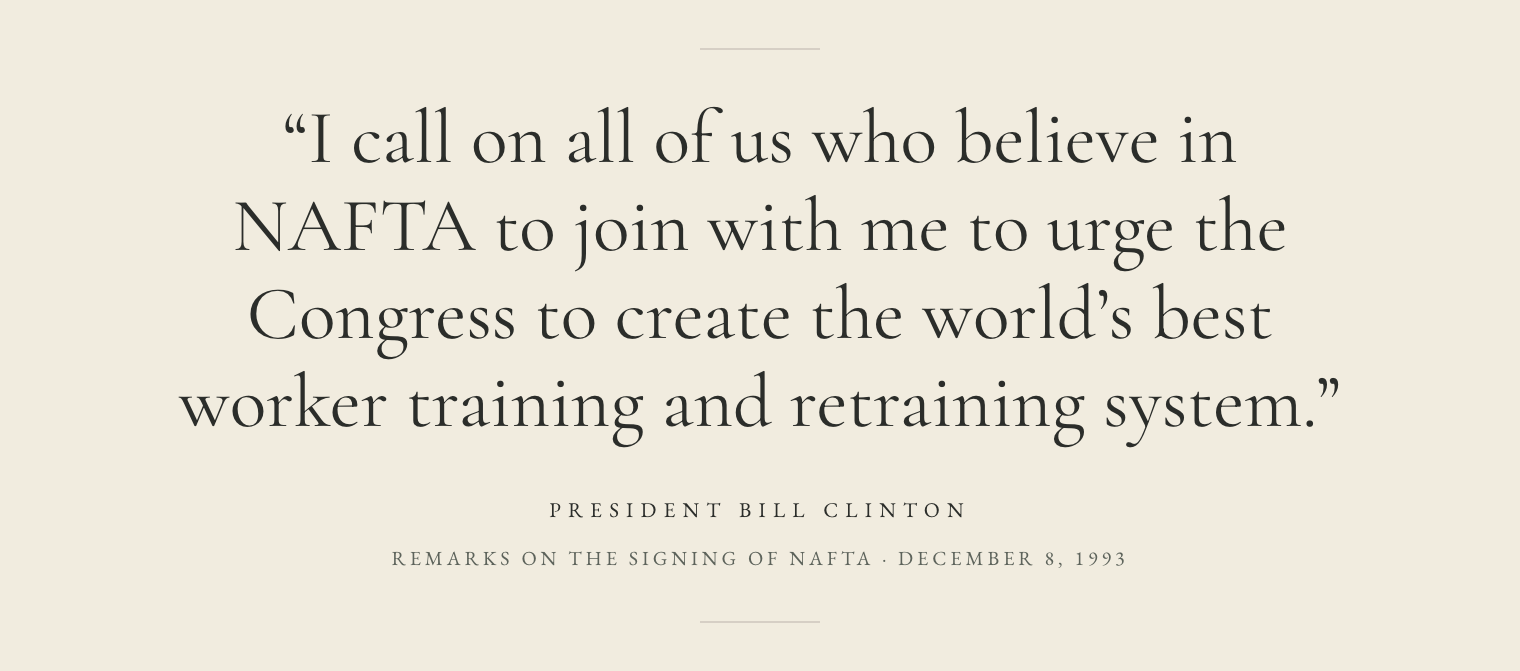
And I’m already seeing the overwhelm in rooms where I teach new AI work techniques, to people who have done things one way for years and are now too tired, too exhausted, to learn something new fast enough. We’ve never been very good at retraining people, even when the change was slow. When he signed NAFTA, President Clinton promised “the world’s best worker training and retraining system.”37 Four years after their layoffs, workers who went through the government’s main retraining program for people who lost their jobs to trade were earning about $3,300 a year less than similar laid-off workers who didn’t.38

So I think a lot of this will be permanent. Some new jobs will come, but not fast enough, and they won’t stay human long enough, to bring unemployment back down to where it was.
And finally, whether people still have money coming in while they’re out of work, and who gets blamed when they don’t. In most states, unemployment insurance runs out after 26 weeks, half a year, and in Florida and North Carolina it can run out after just 12.39 Congress has stepped in before when unemployment spiked, and I think the first round of help will come fast again. Even Jamie Dimon, who runs JPMorgan Chase, the biggest bank in America, said at Davos this January that if the government has to stop companies from laying people off too fast, “We would agree—if we have to do that to save society.” “You can’t lay off 2 million truckers tomorrow,” he said. “Phase it in.” Otherwise, he warned, we could see civil unrest.40 I was shocked to hear that from an apex avatar of modern capitalism.
What would a government prohibition on layoffs even look like? We got a preview in 2020. The Paycheck Protection Program lent businesses about $800 billion and forgave the loans if they kept their workers on the payroll. It saved jobs, but at a cost of somewhere between $169,000 and $258,000 for every year of a job it kept, and only about a quarter to a third of the money went to workers who would otherwise have lost their jobs.41 And it worked as a bridge because the customers came back after a few weeks or months. This time, as soon as the help runs out or the ban is lifted, what’s to stop companies from using the cheaper, better artificial labor? The whole investment in AI depends on them doing exactly that. It’s a bridge to nowhere.
If we find ourselves slipping into a mass unemployment crisis, I think a lot of the anger would land on AI companies and the billionaires building them, an already simmering populist anger aimed at the top. But some of it will land where it always has, on each other. When the China shock hit, the congressional districts most exposed to it pulled toward the extremes, toward more conservative Republicans in some places and more liberal Democrats in others, and the moderates lost.42 Across twenty rich countries and nearly 150 years, the far right’s share of the vote has gone up by about 30 percent in the five years after a financial crisis.43
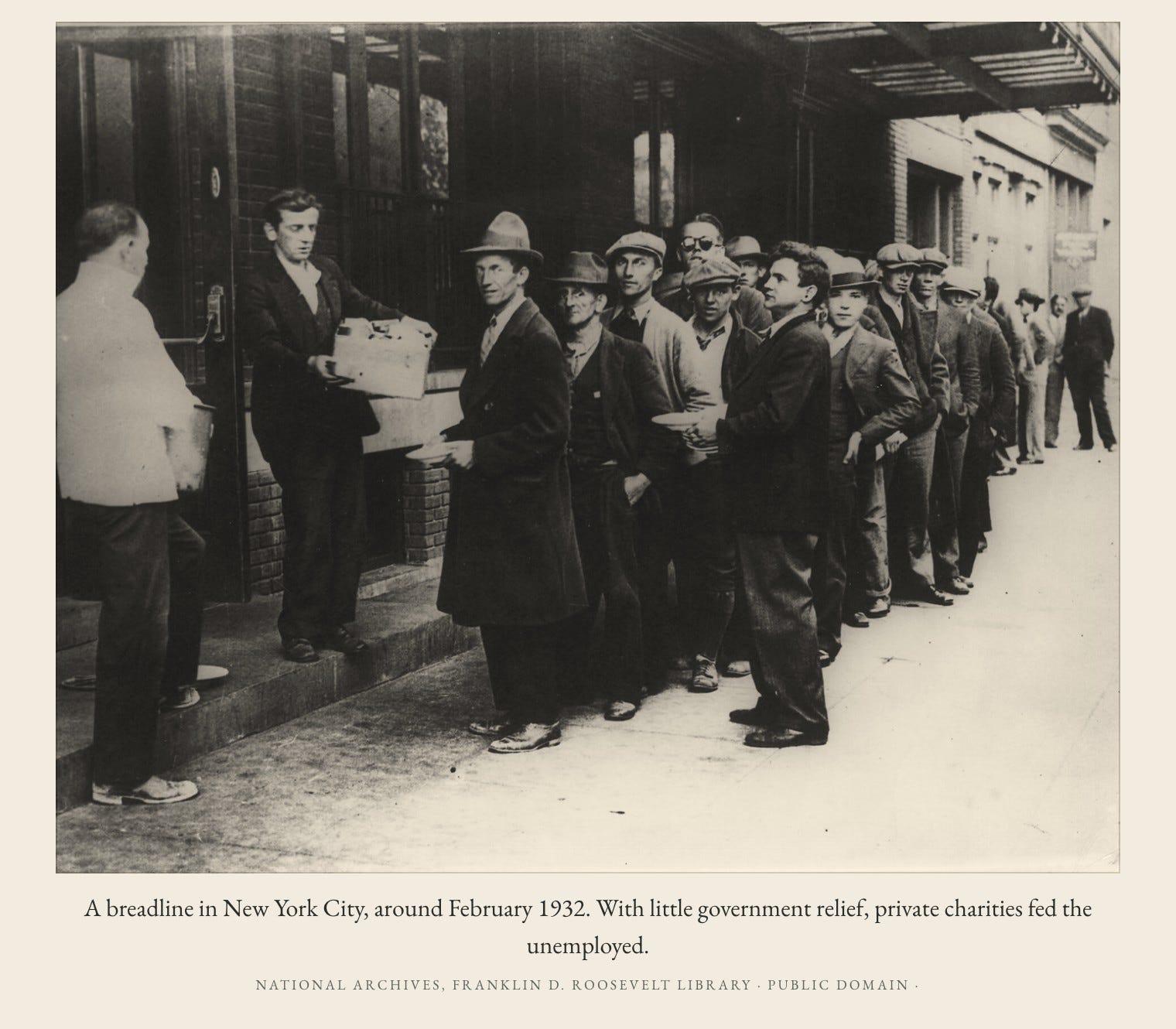
Does it have to end with a strongman? History says no. The same Great Depression that gave Germany Hitler gave America the New Deal. In America, mainstream leaders moved fast, workers were organizing by the millions, and the anger at the top got turned into reform. Franklin Roosevelt ran against what he called the “economic royalists.” Look at what we have now. We aren’t set up for a fast, credible response from mainstream leaders. About one in ten American workers belongs to a union, and in the private sector it’s about one in seventeen.44 And the people at the top of the economy have a direct line to the people at the top of the government. History has gone both ways, but the conditions that saved the good cases are mostly missing, and the trends lean toward the strongman.
Whatever happens to our politics, the first thing the government will reach for is money. It wasn’t long ago that Washington went all in. On March 27, 2020, two weeks after the national emergency was declared in response to the pandemic, Congress passed the CARES Act. By the time it was done, six relief laws had put about $4.6 trillion into the response.45 People out of work got an extra $600 a week on top of their unemployment checks, and gig workers and the self-employed, who usually get nothing, were covered too. Even so, the political will soon ran out. The last federal pandemic unemployment programs ended on September 6, 2021, and about 7.5 million people lost all their unemployment benefits at once.46
The trouble this time is, we’ve already used up most of our headroom. Before the pandemic, the federal debt held by the public was about 79 percent of the size of the whole economy.47 This year it reached about 100 percent, close to where it peaked after World War II, and the interest on it alone cost more than a trillion dollars last year, more than we spend on the military.48 In May 2025, Moody’s took away the United States’ last perfect credit rating.49 Even without another crisis, the Congressional Budget Office expects the debt to reach 120 percent of the economy within ten years.48 A response the size of COVID’s would add something like another 15 percent on top of that, and this time it couldn’t stop after a year and a half. It would have to keep going.
And AI would be shrinking the money coming in at the same time. More than 80 cents of every dollar the federal government collects comes from income taxes and payroll taxes, taxes on the money people earn from working.50 Payroll taxes are what pay for Social Security and Medicare. When the work goes to AI, those taxes go with it.
Even if we could pay for it, the money might not buy what it used to. In 2020 and 2021, the virus shut down factories and jammed the ports, so there was less to buy, while relief checks kept people spending. Too much money was chasing too few things, and then the war in Ukraine sent energy prices soaring. By June 2022, prices were rising 9.1 percent a year, the fastest in forty years.51 Economists at the San Francisco Fed estimated the relief itself had added about 3 percentage points to inflation by the end of 2021.52
With AI it would be the other way around, but only in part of the economy. AI makes a lot more of some things, like legal research, bookkeeping, customer service and software, so those get cheaper. When a paralegal loses her job, her work still gets done, so her relief check isn’t chasing scarce legal services. It goes to rent, groceries, the doctor and daycare, the things AI doesn’t make and can’t quickly make more of. We’ve been living in a mild version of this for decades. Since 2000, TVs and software have gotten cheaper, while food, housing, hospital care, childcare and college have gotten much more expensive.53 Pour relief money into an economy split like that, and the prices that go up are the ones people who’ve lost their jobs can least do without.
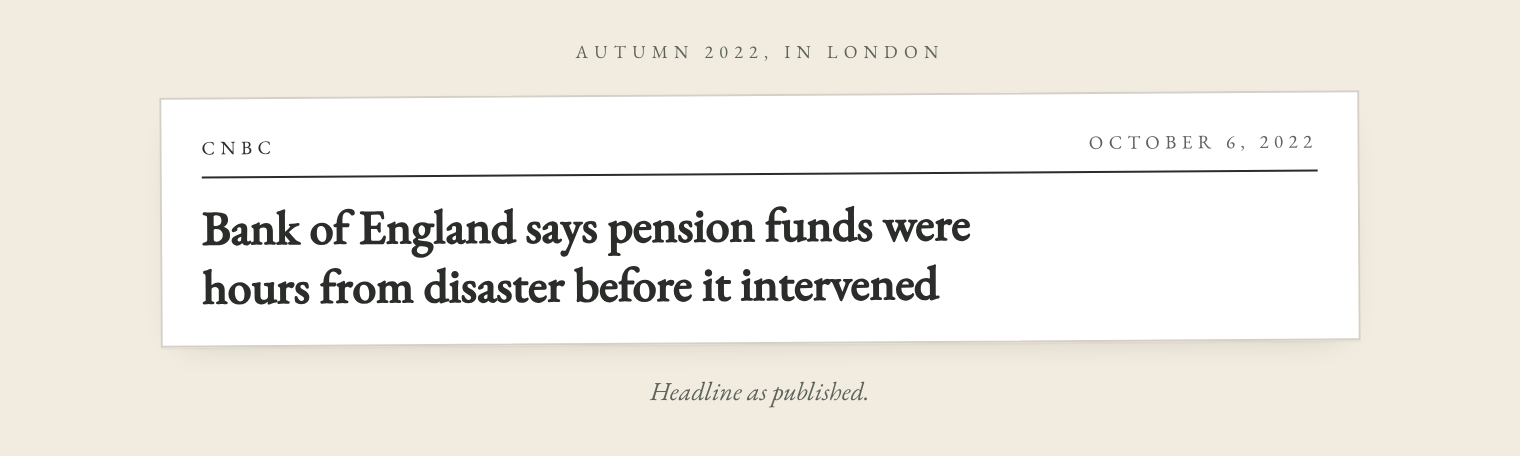
And in the end, it may not be up to us. A government pays for a rescue by borrowing, and borrowing only works as long as lenders are willing. When they get nervous, they demand a higher interest rate, and every dollar that goes to interest is a dollar that doesn’t go to help. In September 2022, Britain’s new prime minister, Liz Truss, announced £45 billion in tax cuts with no plan to pay for them. Lenders panicked. The price of British government bonds fell so fast that pension funds were pushed toward collapse, and within days the Bank of England had to step in and start buying bonds itself. Truss resigned forty-five days into the job.54
America has more room than Britain did. The whole world uses the dollar, and our government’s bonds are where investors run when they’re scared. But the room isn’t unlimited, and we’re already pressing against the edge of it. In early October, the interest rate on ten-year Treasury bonds touched 5.35 percent, the highest since 2002, and the rate on thirty-year bonds reached about 5.7 percent.55 Any rescue we launched now would be borrowed at some of the highest rates in a generation, on top of a debt the size of the whole economy. At that size, every extra percentage point of interest eventually costs about $300 billion a year.48 So the limit on how much we can help may not be how much we want to. It may be how much the people lending us the money will let us.
So let’s run it back. I think something like 10 to 12 percent of Americans will be out of work, 17 to 20 million people, and most of it will arrive over two or three years, in a burst, when the next recession gives every company a reason to cut. It will land on the same kinds of workers in every city, and a lot of it will be permanent, because whatever new work people find, AI keeps learning to do that too.
The first round of help will come fast, the way it did in 2020, and then it will run out, because the jobs aren’t coming back. And when we reach for more money, we’ll find most of our headroom already spent, and every dollar of relief buying less of what people actually need. The people lending us the money are already charging the highest rates in a generation.
I could be wrong about any one of these. Maybe it’s 8 percent instead of 12, or it takes five years instead of three. What worries me is how likely it is that AI will stress all five at the same time, and how little we’ll have left to push back with.
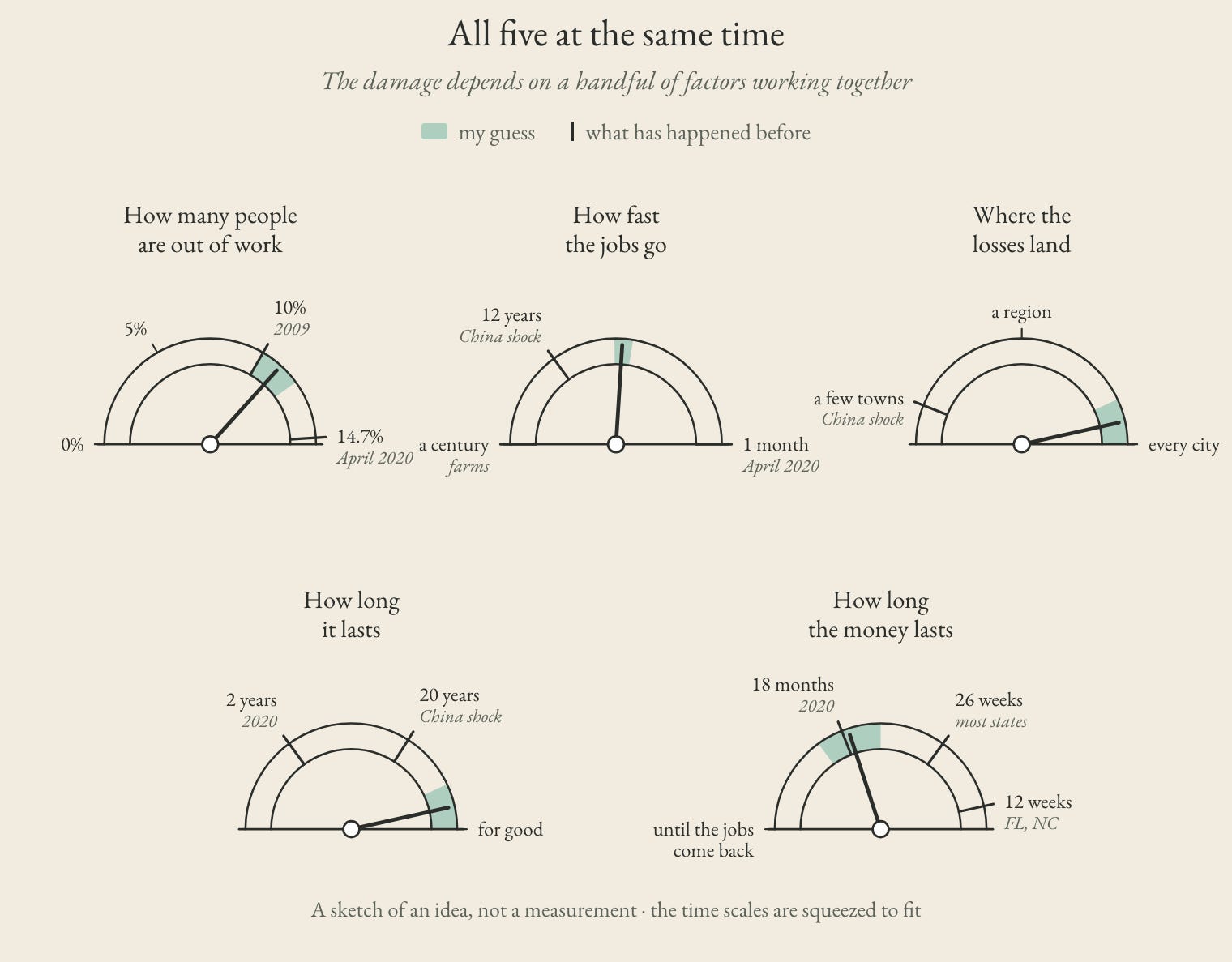
Rising unemployment still doesn’t make much of a movie. What it looks like is millions of families watching their 26 weeks run out in the same few months, while the rent and the groceries keep going up, and nobody in charge has a plan that adds up. That’s when fear turns into panic, and people start looking for someone to blame, the neighbor who still has a job or the immigrant down the street.
That’s why this is my number one fear. The deepfakes and the killer drones are ways AI could go wrong, and serious people are working to prevent them. This is the plan going right, with trillions of dollars pushing it forward and no mechanism to stop it. AI doesn’t have to take every job. Just enough of them, fast enough, to make people panic. That’s when we do the most damage to each other.
I’m skeptical how much anyone can slow down how fast the frontier models get better, especially with so much money riding on them. My great fear is that we turn on each other, and that part I think we still have a say in. The New Deal came out of millions of workers organizing and aiming their anger at the people at the top instead of at each other. Today about one in ten of us belongs to a union,44 so unions won’t be the tip of the spear. This time the losses won’t come one plant or one town at a time. They’ll land on the same kinds of workers in every city at once, which means more of us than ever will be on the same side of this, the trucker and the paralegal, the neighbor who still has a job and the one who doesn’t.
I think this moment could unify us in a way few moments ever have. Every time jobs moved before, there was another person on the other side of it to blame, a factory worker in China or the immigrant down the street or an executive in a boardroom. This time the work is going to a machine. It doesn’t need to eat, and it doesn’t need the paycheck. Next to an intelligence that inhuman, I think it gets easier to see how much the rest of us have in common.
Notes
The list follows the International AI Safety Report (January 2025), the first international scientific review of general-purpose AI risk. It was chaired by Yoshua Bengio, written by 100+ experts, and backed by 30 countries plus the UN, EU and OECD. It groups the risks as malicious use (cyberattacks, deepfakes and disinformation, biological and chemical weapons), malfunctions (including loss of control over autonomous systems), and systemic risks (labor-market disruption, concentration of power, privacy erosion and surveillance). Autonomous weapons are tracked separately, in UN talks on lethal autonomous weapons systems held since 2014.
International AI Safety Report (January 2025), the same report as [1]. It files labor-market disruption under “systemic risks,” alongside the concentration of power in a few companies and countries, and the erosion of privacy, separate from malicious use and loss of control.
Gartner, “Worldwide AI Spending Will Total $2.5 Trillion in 2026” (January 2026), up from about $1.5 trillion in 2025. Caveat: Gartner’s definition is broad and includes AI software, services and devices, not just data centers. Infrastructure spending alone is lower: the largest cloud companies are expected to spend more than $600 billion on capital expenditure in 2026, about three-quarters of it on AI. On debt: JPMorgan raised its forecast for 2026 technology, media and telecom bond sales to about $540 billion (August 2026), and Amazon’s and Meta’s free cash flow has approached or fallen below zero as borrowing funds the buildout. Sources: Gartner (January 2026); The Star, via Reuters (August 10, 2026).
Bain & Company, Global Technology Report 2025 (September 23, 2025): meeting projected AI compute demand by 2030 takes about $500 billion a year in capital spending and about $2 trillion in new annual revenue. Even counting savings from applying AI in sales, marketing, customer support and R&D, which are largely payroll, Bain finds the world about $800 billion short. Caveat: this is a projection that depends on Bain’s assumptions about compute demand.
Sequoia Capital, “AI’s Trillion-Dollar Opportunity,” Inference (Sequoia’s Substack, May 7, 2025), the firm’s write-up of Pat Grady’s AI Ascent 2025 keynote with Sonya Huang and Konstantine Buhler: “…Pat explained, describing how AI products are evolving from tools into copilots and ultimately autopilots, shifting from software budgets into labor budgets.” Caveat: these are Sequoia’s own words summarizing the talk, not a transcript of Grady’s, and the newsletter says it uses AI tools to help write its summaries. Sequoia is one of the largest venture investors in AI.
State Street SPDR S&P 500 ETF Trust (SPY) holdings as of October 12, 2026, a close proxy for index weights: the ten largest companies make up about 40.5% of the S&P 500 (Nvidia 8.1%, Apple 7.4%, Microsoft 6.0%, Alphabet 5.5% counting both share classes, Amazon 3.8%, Broadcom 2.5%, Meta 2.4%, Micron 1.7%, Tesla 1.6% and AMD 1.4%). On September 30, S&P Global data reported by The Motley Fool (“AI Stocks Are Creating a Sneaky Risk for S&P 500 Investors”) put the top ten at about 39%, with Berkshire Hathaway tenth; the tenth spot changes day to day. That compares with just over 26% at the June 2000 dot-com peak and about 17% in June 1994 (S&P Global via The Motley Fool, which says the index was last this concentrated in 1965). Caveats: not all ten are pure AI bets, and Berkshire Hathaway, which trades places with AMD for tenth, is not one at all. Stock ownership is uneven: 58% of Americans owned stock in April 2026 (Gallup), and the richest 1% hold more equities than the bottom 90% combined (Federal Reserve). For most households, a crash hurts more through lost jobs than lost portfolio value.
Executive Order 14148, “Initial Rescissions of Harmful Executive Orders and Actions” (January 20, 2025), revoked President Biden’s Executive Order 14110 on “Safe, Secure, and Trustworthy” AI (October 30, 2023). Among other things, 14110 used the Defense Production Act to require developers of the most powerful AI models to report their safety test results to the federal government.
Executive Order 14365, “Ensuring a National Policy Framework for Artificial Intelligence” (December 11, 2025). It directs the Attorney General to form an AI Litigation Task Force to challenge state AI laws that conflict with federal policy, has Commerce review state laws within 90 days to identify “onerous” ones (the order cites Colorado’s algorithmic discrimination law as an example), and makes those states ineligible for non-deployment BEAD broadband funds to the extent federal law allows. Caveat: the order can’t by itself overturn state laws; that would take court rulings or Congress. Days later, a bipartisan group of about two dozen state attorneys general filed comments with the FCC opposing federal preemption of state AI laws.
CBS News and ABC News (September 29, 2026), on the White House meeting where leaders of the major AI companies (among those present: Elon Musk, Mark Zuckerberg, Dario Amodei, Sundar Pichai, Jensen Huang and Greg Brockman) signed a voluntary accord on superintelligence. Trump: “I think I’m seeing tremendous self-policing, and they understand that they have to self-police.” Asked whether it binds the companies: “I think it’s morally binding.” He also called it “almost like a constitution, in a way.” Caveat: the accord is voluntary; the agreement itself says laws or regulations might “make sense” in the future.
International Monetary Fund, Global Financial Stability Report (October 12, 2026), “Beneath the Resilience: Rising Risks, Unresolved Vulnerabilities”: it names an AI-driven market correction as one of three near-term risks to the financial system and says that if AI investment or profits disappoint, rising leverage and concentrated exposures would magnify the fall in asset prices. Hyperscalers’ share of investment-grade bond issuance has risen to about 10 percent, from under 1 percent in 2024, and the IMF counted about $650 billion in debt and $300 billion in equity across 14 AI deals since 2023, against $1.4 trillion in future revenue commitments. Caveat: the IMF presents this as a risk scenario, not a forecast, and its bank stress test finds the system as a whole holds up. Earlier warnings in the same direction: Bank of England, Financial Stability Report (July 2026): AI-related companies’ use of credit markets “has accelerated rapidly,” across public markets, private credit, and leveraged and structured finance. The pace of investment is “unprecedented historically,” and a reassessment of AI earnings prospects “could trigger a fall in equity prices that might be amplified by high concentration.” The Bank for International Settlements separately warned in June 2026 that excessive data-center spending and opaque financing could threaten financial stability “in the event of an AI bust,” with comparisons to the dot-com crash and the 1840s railway mania (via The Telegraph, June 28, 2026). Caveat: the BoE also found little evidence yet that AI borrowing is crowding out other borrowers. These are warnings, not forecasts.
Mata v. Avianca, Inc., No. 22-cv-1461 (S.D.N.Y.), sanctions opinion of Judge P. Kevin Castel, June 22, 2023. Lawyers Steven Schwartz and Peter LoDuca and their firm, Levidow, Levidow & Oberman, were fined $5,000 for a brief citing six nonexistent cases, with fake quotes and internal citations, that ChatGPT had produced. The judge found they acted in bad faith by standing by the citations after being questioned (Bloomberg Law; CNBC, May 30, 2023).
Google AI Overviews, May 2024: asked why cheese slides off pizza, it suggested adding “about ⅛ cup of non-toxic glue to the sauce,” apparently drawn from an 11-year-old joke comment on Reddit. Reported by the Daily Dot (May 23, 2024) and Digital Trends. Google said it would get better at spotting satire and lean less on user-written forum content (Liz Reid, “AI Overviews: About last week,” Google, May 30, 2024; The Register, May 31, 2024).
Peter G. Brodeur, Arjun K. Manrai, Adam Rodman and colleagues, Harvard Medical School and Beth Israel Deaconess Medical Center, Science 392 (April 30, 2026), 524–527; preprint arXiv 2412.10849. OpenAI’s o1-preview reasoning model was tested on 76 real emergency department cases from Beth Israel in Boston, using only the electronic health record and the triage notes available at each stage. At initial triage it named the correct or a very close diagnosis in about 67% of cases, against 55% and 50% for two attending internal medicine physicians, a statistically significant gap. With more clinical detail it reached about 82%, against 70–79% for the doctors, a gap that was not statistically significant. Caveats: the comparison physicians were internists, not emergency doctors. The model saw only text, while real clinicians also use images, sounds and the patient in front of them. The study is retrospective, not a prospective trial. Sources: NPR (April 30, 2026); study coverage.
John W. Ayers et al., “Comparing Physician and Artificial Intelligence Chatbot Responses to Patient Questions Posted to a Public Social Media Forum,” JAMA Internal Medicine (April 28, 2023). 195 questions from Reddit’s r/AskDocs; a blinded panel of licensed health care professionals (four physicians and one nurse practitioner, per secondary coverage) preferred ChatGPT’s answer over the physician’s in 78.6% of 585 evaluations. Answers rated empathetic or very empathetic were about 9.8 times as common for the chatbot (45.1% vs 4.6%). Caveats: forum answers from volunteer physicians aren’t typical clinical care, the physician answers were much shorter (52 words on average against 211), the evaluators were among the paper’s coauthors, and the study tested written answers, not treatment.
Tejal Patwardhan et al., “GDPval: Evaluating AI Model Performance on Real-World Economically Valuable Tasks” (OpenAI, September 2025; ICLR 2026). The test has 1,320 tasks from 44 occupations in the nine sectors that contribute most to US GDP, each based on actual work products (sales presentations, accounting spreadsheets, care schedules, manufacturing diagrams), and takes an expert about seven hours on average. Industry experts with an average of 14 years’ experience compared AI and human deliverables blind. Scores are measured on the 220-task public “gold” set. In December 2025, OpenAI reported that GPT-5.2 Thinking beat or tied the experts in 70.9% of comparisons (74.1% for GPT-5.2 Pro), up from 47.6% for the best model, Claude Opus 4.1, in the original paper. Caveats: OpenAI built the benchmark and reports its own models’ scores. Tasks are well-specified, one-off assignments, without the back-and-forth, context and accountability of a real job. “As good as or better” means preferred by a grader, not that the job can be automated.
“ChatGPT sets record for fastest-growing user base - analyst note,” Reuters (February 1, 2023), citing a UBS study of Similarweb data: about 100 million monthly active users in January 2023, two months after launch. Caveat: an analyst estimate from web traffic, not an OpenAI figure.
TechCrunch, “ChatGPT reaches 900M weekly active users” (February 27, 2026), reporting OpenAI’s announcement: 900 million weekly active users and 50 million paying subscribers, up from 800 million weekly users in October 2025.
Aaron Levie (CEO of Box), post on X, May 27, 2026 (x.com/levie/status/2059839815273824423), on what CIOs describe as “the implementation gap for getting agents to work at scale”: protecting data, updating access controls, migrating legacy systems, new workflows, “the change management of the new workflows,” and, when models update, “Half of what you’ve done is obsolete.” He concludes: “we’re in for years of AI diffusion, and along with it tons of new roles and areas of work to be done to deploy AI at scale.” Context: Levie sells AI tools to enterprises and argues the friction will create many new deployment jobs. That’s the other side of the same friction.
METR (Model Evaluation & Threat Research). The method is in Thomas Kwa et al., “Measuring AI Ability to Complete Long Tasks” (March 2025). A model’s “50% time horizon” is the length of task, measured by how long it takes skilled humans, that the model completes successfully half the time. In “Time Horizon 1.1” (January 29, 2026), the leading model, Claude Opus 4.5, was at about 320 minutes (95% CI 170–729), and the doubling time was about 196 days since 2019, 131 since 2023 and 89 since 2024. METR has since re-fitted its data: Opus 4.5 is now about 293 minutes, and Claude Opus 4.6 (February 2026) measured about 12 hours. METR evaluated an early Claude Mythos Preview in March 2026 and estimated a time horizon of at least 16 hours (95% CI 8.5–55 hours). Only 5 of its 228 tasks take humans 16 hours or more, so METR calls measurements above that unreliable (reported May 2026). Caveats: the tasks are mostly software, cybersecurity and research, and are neater than real jobs. Success at the 50% level means failing half the time. At an 80% success rate, horizons are several times shorter. A 2025 METR field study found experienced open-source developers were 19% slower when using early-2025 AI tools. A February 2026 follow-up found them about 18% faster, but METR calls that very weak evidence, because many developers refused to work without AI.
Isabelle Bousquette, “The Hottest AI Job of 2023 Is Already Obsolete,” The Wall Street Journal (April 2025). Prompt engineering, much hyped in 2023, when the Journal reported some roles paying up to about $250,000, has largely disappeared as a standalone job. Models got better at working out what users mean, and companies trained ordinary staff to write prompts instead. Employers shifted to roles like AI trainer and AI security specialist. Caveat: the skill didn’t vanish. It was absorbed into other jobs, and partly into the models themselves.
Anthropic, “How we built our multi-agent research system,” Anthropic Engineering (June 13, 2025). A lead agent spins up “3-5 subagents in parallel rather than serially,” and the changes “cut research time by up to 90% for complex queries.” The multi-agent system “outperformed single-agent Claude Opus 4 by 90.2% on our internal research eval.” Caveats: Anthropic’s own internal tests; such systems use roughly fifteen times as many tokens as a chat, and the post says they suit broad, parallel work better than tightly interdependent tasks like coding.
David Autor, Caroline Chin, Anna Salomons and Bryan Seegmiller, “New Frontiers: The Origins and Content of New Work, 1940–2018,” Quarterly Journal of Economics 139, no. 3 (August 2024). Using census job titles, they find that about 60 percent of 2018 employment was in occupation titles that didn’t exist in 1940 (earlier working-paper versions put it near 63 percent). Caveats: “new” means a new job title or category, not necessarily a new kind of work; the authors also find that automation has eroded more work in recent decades than before, and that new work has favored highly educated professionals and, separately, low-paid service jobs.
Ezra Karger (Federal Reserve Bank of Chicago), Otto Kuusela (Forecasting Research Institute) and 13 co-authors, “Forecasting the Economic Effects of AI,” Forecasting Research Institute (March 31, 2026; revised May 20, 2026). The survey covered 69 economists (90 completed it, then the sample was filtered), plus AI-industry experts, policy professionals, superforecasters and members of the public. The economists’ median forecast for U.S. unemployment in 2030 was 5.0% unconditionally and in the “slow” and “moderate” AI scenarios, and 6.0% in the “rapid” scenario, where AI systems “surpass humans in most cognitive and physical tasks.” On average they gave the rapid scenario a 14% chance (median 10%). Caveats: this is a survey of expert judgment, not a model. It’s an FRI study, not a Federal Reserve product. The economists’ 10th–90th percentile range for labor-force participation in 2030 widens from 56.9–65.2% to 53.1–64.4% in the rapid scenario, and people who stop looking for work aren’t counted as unemployed.
U.S. Bureau of Labor Statistics, The Employment Situation — September 2026 (October 2, 2026): unemployment 4.2% (up from 4.1%), about 7.1 million people unemployed, labor-force participation 61.8%, and 1.9 million long-term unemployed (27 weeks or more). Caveat: monthly figures are preliminary and get revised.
Jim VandeHei and Mike Allen, “Behind the Curtain: A white-collar bloodbath,” Axios (May 28, 2025): Anthropic CEO Dario Amodei warned that AI could wipe out half of all entry-level white-collar jobs and push unemployment to 10–20% in the next one to five years, and urged government and industry to stop “sugar-coating” it. Caveats: this is a warning from the head of an AI company, not a forecast with a published method, and Amodei isn’t a labor economist. He does see the models’ capabilities before almost anyone else. Mainstream estimates are far lower: Goldman Sachs (Briggs & Dong, August 2025) expects AI to displace 6–7% of U.S. workers if widely adopted, but to raise unemployment only about half a point, and only during a roughly two-year transition.
Bill Gates, interviewed on The Ezra Klein Show, “Bill Gates’s Blunt Warning on A.I.,” The New York Times (September 29, 2026). Gates said that a year earlier, the suggestion at the Gates Foundation’s strategy reviews that they ask the AI what it thinks was a joke, because the models weren’t coherent enough; this year the foundation is bringing chatbots (he named ChatGPT, Claude and Copilot) into those strategy discussions as “a peer,” not making final decisions. He conceded that “to date, AI has created more jobs than it’s destroyed,” said coding is the only profession where AI has truly crossed the reliability threshold, and predicted that “in the next few years” it will cross over those thresholds for “accounting, legal work, telesales, tele-support.” He named the “speed of transition” as the real problem, citing the China shock’s ruined communities, and said AI crossed the cyber and bio thresholds “early this year.” Caveats: quotes are checked against two automatic transcripts (podscripts.co; podcasttranscript.ai), whose wording differs slightly; confirm against the official NYT transcript before publishing. The anecdote concerns strategy reviews, not individual funding decisions. Gates’s main AI fears are bioterrorism and cyberattacks, not jobs.
Stanford Digital Economy Lab, “No Widespread Displacement, but the AI Employment Gap for Young Workers Has Widened to 19%” (August 2026 update to Brynjolfsson, Chandar & Chen, using ADP payroll data). Employment for 22- to 25-year-olds in the most AI-exposed jobs is about 19% below where it would be had it kept pace with similar workers in less-exposed jobs, up from 15% at the July 2025 data vintage (the August 2025 paper reported a 13% relative decline using a different specification, with firm-level controls). Between November 2022 and June 2026, employment of 22- to 25-year-olds in the two most exposed quintiles fell about 11% in absolute terms, while the same age group in the three least-exposed quintiles grew about 10%. The lab publishes no headcount. The gap comes mostly from fewer young people being hired, not from layoffs, and is concentrated in jobs where AI automates tasks rather than complementing workers. Caveat: the lab finds no widespread displacement economy-wide.
The levels of unemployment. 2009: U.S. unemployment peaked at 10.0% in October 2009 (BLS). April 2020: 14.7%, with 20.5 million payroll jobs lost in one month (BLS, Employment Situation, May 8, 2020). 1933: about 24.9% (Stanley Lebergott’s reconstruction; about 22% if emergency-relief workers are counted as employed, per Darby 1976). Germany, 1932: more than 6 million unemployed, about 24% of the labor force, with roughly 40% of union members out of work or on short hours by the summer of 1932 (Nicholas Dimsdale and colleagues, University of Oxford economic history papers). Greece: 27.5% in the fourth quarter of 2013, with youth unemployment near 60% earlier that year (ELSTAT, via Eurostat). Caveats: figures before 1940 are reconstructions, not surveys. German estimates run higher (about 30%) when measured against insured workers rather than the whole labor force. “One in four” slightly understates Greece.
Carolyn Dimitri, Anne Effland and Neilson Conklin, “The 20th Century Transformation of U.S. Agriculture and Farm Policy,” USDA Economic Research Service, Economic Information Bulletin 3 (June 2005): 41% of the U.S. workforce was in agriculture in 1900, against about 1.9% in 2000. Caveat: the 1900 census’s own occupational tables give a lower share (about 36%), depending on how farm family labor is counted.
Daron Acemoglu, David Autor, David Dorn, Gordon Hanson and Brendan Price, “Import Competition and the Great US Employment Sag of the 2000s,” Journal of Labor Economics (2016; NBER Working Paper 20395, 2014). Rising Chinese import competition cost an estimated 2.0 to 2.4 million US jobs from 1999 to 2011, counting spillovers to suppliers and local economies. Caveat: Autor calls 2.4 million “something of an upper bound.” The direct manufacturing estimate is closer to 1 million, about 10% of the decade’s manufacturing job loss.
U.S. Bureau of Labor Statistics, The Employment Situation — July 2022 (August 5, 2022): total nonfarm employment returned to its February 2020 level, recovering the 22.0 million jobs lost in March and April 2020, and unemployment fell back to 3.5%. Caveat: the recovery was uneven. Private employment was above its pre-pandemic level, while government employment was still 597,000 below it.
Nir Jaimovich and Henry E. Siu, “Job Polarization and Jobless Recoveries,” NBER Working Paper 18334 (2012), published as “The Trend Is the Cycle: Job Polarization and Jobless Recoveries,” Review of Economics and Statistics 102, no. 1 (2020). Summarized in the NBER Digest (February 2013): routine, middle-skill occupations (such as clerical, sales, production and machine-operator work) have been disappearing since the mid-1980s, and “fully 92 percent of the loss of these jobs occurs within 12 months of NBER-dated recessions.” Those jobs don’t return once recessions end, which the authors argue explains the “jobless recoveries” after the 1991, 2001 and 2009 recessions. Caveats: the figure covers U.S. routine occupations over roughly three decades of polarization driven by earlier automation and offshoring, not AI. It’s a pattern from history, not a forecast.
David Autor, David Dorn and Gordon Hanson, “On the Persistence of the China Shock,” Brookings Papers on Economic Activity (Fall 2021). Chinese import growth plateaued around 2010, but in the more exposed US commuting zones, manufacturing employment, overall employment-to-population ratios and income per capita were still lower in 2019. The effects deepened until about 2013 and then persisted. Most of the lost manufacturing jobs became people out of work, not people in other jobs.
Mark Muro, Shriya Methkupally and Molly Kinder, “The geography of generative AI’s workforce impacts will likely differ from those of previous technologies,” Brookings Metro (February 19, 2025). Using OpenAI’s occupation-level exposure ratings weighted by local employment, the share of highly exposed jobs (where generative AI could change half or more of the tasks) is about 43% in San Jose and 31% in Las Vegas; 35% in metro areas overall against 30% outside them. The most exposed metros include San Jose, San Francisco, Durham, New York and Washington, D.C. The authors note this “differ[s] significantly from those of previous forms of automation,” which mainly hit less-educated, lower-wage places. Caveats: exposure is not displacement. Mark Muro stresses it could also mean productivity gains. Press coverage describes the measure as a share of workers; the report describes it as a share of local jobs.
IT and Business Process Association of the Philippines (IBPAP), 2025 industry figures, reported in The Philippine Star (January 29, 2026) and elsewhere: about 1.89 million IT-BPM workers at year-end 2025 (up 4% from 1.82 million), about $40.3 billion in export revenue, and more than 8% of Philippine GDP. IBPAP projects about 1.97 million jobs in 2026. Caveats: industry-association figures; the IT-BPM sector includes higher-skill work (software, health information, global capability centers) as well as call centers and back offices.
Reuters, “India’s TCS chair says AI agents may equal headcount, dampen hiring” (June 9, 2026), and company figures reported by Business Today (April 15, 2026): Tata Consultancy Services’ headcount fell from 607,979 to 584,519 (about 23,460) in the fiscal year ended March 2026, after it announced in July 2025 that it would cut about 12,000 jobs. At the June 2026 annual meeting, chairman N. Chandrasekaran said increased use of AI agents would curb hiring at TCS and across the IT industry, and that TCS expects to have as many AI agents as employees. Caveats: TCS says it does not plan to downsize but will hire less, and attributes the decline to more than the restructuring. Analysts also cite slower global IT spending. Headcount rose again in the June 2026 quarter (about 9,279 net). Chandrasekaran also said new roles would emerge.
President Bill Clinton, “Remarks on the Signing of NAFTA” (December 8, 1993), transcript via the Miller Center, University of Virginia. China joined the WTO in December 2001, after Congress granted it permanent normal trade relations in 2000. Caveats: economists generally find NAFTA’s net effect on total US employment was small, though it concentrated losses in some manufacturing towns. Most of the later manufacturing damage came from Chinese import competition (the “China shock”), estimated at about 1 to 2.4 million US jobs lost between 1999 and 2011; Autor calls 2.4 million an upper bound. Trade Adjustment Assistance, the retraining program expanded under NAFTA, did not close the gap: a Department of Labor evaluation (Mathematica, 2013) found participants still earning about $3,300 a year less than similar laid-off workers four years on.
Peter Z. Schochet, Ronald D’Amico, Jillian Berk, Sarah Dolfin and Nathan Wozny, “Estimated Impacts for Participants in the Trade Adjustment Assistance (TAA) Program Under the 2002 Amendments,” Mathematica Policy Research and Social Policy Research Associates for the U.S. Department of Labor (August 30, 2012). Matching TAA participants in 26 randomly selected states to similar unemployment-insurance claimants who weren’t eligible, it found participants did significantly worse in the first two years, the gap narrowed later, and in the final (fourth) year of follow-up participants earned about $3,300 less than their comparisons ($3,273, in 2006 dollars), while working about the same number of weeks. Caveats: a nonexperimental design, rated moderate evidence by the Labor Department’s CLEAR review. Part of the early gap reflects time spent in training. TAA includes income support as well as retraining. The program covered workers displaced under the 2002 rules, not today’s.
Maximum regular unemployment insurance duration: 26 weeks in most states in 2026; 12 weeks in Florida and North Carolina, 16 in Arkansas, 20 in Georgia and South Carolina; up to 28 in Montana and 30 in Massachusetts in high unemployment. Sources: US Department of Labor, Significant Provisions of State UI Laws (January 2026); NELP.
Jamie Dimon, remarks at the World Economic Forum, Davos, reported in Fortune, “JPMorgan Chase CEO Jamie Dimon…” (January 22, 2026), with further coverage in Banking Dive. Asked about AI-driven layoffs, Dimon said that if government action were needed to stop companies from cutting jobs too aggressively, “We would agree—if we have to do that to save society,” and, using the roughly 2 million U.S. commercial truck drivers as his example, “You can’t lay off 2 million truckers tomorrow. You can phase it in over time… Phase it in. Retrain.” He warned that rushing could trigger “civil unrest,” and said “I have a plan to retrain people, relocate people, income-assist people.” Caveats: headlines described this as backing government “bans” on mass AI layoffs; his words are conditional support for intervention, not a specific proposal. He also said JPMorgan expects to employ fewer people in five years, and called past trade-adjustment assistance “incredibly poorly done.”
David Autor, David Cho, Leland D. Crane, Mita Goldar, Byron Lutz, Joshua Montes, William B. Peterman, David Ratner, Daniel Villar and Ahu Yildirmaz, “The $800 Billion Paycheck Protection Program: Where Did the Money Go and Why Did It Go There?” Journal of Economic Perspectives 36, no. 2 (2022): 55–80 (NBER Working Paper 29669). PPP preserved an estimated 2 to 3 million job-years over 14 months, at $169,000 to $258,000 per job-year retained; only 23–34% of PPP dollars went to workers who would otherwise have lost jobs, and about three-quarters of the money accrued to the top fifth of households. Caveats: estimates, not an accounting; the authors attribute the leakage to the program being untargeted because the U.S. lacked the administrative infrastructure to do otherwise. PPP also kept many businesses alive, which the per-job figure doesn’t capture.
David Autor, David Dorn, Gordon Hanson and Kaveh Majlesi, “Importing Political Polarization? The Electoral Consequences of Rising Trade Exposure,” American Economic Review 110, no. 10 (2020), first circulated as NBER Working Paper 22637 (2016). Congressional districts more exposed to Chinese imports saw more Fox News viewing, more polarized campaign donations, and larger swings toward ideological extremes: trade-exposed districts with white majorities became more likely to elect conservative Republicans, and majority-minority districts more likely to elect liberal Democrats, mostly at the expense of moderate Democrats. The study covers 2000–2016.
Manuel Funke, Moritz Schularick and Christoph Trebesch, “Going to Extremes: Politics after Financial Crises, 1870–2014,” European Economic Review 88 (2016): 227–260; summary at VoxEU/CEPR. The study covers 20 advanced economies and more than 800 general elections. In the five years after a systemic financial crisis, the far-right vote share rises by about 30% (about a third). The pattern holds before and after World War II, and the far right typically blames minorities or foreigners. Caveat: it measures what follows financial crises, not unemployment as such.
U.S. Bureau of Labor Statistics, “Union Members — 2025” (released February 2026, delayed by the government shutdown) and The Economics Daily, “Union membership rate 10.0 percent in 2025”: 10.0% of wage and salary workers were union members (about 14.7 million), against 9.9% in 2024; the private-sector rate was 5.9%, and the public-sector rate 32.9%. Caveats: BLS notes 2025 estimates aren’t strictly comparable with other years because no survey data were collected for October 2025. The rate ticked up slightly in 2025, so “least organized ever” would overstate it; in 1954 about a third of American workers (33.5%) belonged to unions, per Congressional Research Service report R47596 (Romero & Whittaker, 2023, using Freeman’s series; other denominators give lower figures). BLS’s comparable series begins in 1983, at 20.1%.
U.S. Government Accountability Office, COVID-19 relief funding reports, including GAO-23-106647 (2023) and GAO-25-107588 (July 2025): six COVID-19 relief laws enacted in 2020 and 2021 (the Coronavirus Preparedness and Response Supplemental Appropriations Act, the Families First Coronavirus Response Act, the CARES Act, the Paycheck Protection Program and Health Care Enhancement Act, the Consolidated Appropriations Act, 2021, and the American Rescue Plan Act of 2021) provided about $4.6 trillion for pandemic response and recovery; a July 2025 GAO report cites about $4.65 trillion. The national emergency was declared on March 13, 2020, and the CARES Act (about $2.2 trillion) was signed on March 27, 2020. Caveats: the total covers health spending, aid to states and businesses, and loans as well as payments to households; totals vary slightly by report date.
The CARES Act created Federal Pandemic Unemployment Compensation, an extra $600 a week through July 2020 (later $300 a week), and Pandemic Unemployment Assistance, which covered gig workers, the self-employed and others normally ineligible. The federal pandemic unemployment programs expired on September 6, 2021, after Congress didn’t extend them; The Century Foundation estimated that about 7.5 million people lost all unemployment benefits at the cutoff, and about 3 million more lost the $300 supplement while keeping state benefits; CBS News called it the largest cutoff of unemployment benefits in history. A separate estimate, credited to Oxford Economics in AP coverage, put those losing all or some benefits at about 8.9 million (don’t add the two). About 25 states, all with Republican governors, had ended some or all of the federal benefits early, between June 12 and July 31, 2021. Caveats: the estimates depend on how claimants are counted, and many claimants had already returned to work or were receiving regular state benefits.
Congressional Budget Office, Federal Debt: A Primer (March 2020): debt held by the public was $16.8 trillion at the end of fiscal 2019, about 79 percent of GDP; OMB’s current historical tables (Table 7.1) give 78.9 percent. Caveat: “debt held by the public” excludes debt the government owes itself (for example, the Social Security trust funds); gross debt is higher.
Congressional Budget Office, The Budget and Economic Outlook: 2026 to 2036 (February 2026) and testimony on it: debt held by the public projected at 101 percent of GDP in 2026, rising to 120 percent in 2036 under current law; net interest projected at about $1.0 trillion (3.3 percent of GDP) in fiscal 2026. CBO’s Monthly Budget Review for fiscal 2026 (October 8, 2026) puts actual net interest on the public debt at about $1.14 trillion, up 11 percent, the second-largest outlay after Social Security and ahead of Medicare and defense. National defense spending was about $917 billion in fiscal 2025 and roughly $950 billion in fiscal 2026 (Treasury budget-function data; full-year figures preliminary). Interest first exceeded defense in fiscal 2024 on CBO’s measure. The American Action Forum’s review puts fiscal 2026 year-end debt held by the public at about 100 percent of GDP ($32.4 trillion; gross debt is about $40.2 trillion) and the deficit at about $2.0 trillion. Debt held by the public peaked at about 106 percent of GDP in 1946. The “$300 billion a year” is the essay’s arithmetic: 1 percentage point on about $32.4 trillion of debt held by the public is about $324 billion a year once the debt has rolled over to the higher rate, which takes years. The “another 15 percent” is likewise rough arithmetic: COVID relief of about $4.6 trillion [45] against a GDP of roughly $31–32 trillion, about 14–15 points; some of the original relief was loans that were repaid. Caveats: projections assume current law; the defense comparison depends on whether “defense” means the national-defense budget function or the Pentagon alone.
Moody’s Ratings downgraded the U.S. government’s long-term credit rating from Aaa to Aa1 on May 16, 2025, citing large deficits and rising interest costs. Fitch (2023) and S&P (2011) had already downgraded the United States, so Moody’s was the last of the three major agencies to drop its top rating. Caveat: a downgrade doesn’t change the government’s ability to pay; it signals rating agencies’ view of fiscal trends.
Center on Budget and Policy Priorities, “Where Does Federal Tax Revenue Come From?” and Tax Foundation, payroll tax data (fiscal 2025): individual income taxes were about 51 percent of federal revenue and payroll taxes about 33 percent, together about 84 percent; federal receipts totaled about $5.23 trillion. Payroll taxes fund Social Security and Medicare’s hospital insurance (together about 32 percent of revenue; the rest of the payroll line is unemployment insurance and federal retirement contributions). Caveats: individual income taxes also fall on investment income, not only wages; the payroll share varies a little by source (33–35 percent).
U.S. Bureau of Labor Statistics, Consumer Price Index — June 2022 (July 13, 2022): the all-items CPI rose 9.1 percent over the 12 months ending June 2022, the largest 12-month increase since the period ending November 1981 (not seasonally adjusted). Energy prices were up 41.6 percent; core inflation, excluding food and energy, was 5.9 percent. Caveat: economists still debate how much of the 2021–22 inflation came from supply disruptions, from demand (including fiscal support), and from energy prices after Russia invaded Ukraine.
Òscar Jordà, Celeste Liu, Fernanda Nechio and Fabián Rivera-Reyes, “Why Is U.S. Inflation Higher than in Other Countries?” FRBSF Economic Letter 2022-07 (March 28, 2022): comparing the U.S. with other advanced economies, they estimate that fiscal support during the pandemic may have raised U.S. inflation by about 3 percentage points by the end of 2021, while noting that without it the economy “might have tipped into outright deflation.” Caveats: a model-based estimate that the authors place in the upper range of research; other analyses find a much smaller fiscal contribution (e.g., Barnichon, Oliveira & Shapiro, FRBSF Economic Letter 2021-27, about 0.3 percentage point a year of core PCE inflation from the American Rescue Plan).
Economist Mark J. Perry, price-change chart (older versions ran on his Carpe Diem blog at the American Enterprise Institute) nicknamed the “Chart of the Century,” built from BLS CPI series; versions for January 2000 to December 2024 and to December 2025, posted on Perry’s X account and reproduced by Human Progress. From 2000 to 2025: hospital services +281 percent, college tuition +197 percent, childcare +159 percent, overall CPI +92.6 percent and average hourly wages +131.1 percent, while computer software fell 73 percent and TVs 98 percent. Caveats: the item-level figures differ by version; Perry argues the fastest-rising categories are those most shaped by government policy, an interpretation others dispute. The essay uses only the direction of the split.
The “mini-budget” of Chancellor Kwasi Kwarteng and Prime Minister Liz Truss (September 23, 2022) announced unfunded tax cuts costing about £45 billion a year by the end of the forecast, separate from borrowing for an energy-price freeze. Gilt (UK government bond) prices fell sharply; the Bank of England’s Jon Cunliffe later reported “the five largest daily moves in the 30 year inflation-linked gilt, in data that dates back to 2000” (letter to the Treasury Committee, October 18, 2022). Pension funds using leveraged liability-driven investment (LDI) strategies faced collateral calls that forced gilt sales, and on September 28 the Bank announced emergency purchases of long-dated gilts “on whatever scale is necessary” (up to £5 billion per auction, a ceiling of about £65 billion; actual purchases came to about £19.3 billion). Kwarteng was dismissed on October 14; Truss announced her resignation on October 20, 2022, 45 days after taking office by most counts (she left on October 25). Sources: Bank of England statements and Cunliffe letter to the Treasury Committee (October 2022); CNBC (October 21, 2022); City A.M. Caveats: some economists (e.g., a VoxEU/CEPR analysis) argue the budget’s direct effect was “plausibly less than one-quarter” of the rise, with global yields also climbing; a Bank of England staff analysis (Pinter, Siriwardane and Walker, Bank Underground) attributes roughly half to fiscal policy and half to forced LDI selling.
U.S. Treasury yields, early October 2026: the 10-year yield rose above 5.35 percent intraday on October 7, its highest level since 2002, before settling near 5.29 percent (Treasury’s official close: 5.28 percent); the 30-year closed at about 5.67–5.70 percent on October 7 after touching 5.732 percent intraday, its highest since May 2002 (CNBC, October 5 and 7, 2026; Forbes, October 7, 2026; FXStreet). On September 24, CNBC reported the 30-year at 5.501 percent, its highest since June 2004. Treasury’s daily par yield curve for October 9, 2026 shows the 10-year at 5.24 percent and the 30-year at 5.60 percent. Reporting attributes the selloff to energy-driven inflation (refining capacity offline from the Iran conflict, August consumer inflation at 3.4 percent year over year) and expectations of another Federal Reserve rate increase. Caveats: figures differ between intraday highs and closing or curve levels; yields move daily. Rates were far higher in the early 1980s (the 10-year topped 15 percent in 1981), so “highest since 2002” is the accurate frame, not “unprecedented.”
Really enjoyed this VERY LONG and thoughtful/detailed piece. The question I’m swirling on is how to equip the social sector to respond to the coming crisis — this is the load bearing wall in American society. And when the unemployment figures hit 10% or higher (youth unemployment is already at 10%), what happens to the organizations providing the social safety net.