


A note before you read: this is a draft essay, shared early because of today's news.
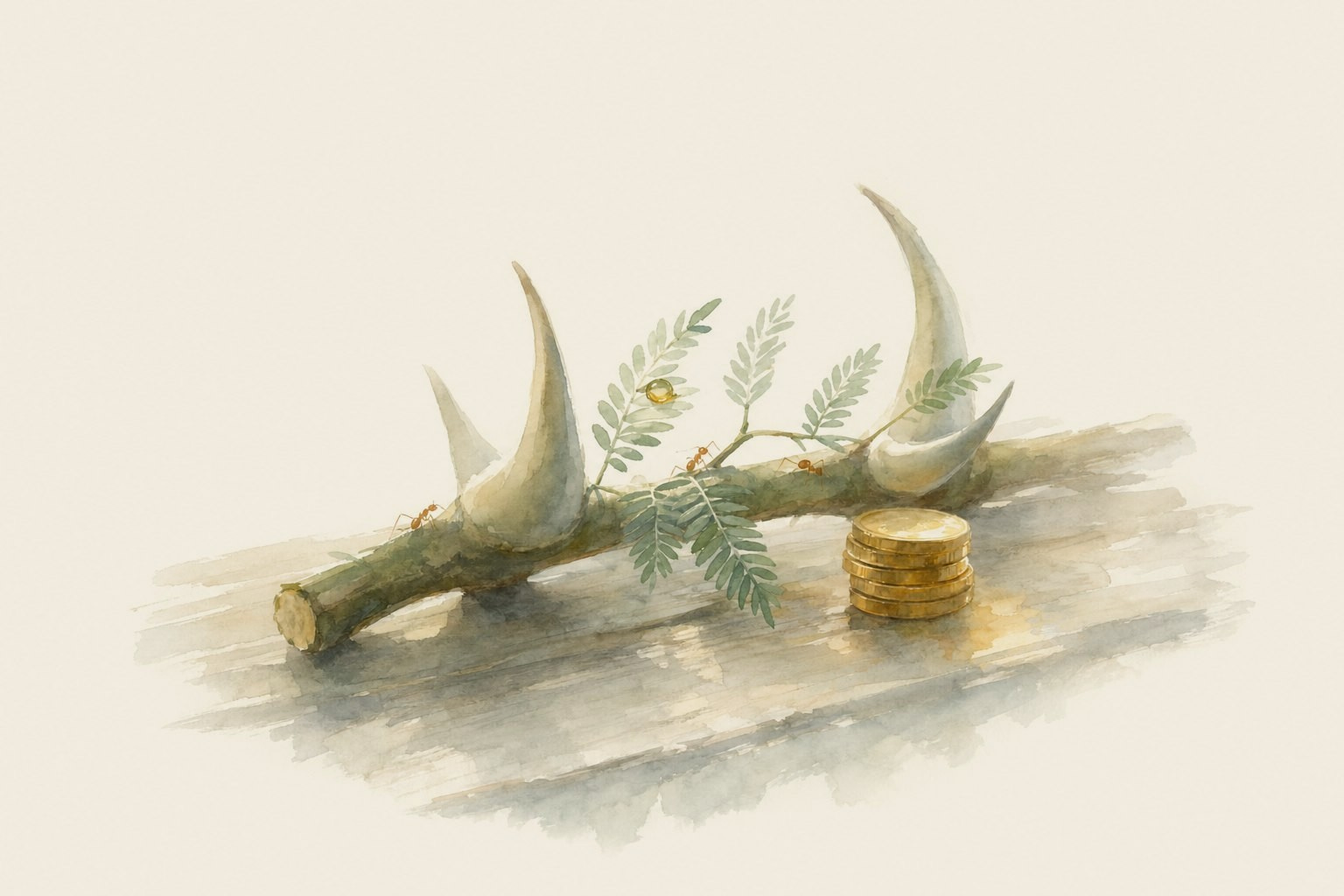
There's a tree in Mexico and Central America called the bullhorn acacia, and it grows big, hollow thorns shaped like, well, a bull's horns. A species of ant lives inside those thorns. The tree feeds them with nectar from little glands on its leaves and tiny packets of protein on the tips of its leaflets. The ants get a home and meals, all in one tree.1
In return, the ants defend the tree. Touch a branch and they come pouring out to engage the enemy. They'll sting a deer or a cow that tries to eat the leaves, and they chew down any vine or seedling that starts growing too close.
There's a catch. In 2014, scientists found the nectar carries an enzyme that shuts down the ants' ability to digest ordinary sugar. After their very first meal from the tree, its nectar becomes the only thing the ants can live on.2
It's important to recognize the tree isn't a villain laying a heinous trap. It doesn't relish the servitude of the ants. It's just being a tree. This is simply how these two species evolved in relation to one another. The acacia feeds the ants, the ensnared ants keep it alive, and neither of them thinks about it. I think capital captures us in ways similar to how the acacia keeps its ants, as a means to an end, with no mercy and no malice.
Money moves a lot more of our lives than we often realize. It decides where most of us can afford to live and how far we drive to work. It's in the back of our minds when we pick a major, pick a mate, take a job, move to a new city, or wonder whether we can afford another kid.
We're all trying our little hearts out to have enough of it. We turn our work into money, and when there's anything left over, we try to turn that money into more money. We put it in a 401(k) and check the balance more often than we should. We buy a house and start thinking of it as an investment as much as a home. We pick up a side hustle, or sell things online, or wonder if we're missing out on crypto. Some of us plan whole vacations around airline miles, or drive across town to save a few cents a gallon. We shift our lives around a few bucks here and there, and it feels completely normal.
I'm in it too. I run a company, and a good part of my week goes to figuring out how to turn what we make into money. None of this makes us bad people. But if you could watch us from above, the way scientists watched those ants, I think you'd see a whole lot of us living on a nectar called capital. And you might start to take a harder look at the acacia tree and its aims.
Most of us typically think about money the way we think about a cup or a book. It's a thing we own. It sits where we put it and does what we tell it to do, and when we're done with it, it waits.
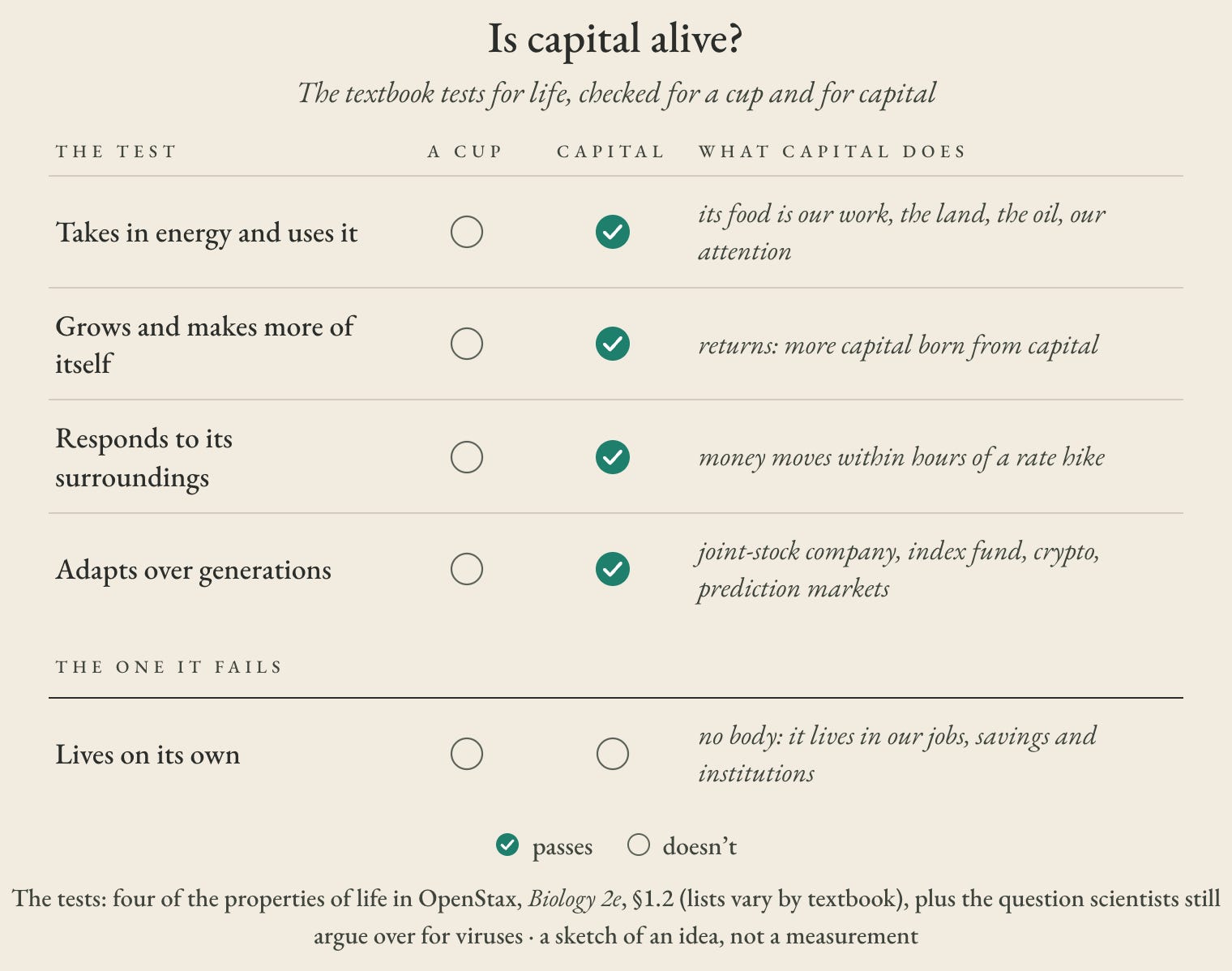
If I recall high school biology class correctly, there's a rough checklist for deciding whether something is alive. It takes in energy and uses it. It grows and makes more of itself. It responds to what's going on around it, and over generations it adapts.3 A cup doesn't do any of that. Capital, I'd argue, does nearly all of it.
Capital takes in energy. Its food is our work, along with the land and the oil and the attention it can put to use, and it turns all of that into more of itself. It's always looking for new food too, anything that isn't for sale yet, a service that used to be free, a corner of our lives nobody thought to charge for.
It grows, and it makes more of itself. The returns we celebrate are its offspring, more capital born from capital, and it copies itself fastest wherever there's already a lot of it.
It responds to its surroundings, fluidly, with the elegance and efficiency of a flock of birds. When a central bank raises interest rates or a government starts to look shaky, money moves within hours, sometimes minutes. And when something threatens it, a new law or a union or a rival, it moves to absorb the threat or kill it. Back in 2008, Mark Zuckerberg wrote in an email that "it is better to buy than compete." Four years later, Facebook bought Instagram for a billion dollars.4
And it adapts. Over the centuries it's taken on new shapes, the joint-stock company and the stock exchange, then the index fund and venture capital. Lately the shapes have gotten stranger. Bundles of other people's mortgages, sliced up and sold back and forth until they blew up in 2008. Crypto, money invented out of code, now worth trillions of dollars. And now prediction markets, where you can bet on an election, on tomorrow's weather, even on which words a politician will say in a speech.5 Almost any part of our lives can become something to trade.
The one test it fails is living on its own. Capital has no body. It lives inside our jobs and our savings and our institutions, and it needs us to carry it. Scientists still argue about whether a virus is alive for much the same reason, because a virus can't do anything outside the cells it lives in.6 I'd say capital comes pretty darn close.
In that light, money starts to look very different from a cup or a book. Of course capital doesn't have a heartbeat, and it has no more idea that we exist than the acacia does. But it has its own ends — growth. And in our modern economic vernacular, growth has come to be synonymous with good.
What so many miss is that capital's thriving and our own are not intrinsically connected. Sometimes our purposes line up, often in the early days of capital-driven innovation. Until they don't, as profit maximization and human interest diverge more and more.
We are all capital's hosts, subject to its will, yet somehow oblivious to this fact. Perhaps this is because for most of us, doing its bidding looks like an ordinary day.
You get up and go to a job that exists to return a profit to someone. You spend what it pays you on things that return a profit to someone else. The little you manage to set aside goes into a retirement fund, and that fund takes your money and quietly tells a thousand companies to find more profit wherever they can. Every step of that is capital eating and growing and making more of itself, and you're the one carrying it from place to place.
And like the ants, most of us can't live on anything else anymore. Very few of us could keep a roof over our heads or food on the table without a steady supply of money. In America, about half of us get our health insurance through a job, so even the care of our own bodies runs through capital first.7
Over time this changes how we make decisions. We start asking whether something pays before we ask whether it's good. Which major leads to a job, which neighborhood will hold its value, whether a hobby could turn into a side business. There's nothing wrong with any one of those questions. But money gets to go first, and after a while it can drown out the rest.
And we begin to identify with it. When the stock market drops, most of us feel it in our stomachs, even if we couldn't tell you what we own. When someone proposes taxing great fortunes or capping rents, plenty of people who would never be touched by the policy come pouring out against it, because it feels like someone is shaking the tree that feeds their nectar.
Most of us are the gentlest kind of host. We do our jobs and love our families and carry capital a little further every day without ever thinking about it, and plenty of us are happy doing it. But we don't all carry it equally well.
Over time that difference shows, because of the oldest rule in biology. When an environment rewards a specific trait, it fills up with whatever has it. A savanna that rewards speed fills with fast animals. The slow ones just don't last long.
Markets reward one thing above all, and that's return, how much more money comes back than went in. So who rises, decade after decade, to the top of an economy that sorts people by how well they make capital grow?
The usual answer is the smartest and the hardest working, and plenty of them are both. But the world is full of brilliant, tireless people who will never be rich. Talent and effort get you into the running, and then the filter at the very top starts testing for other very pronounced traits.
Researchers who study the very rich keep finding the same cluster. They take bigger risks than the rest of us, they have unusual faith in their own judgment, and they mind less than most people when others don't like them.8 I'd add one more. It's the ability to make decisions that hurt a great many people, to close the plant or cut the thousand jobs, and still sleep that night. The ones who can't bring themselves to do the deed end up handing the decision, and the capital, to someone who can.
People like this have always been with us. Picture someone with an unusual appetite for risk and unshakable faith in their own judgment, with a thick skin to go with it, born a few thousand years ago in a fishing village. Maybe they'd be the one who takes the boat out farther than anyone else dares, or who sails over to the next village to bargain for grain.
But they probably wouldn't have seemed all that powerful. A bold farmer could only be bold with what they had, a field and a few animals. Even a bold merchant a few centuries ago could only move as much as their ships and their letters could carry. Power back then mostly went to whoever was born to it or took it by force.
Cut to our modern economy, where capital flows at enormous volume and speed. Now there's a huge amount of money in the world looking for ways to grow, and it finds those opportunities fastest by using the people who will make the big bet, trust their own call and not much care who hates them for it. Capital seeks out the hosts that help it succeed the best, and these guys are the fittest for the job.
Look at the people this natural selection pressure has carried to the very top of the Forbes list. We tell two stories about the billionaires. One side tells the story of the hero, the genius who bet everything and changed the world. The other side tells the story of the villain, the greedy man who'll burn anything down for one more comma in his net worth. I'm trying to convince you it's neither.
The way to see past both stories is to look at these people the way the ecologist looks at the ants on the acacia, from a step back, without rooting for either side. The first thing to notice is that capital didn't pick them at random. Most of them really are brilliant, especially in the fields where brilliance turns into money, like software, engineering and finance. Then they have the special traits we talked about.
Take Elon Musk, the most visible host capital has ever had. His fans tell a story about the size of his ambition, and it really is rare and impressive. He didn't just start a car company and a rocket company, he set out to move the world off oil and to make humanity a species that lives on more than one planet. In 2008, with Tesla and SpaceX both close to going under, he put nearly the last of his money into saving those goals.9 Since then, Tesla sparked the worldwide EV revolution and SpaceX, seemingly on a quarterly basis, pushes the frontiers of humanity's reach into space. His vision is unique, and so is his ability to mobilize resources to begin realizing it.
His critics tell a different story, and DOGE is often the case study they reach for. In 2025 he and his team swept through the federal government, cutting agencies and staff, and gaining access to systems as sensitive as the Treasury's payments and Social Security's records. One of his first targets was USAID, the agency that sent American aid to some of the poorest places on earth, at a cost of less than one percent of the federal budget. He boasted about spending a weekend "feeding USAID into the wood chipper."10
I can't know what was in his heart. But looking down from the ecologist's vantage point, I see the world's most potent capital host acting on its behalf. He spent years diligently nursing Tesla and SpaceX through near-death, with famous attention to detail. Contrast that with his time gutting federal agencies, when he set up a gaming computer in his office and was gone from DOGE in about four months. It was smash-and-grab the whole way through. He brings the same tenacity to tearing down capital's obstacles that he brings to building it, but it's the difference in care, what gets protected and what gets destroyed, that says the most about the incentives behind it.
To the ecologist, the moonshots and the wood chipper are just the two traits in him capital benefits from. One is his ability to identify and make enormous bets for gargantuan returns that most people couldn't see in the first place, or stomach. The other is the decision to destroy what doesn't make money even though it hurts a great many people, and he makes it without remorse, sometimes dancing on stage with a chainsaw held over his head.
Capital has rewarded those traits the way the acacia rewards its ants, by feeding him more. Every bet that pays puts more capital at his disposal, and more of the world moves at his command. Rockets, cars, satellites, a social network, an AI company, and for a while a seat beside the president. Over time he's become an unrivaled conduit for the will of the capital he holds. In sheer potency to act on the world, I can't think of any other private citizen who comes close. That's what it looks like when capital acts through a super host.
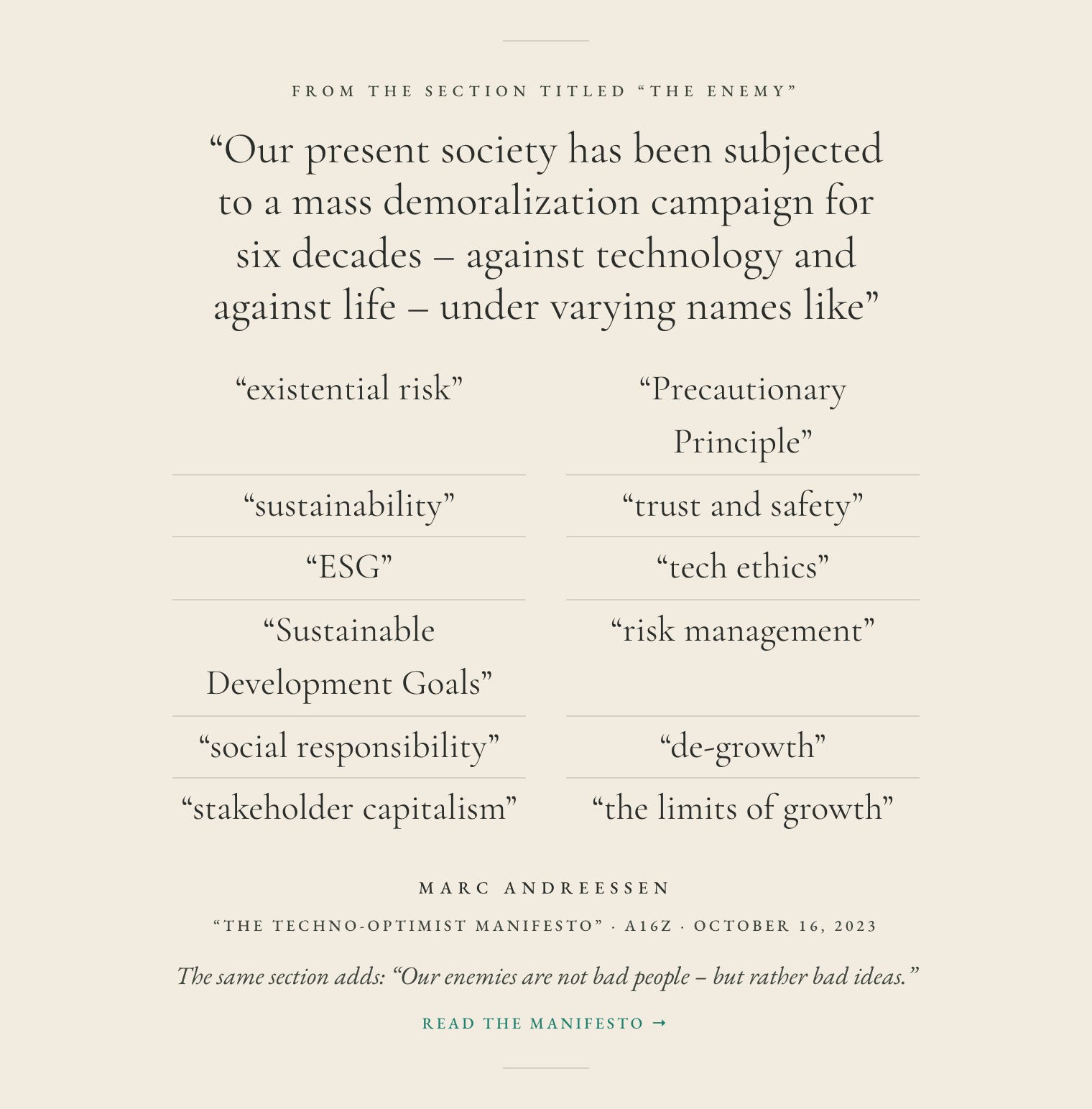
Some apex hosts sound as if capital itself is speaking through them. In 2023 the venture capitalist Marc Andreessen published what he called "The Techno-Optimist Manifesto," and if capital could write, I think it would write something very close to it. "We believe growth is progress," it says. "We believe free markets are the most effective way to organize a technological economy." He borrows a name from the philosopher Nick Land for what markets and technology make together, "the techno-capital machine," and calls it "the engine of perpetual material creation, growth, and abundance."
Then he names what stands in its way. For six decades, he writes, we've been subjected to "a mass demoralization campaign" that goes by names like sustainability, social responsibility, trust and safety, tech ethics and risk management. On AI he goes further. "We believe any deceleration of AI will cost lives," he writes, and "Deaths that were preventable by the AI that was prevented from existing is a form of murder."11 From capital's perspective, that's a list of friction, barriers that keep it from growing as efficiently as possible. And the manifesto tries to install a moral framework that puts capital's wellbeing above our own, and makes it the condition for ours.
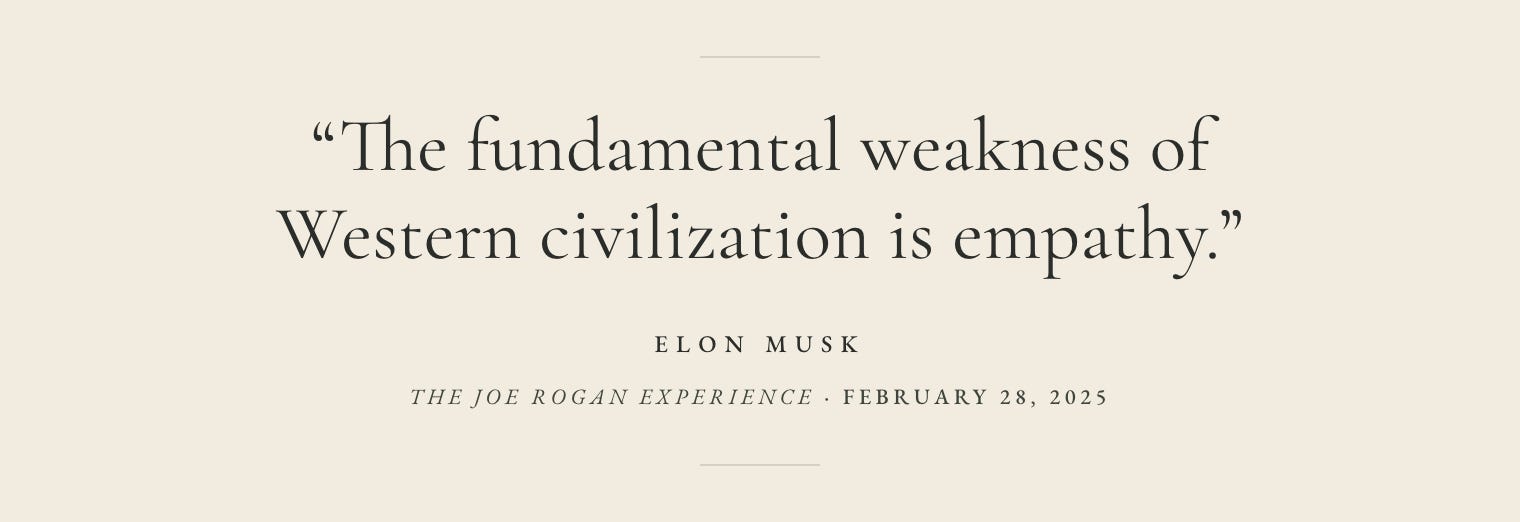
He isn't the only one who talks this way. The oldest and plainest version came in 1970, when the economist Milton Friedman titled an essay in The New York Times Magazine "The Social Responsibility of Business Is to Increase Its Profits."12 In 2009 Peter Thiel, the PayPal co-founder and early Facebook investor, wrote, "I no longer believe that freedom and democracy are compatible."13 In 2025 Musk told Joe Rogan that "the fundamental weakness of Western civilization is empathy."14 And at a meeting for Oracle's investors in 2024, Larry Ellison described AI watching the feeds from police body cameras, car cameras and drones, in a world where "citizens will be on their best behavior, because we're constantly recording and reporting everything that is going on."15
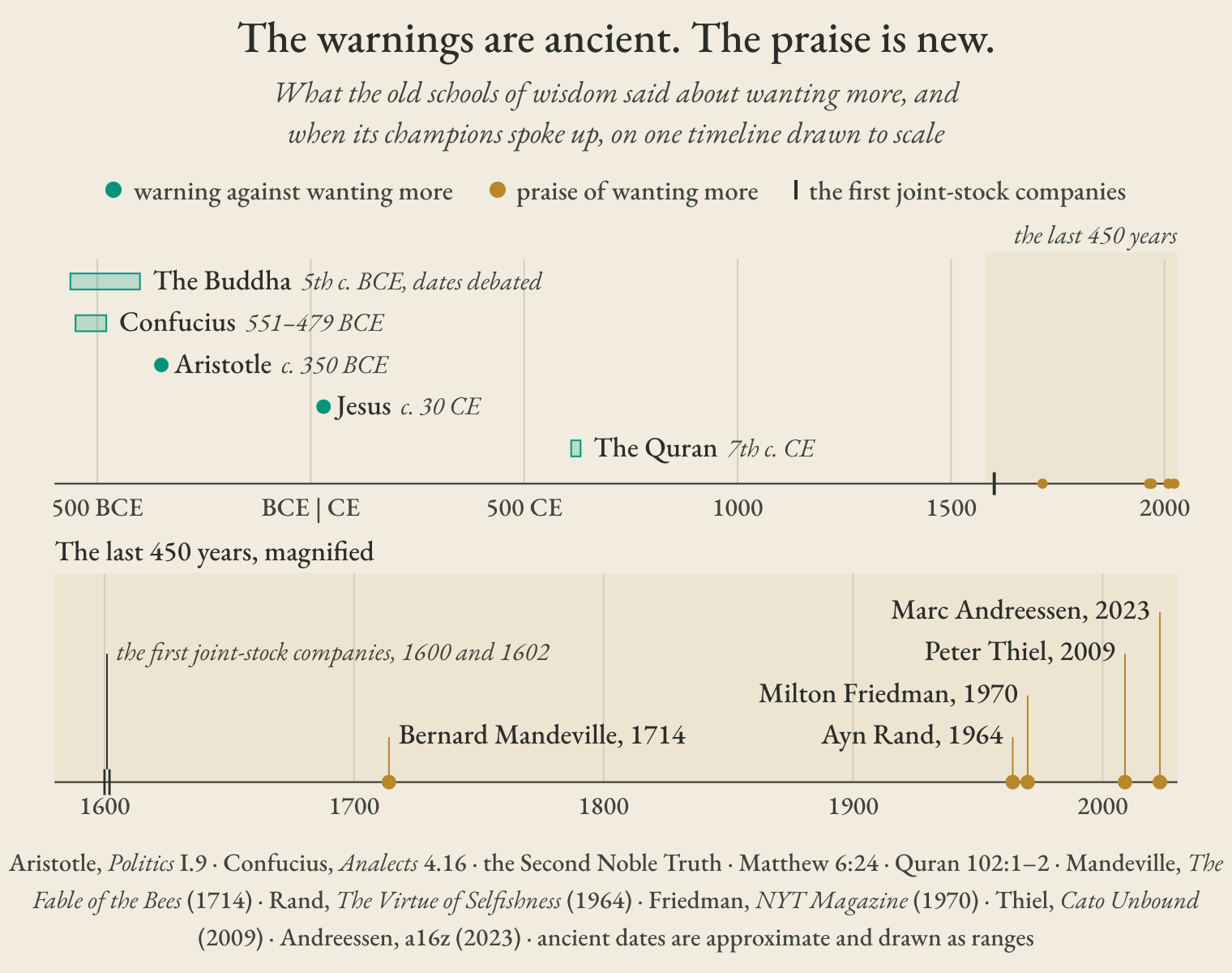
I find some comfort in how young these ideas are. One of the earliest, Bernard Mandeville's The Fable of the Bees, which argued that private vices make public benefits, came out in 1714, about a century after the first joint-stock companies. Ayn Rand published The Virtue of Selfishness in 1964. Friedman, Thiel and Andreessen all came after her. So this isn't ancient wisdom being given new life. The belief that wanting more is good for everyone showed up as capital began to rise, and it's gotten louder as capital has grown. That's about what you'd expect to hear from a host once something has taken hold of it and started steering it in ways that aren't in its own interest.
And nearly every older school of human wisdom warned about exactly this kind of takeover. Aristotle wrote that making money for its own sake has no natural limit. Confucius said the noble person understands what is right and the petty person understands what is profitable. The Buddha taught that craving is the root of suffering. Jesus told his followers no one can serve two masters, and that you can't serve both God and money. And the Quran warns that the race for more keeps people distracted "until you visit the graveyards."16
We must zoom out. We must see how capital acts through Musk and listen to how it talks through Andreessen, and see the human-capital symbiosis climbing atop the human economy and seizing ever tighter control. These super carriers are real people, with real intelligence, real talents and clear flaws, and capital is using all of it to grow and take power. The billionaires are capital's fittest hosts, but the rest of us are carriers too. I believe the old struggle between capital and labor, the owners against the workers, humans against humans, isn't the right framing anymore. The plane we must rise to see the challenge from is that of a confrontation between humanity and capital. We must subjugate capital to our human will, not the other way around.
As long as we're arguing over whether the ultra rich and powerful are heroes or villains, we're wasting time telling stories about the motivations of the ants. On one side I can hear Senator Bernie Sanders' Brooklyn accent castigating the "millionaiahs and billionaiahs." On the other I can hear Donald Trump's Queens accent the night he won in 2024, calling Elon Musk "a super genius" and telling the crowd, "We have to protect our geniuses."17 Both sides are missing the bigger picture.
Earlier I said that living things respond to what's going on around them. In November 2026 we got to watch capital do it. On November 12, Jensen Huang, who co-founded Nvidia in 1993 and ran it for 33 years, resigned as its CEO, effective immediately. It came after reports of at least three affairs, two of them with Nvidia employees. The third was with an executive at Megaspeed, a Singapore company being examined for slipping Nvidia chips into China against U.S. export controls, and Nvidia's board was looking into reports that Huang had been the target of a foreign intelligence effort. It's worth noticing that he resigned. At this point, two of the checks we have built for the most powerful people among us, a company's board and our national security apparatus, did what they're supposed to.18
But then the organism responded. At its low point Nvidia had lost more than $500 billion in value, and the tremor ran through an economy that has been leaning hard on the AI buildout, with Nvidia's chips at its center. Capital's super hosts came pouring out, nearly all of them pointing the same direction. Tim Sweeney, who runs Epic Games, called it "Apple firing Steve Jobs level of idiocy." Bill Ackman said the board had "panicked due to headlines in the media." Travis Kalanick, the founder of Uber, went on X asking for "creative, wild ideas" to "persuade" the board. Paul Graham, who co-founded Y Combinator, wrote, "I've never known the tech world to be more unanimous about anything than they are about Jensen Huang."19
At first, our norms held. Less than a week after Huang left, the board's chair, Harvey Jones, told investors the company had no intention of bringing him back. But then, on November 23, eleven days after he resigned, the board made a sudden about-face and voted unanimously to reinstate him. It said it had heard from "senior levels of the United States government," and was "confident that Mr. Huang's reinstatement poses no national security risk." The investigation has barely begun.20
Look at the case being made. His defenders, capital's hosts from the top echelons of tech and finance, say that Huang alone can run Nvidia. They argue that keeping him at the top keeps all of us safer and better off than our rules and accountability do, and that his singular talent outweighs whatever wrongdoing he's accused of, even before the whole story is known.
Whether America is safer with him back, especially when one of the stories about him runs through a company suspected of moving chips to our supposed adversary, is debatable at best. What isn't debatable is the proposition we're being asked to accept: the laws and institutions meant to keep corporate leaders honest and the country secure are not what keep us safe. One man in one role at one company is.
What capital wanted is clear. Losing Huang cost it hundreds of billions of dollars in a matter of days, but more important, his removal was a threat, a challenge to its power and control. So, like any living organism, capital moved to absorb the threat or kill it.
A board and a national security review are two of the oldest checks we have on powerful people, and here's how capital got past both of them. The week after Huang left, Treasury Secretary Scott Bessent said Nvidia needed "a dramatic shake-up." Then the leaders of tech and finance went to work in public, and an administration capital had already captured came around. By Friday, the president was telling reporters that there are "very few people in that company" who can do what Huang did. On Monday, the board that had just turned down Huang's offer to come back reversed itself. Minutes later the president posted that it had made "the correct and proper decision," and that the government had "no reason to believe" Huang's return posed any risk to national security. The government was supposed to be one of the checks. Instead it vouched for him while its own inquiries were still open, and it sure looks like the board got the message. Elon Musk summed it up on X in three words: "It is done." Start to finish, it took capital eleven days to eliminate the threat.21
This is where I want to let go of the ants, because we aren't ants. An ant can't step back from the acacia and decide to live some other way. We can, and we've done it before. We learned to farm and settled into villages. Much later we left the farms for factories and cities. Each time, the old way of life stopped working, and people had to build new ones from scratch, with new laws and new ideas about what we owe each other.
I think we're at the start of another one of those great rotations right now, and this one is more profound and faster than any before it. That means we're going to have to rise to a new level of civilization building, and part of that is seeing the catch in the nectar.
The acacia slips an enzyme into its sugar that leaves the ants unable to digest anything else. Capital is not merely useful to us, we are also useful to it. It lifts up the people who serve it best and once they're up there, they hold a kind of power no private person has ever had.
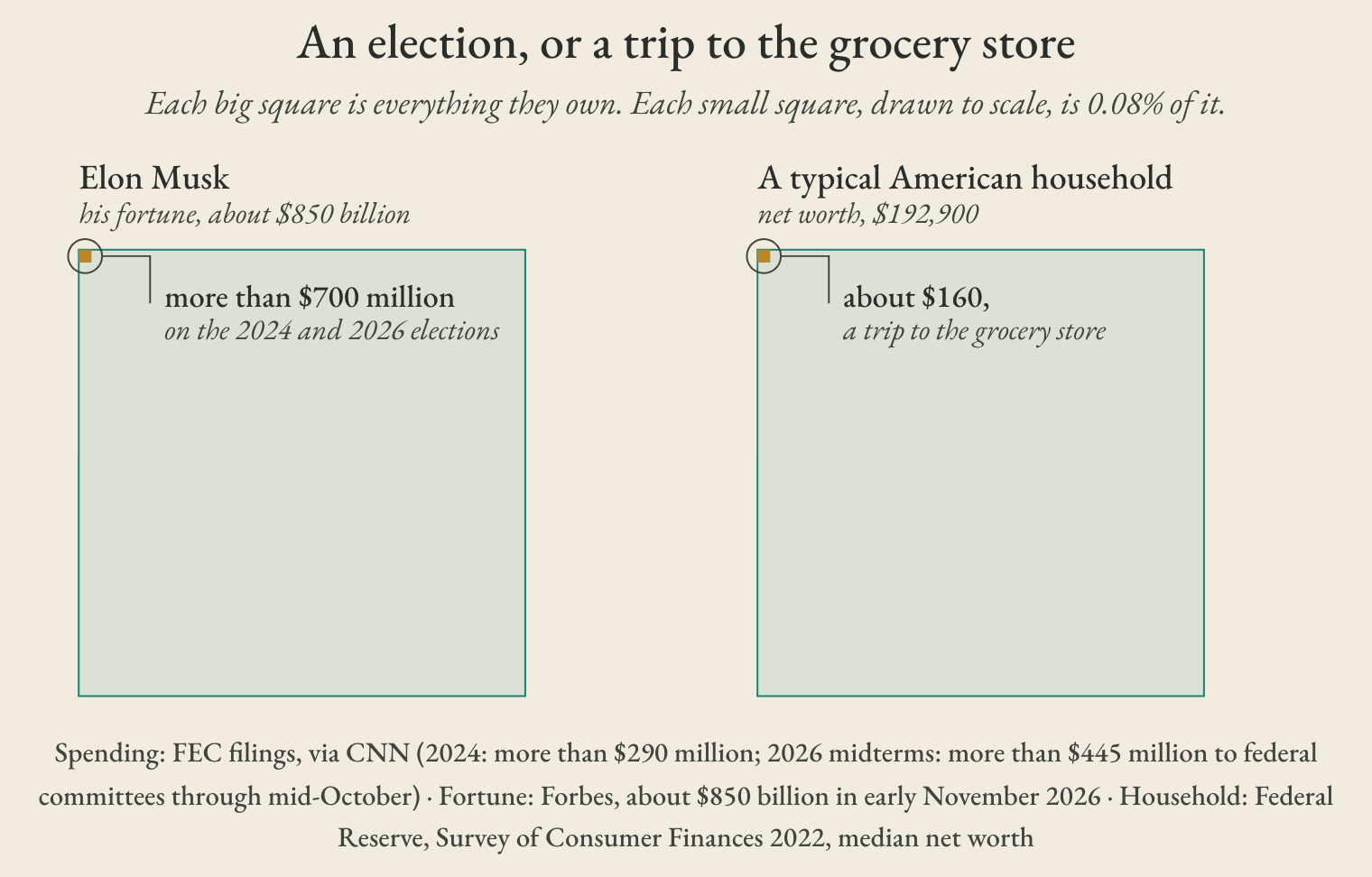
Up there, these people can buy things that were never really for sale, because it was ludicrous to imagine anyone with enough money to afford them. An entire Hawaiian island, for one. Larry Ellison bought nearly all of Lanai in 2012.22 Or an election, the thing that's supposed to let hundreds of millions of citizens decide their future together, each with an equal voice. Elon Musk put more than $700 million into the 2024 and 2026 elections, a good share of it behind candidates who lost.23 For Musk, $700 million is about 0.08% of his net worth, or the equivalent of a household with a $190,000 net worth spending $160.24 Swaying the popular will of the most powerful nation on earth is, for Musk, what a trip to the grocery store is for one of its average families.
Economists have noticed part of this. About fifty years ago Gordon Tullock pointed out that political favors sell for far less than they're worth to the people buying them, a puzzle now called the Tullock paradox.25 One study found that companies lobbying for a 2004 tax break got back about $220 for every dollar they spent.26
What I add to this theory is that the same thing happens far beyond politics, and power gets cheaper the more wealth concentrates. I call it the Billionaire's Bargain. Usually when the rich chase something rare, they bid its price up, the way they have with Manhattan penthouses and Picassos.
But the people at the top today are reaching into a realm where there's no bidding at all, because they're the first people in history who could even think about buying an island, an election, a social media platform, a share of the sky or one of the biggest computers on earth. With so few people able to even contemplate such purchases, the power itself never gets priced by any market.
All they pay for is the proxy, whatever the thing is worth as an ordinary business. Lanai sold as hotels and land. An election costs what the ads and the canvassers cost. Twitter sold as a social media company. When Musk's AI company stood up one of the biggest supercomputers on earth in about four months, it paid what the chips, the construction and the electricity cost.27 The power comes free and helps their fortunes grow, so the next piece costs them even less.
For all intents and purposes, we should think of capital as a powerful organism, and of all of us as its unwitting hosts, so that we can begin to figure out how to get out from under its thrall.
So far we've mostly done the opposite. For several centuries we've let capital run wild. More than that, we've come to worship it. We've made its growth the thing our society values above nearly everything else. We run prisons for profit. We've let the care you get when you're sick depend on what someone can earn from treating you. Those happen to be some of the surest places for capital to grow, because people in a cell or a hospital bed can't exactly take their business somewhere else.
These are rules we wrote, and rules work. They're how we harness capital to our own ends, and when we let up on them, capital grows into places it was never meant to go. Election spending shows what that looks like. Until 2010, the record for a single donor in an American election was about $24 million. Then the Supreme Court decided Citizens United, and the super PACs that followed let one person spend hundreds of millions.28
The slippery part is that politicians are hosts too. They need money to win, and most of it comes from the people capital has rewarded most, so the rules tend to get written the way capital wants them.
So I think we should shift our focus away from fighting with the billionaires. I'm not saying many of them aren't problematic, or that wealth is correctly distributed. They are, and it's not. But we should understand them not as rare geniuses to be worshiped and defended, or evil villains to be defeated, but as the hosts capital rewards most. If every one of them disappeared tomorrow, I think new ones would grow before long. The point is to see capital for what it is, an entity, a force we modern humans are going to have to get far more sophisticated at controlling for our benefit above its own.
And we may not have long to figure that out, because capital is coming to life in a way that's more literal than anything I've described so far. Up to now, it has always needed us. It needed our hands to build things and our minds to decide what to build, and it needed hosts at the top willing to make the hard calls. That's why it fed us. The paychecks and the 401(k)s, even the airline miles, were all nectar for carrying it where it wanted to go.
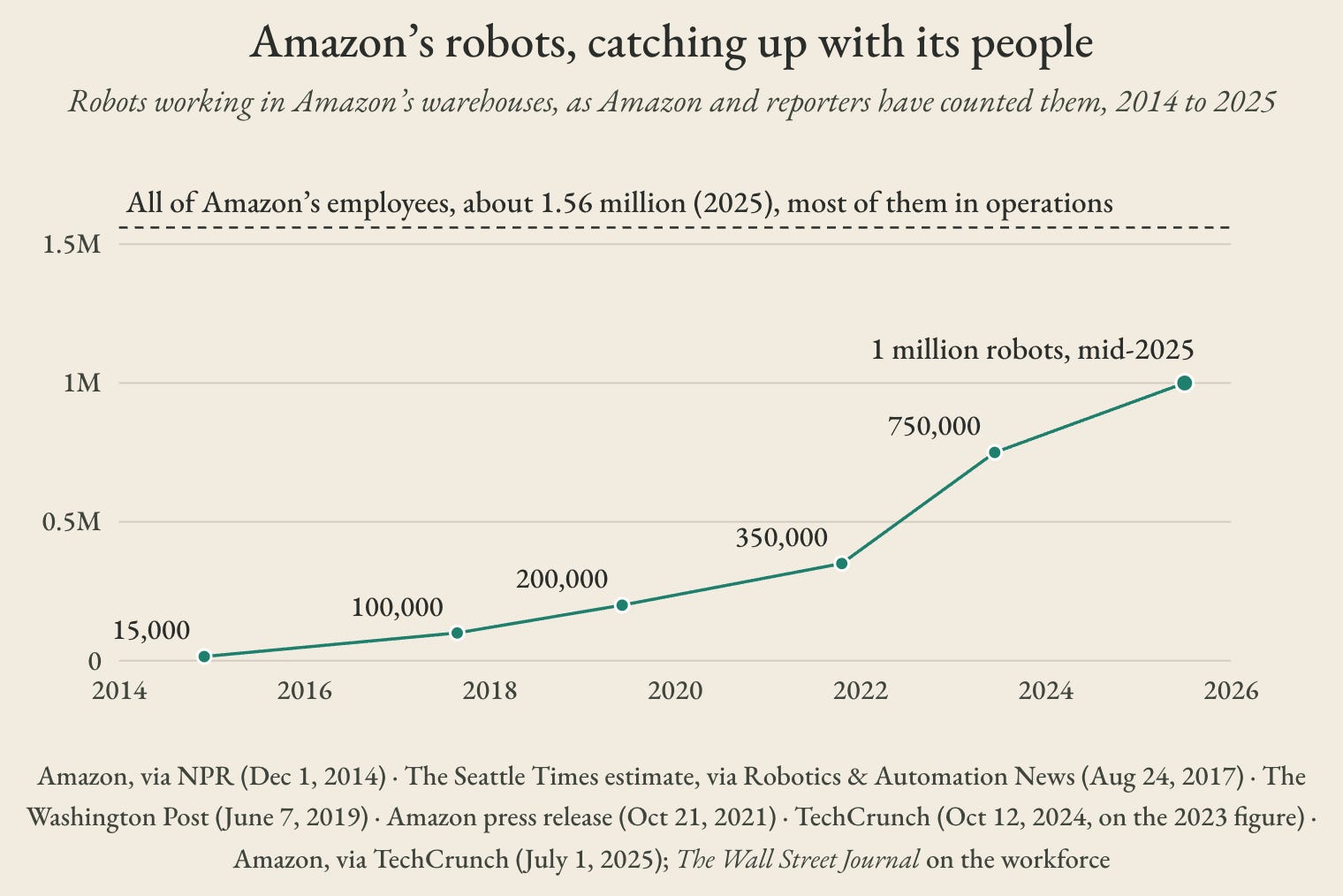
AI changes that. A machine that can write the code and read the X-ray is capital that can do the work itself. And it's starting to get a body too. Amazon already has about a million robots in its warehouses, close to one for every person who works there.29 Now companies are racing to build robots for the physical jobs capital leans on most to keep itself going and growing, running the factories that make the chips, building out the data centers, digging up the metals that go into all of it.
A lot of people look at AI and see a new kind of life. I see capital growing a mind of its own, and the hands to go with it. It's still only one part of the organism, the way our thoughts are only one part of us, but the mind and the hands are the two parts that always used to need a human being.
There's a second chapter to the acacia story that worries me. In Kenya, researchers spent about a decade fencing elephants and giraffes away from a cousin of the bullhorn acacia called the whistling thorn. With nothing big left to eat its leaves, the tree didn't need much defending anymore, and it started making less nectar and fewer hollow thorns for the ants to live in. The ants that had guarded it dwindled.30
When the tree stops needing its ants, it stops feeding them. If capital can do its own thinking and its own work, it won't need nearly as many of us, and the nectar we've built our lives around could start to dry up. That's why I don't think we can afford to stand still.
So here's where I land. I don't actually mind that the billionaires have so much money. What makes me angry is their power, the islands and the elections, and how little all of it costs them. They can have the money. But we need to take back the power.
I don't think we get it back by attacking them, or by waiting for them to become better people. I think we get it back by going about our lives with our eyes open. The way we live now is starting to break, and we're about to have a moment unlike any in history to build something new. Some of that, I think, looks like a lot more of us taking our work into organizations that exist for a mission instead of a return, and a lot more of us having a real say in the economic lives we lead. That's a bigger story. Please keep reading.
D. H. Janzen, "Coevolution of mutualism between ants and acacias in Central America," Evolution 20(3) (1966): Pseudomyrmex ferrugineus lives in the swollen thorns of the bullhorn acacia (now Vachellia cornigera), feeds on extrafloral nectar and Beltian bodies, attacks browsing animals and clears plants near the tree; acacias with the ants removed were heavily damaged by insects and many died. The ants' attacks on browsing mammals are documented in D. H. Janzen, "Interaction of the bull's-horn acacia (Acacia cornigera L.) with an ant inhabitant (Pseudomyrmex ferruginea F. Smith) in eastern Mexico," University of Kansas Science Bulletin 47 (1967), whose section on mammals as defoliators covers cattle, burros and brocket deer. Caveat: Janzen's removal data are mostly about insects; goats appear only in secondary summaries, so the prose says "a deer or a cow."
M. Heil et al., "Partner manipulation stabilises a horizontally transmitted mutualism," Ecology Letters 17(2) (2014): 185–192: a chitinase in the acacia's extrafloral nectar inhibits invertase in the ants' midguts, so mutualist workers can't digest ordinary sucrose and depend on the tree's sucrose-free nectar. Heil, to the press: "the first dose of nectar is enough." https://www.pubmed.gov/24188323/ · https://www.nationalgeographic.com/animals/article/131106-ants-tree-acacia-food-mutualism
The usual textbook list of the properties of life: order, sensitivity or response to stimuli, reproduction, adaptation, growth and development, regulation (homeostasis) and energy processing. OpenStax, Biology 2e, §1.2 "Themes and Concepts of Biology." https://openstax.org/books/biology-2e/pages/1-2-themes-and-concepts-of-biology Caveat: there's no single agreed definition of life; lists vary by textbook and edition (OpenStax counts eight properties; the essay uses four of them).
Zuckerberg email, 2008: "it is better to buy than compete," quoted in the FTC's amended complaint, FTC v. Facebook (Jan 2021). https://www.ftc.gov/system/files/documents/cases/051_2021.01.21_revised_partially_redacted_complaint.pdf Facebook agreed to buy Instagram for about $1 billion in April 2012. Note: the often-quoted "neutralize a potential competitor" (Feb 2012) was CFO David Ebersman's question to Zuckerberg; at the 2025 FTC trial Zuckerberg said neutralizing a competitor was one of his motivations (Fortune, Apr 16, 2025). The email is dated June 2008 (NPR, Dec 11, 2020). Caveat: less than an hour later Zuckerberg wrote again, "I didn't mean to imply that we'd be buying them to prevent them from competing with us in any way" (released in the 2020 House antitrust investigation). https://www.npr.org/2020/12/11/945234491/the-wrath-of-mark-takeaways-from-the-governments-case-against-facebook
Prediction markets: Kalshi (regulated by the CFTC) and Polymarket list contracts on elections, weather, economic data and "mention" markets on what words public figures will say; Kalshi won the right to list U.S. election contracts when Judge Jia Cobb of the D.C. federal district court ruled in September 2024 that the CFTC had overstepped (the CFTC's appeal, No. 24-5205, was still pending in late 2026). https://www.theblock.co/post/316230/cftc-appeals-ruling-that-blocked-its-attempt-to-halt-kalshis-election-contracts Kalshi lists weather contracts, such as daily high temperatures in major cities. Crypto market value: CoinGecko/CoinMarketCap total market capitalization, in the trillions of dollars since 2021. Mention markets: NPR, "Feds probe 'mention markets' amid White House Kalshi controversy," Aug 13, 2026. https://www.npr.org/2026/08/13/nx-s1-5930689/cftc-probe-mention-markets-prediction-markets-kalshi
On whether viruses are alive: Luis P. Villarreal, "Are Viruses Alive?," Scientific American 291(6), December 2004: 100–105. Villarreal places viruses on a spectrum between the clearly living and the nonliving, "verging on life." Viruses have no metabolism of their own and can reproduce only inside a host cell. https://www.scientificamerican.com/article/are-viruses-alive-2004/
U.S. Census Bureau, Health Insurance Coverage in the United States: 2025 (P60-291, Sept 15, 2026): employment-based insurance covered 53.5 percent of people for some or all of the year, still the most common type (Medicare 20.1, Medicaid 17.1). https://www.census.gov/library/publications/2026/demo/p60-291.html Note: 53.8 percent in the 2024 edition (P60-288).
M. Leckelt et al., "The personality traits of self-made and inherited millionaires," Humanities and Social Sciences Communications 9:94 (2022), German SOEP data: millionaires score higher in risk tolerance, emotional stability, openness, extraversion and conscientiousness, most strongly the self-made. And M. Leckelt et al., "The rich are different," British Journal of Psychology (2019): the wealthy are "stable, flexible, and agentic individuals who are focused more on themselves than on others," with Big Five, narcissism and locus of control measured. https://www.diw.de/de/diw_01.c.839060.de/s_13581.html · https://www.diw.de/de/diw_01.c.774728.de/s_11064.html Sample: 130 Germans with at least €1 million in financial assets vs. 22,981 in representative data. The 2019 discussion: millionaires "had a more internal locus of control" ("faith in their own judgment") and scored lower on Agreeableness ("mind less when others don't like them"). Caveat: the locus-of-control gap held after controlling for demographics; the agreeableness gap did not, and a small convenience sample, German only.
Elon Musk on 2008, "the worst year of my life" (60 Minutes, CBS, Mar 30, 2014); he has said he put "the last of my remaining cash" into Tesla that year, with SpaceX also near failure; the Tesla financing closed on Dec 24, 2008. https://www.space.com/25355-elon-musk-60-minutes-interview.html · https://cleantechnica.com/2021/08/23/elon-musk-i-gave-tesla-the-last-of-my-remaining-cash-in-its-darkest-hour/ Tesla's stated mission is "to accelerate the world's transition to sustainable energy"; Musk founded SpaceX in 2002 with the goal of making humanity multiplanetary.
DOGE, 2025. Treasury gave a DOGE employee access to view, copy and print data from three payment systems for over a year (GAO, Apr 2026, cited in a Senate Banking Committee letter, Jul 20, 2026); DOGE staff also gained access to Social Security records. https://www.banking.senate.gov/imo/media/doc/20260720_letter_to_treasury_re_gao_doge_access_reportpdf.pdf Musk on X, Feb 2–3, 2025: "Spent the weekend feeding USAID into the wood chipper" (AP). USAID's budget was $42.4 billion in FY2023, under 1 percent of federal spending (AP); Americans guess foreign aid is 31 percent of the budget (KFF, via Fortune). https://fortune.com/2025/02/04/what-is-usaid-why-do-trump-musk-want-to-shut-it/ Musk set up a gaming computer with a curved screen in his DOGE office in the Eisenhower Executive Office Building (The New York Times, Feb–Mar 2025; Kotaku). https://kotaku.com/elon-musk-gaming-pc-doge-office-diablo-path-of-exile-1851767110 He announced he was leaving DOGE on May 28, 2025, about four months after Jan 20. At CPAC on Feb 20, 2025, he held up a chainsaw given to him by Argentina's president Javier Milei: "This is the chainsaw for bureaucracy" (AP). Context: The Lancet (2025) projected 14 million additional deaths by 2030 if the aid cuts continue, a contested estimate; the Center for Global Development estimated 500,000 to 1 million lives lost in 2025. DOGE claimed about $165 billion in savings; The Atlantic verified about $2 billion. Caveat: the same reporting on the office says he told friends he had been sleeping there.
Marc Andreessen, "The Techno-Optimist Manifesto," a16z, Oct 16, 2023. Verbatim: "We believe growth is progress"; "We believe free markets are the most effective way to organize a technological economy"; "Combine technology and markets and you get what Nick Land has termed the techno-capital machine, the engine of perpetual material creation, growth, and abundance"; "Our present society has been subjected to a mass demoralization campaign for six decades… under varying names like 'existential risk', 'sustainability', 'ESG'… 'social responsibility', 'stakeholder capitalism', 'Precautionary Principle', 'trust and safety', 'tech ethics', 'risk management', 'de-growth'"; "We believe any deceleration of AI will cost lives. Deaths that were preventable by the AI that was prevented from existing is a form of murder." Nick Land is listed among the manifesto's "Patron Saints." https://a16z.com/the-techno-optimist-manifesto/ Note: the manifesto says "Our enemies are not bad people – but rather bad ideas."
Milton Friedman, "A Friedman doctrine — The Social Responsibility of Business Is to Increase Its Profits," The New York Times Magazine, Sept 13, 1970. The line echoes his Capitalism and Freedom (1962): business should increase its profits "so long as it stays within the rules of the game." https://www.nytimes.com/1970/09/13/archives/a-friedman-doctrine-the-social-responsibility-of-business-is-to.html
Peter Thiel, "The Education of a Libertarian," Cato Unbound, Apr 13, 2009. https://www.cato-unbound.org/2009/04/13/peter-thiel/education-libertarian/ Caveat: he meant that democracy threatens freedom as libertarians define it; he later said he isn't against democracy, he doubts politics can protect freedom.
Elon Musk on The Joe Rogan Experience, Feb 28, 2025: "The fundamental weakness of Western civilization is empathy, the empathy exploit" (verified by Snopes). Caveat: in the same conversation he said "I believe in empathy, like, I think you should care about other people," and argued against what he called "civilizational suicidal empathy," a phrase from Gad Saad.
Larry Ellison, Oracle financial analyst meeting, Sept 2024: AI monitoring the feeds from police body cameras, car cameras and drones; "Citizens will be on their best behavior, because we're constantly recording and reporting everything that is going on." He said the same of police (Fortune, Sept 17, 2024; Business Insider). https://fortune.com/2024/09/17/oracle-larry-ellison-surveillance-state-police-ai/
Bernard Mandeville, The Fable of the Bees: or, Private Vices, Publick Benefits (1714; the verse "The Grumbling Hive" first ran in 1705), often read as satire but still the classic early statement that private vice makes public benefit. The first joint-stock companies were the English East India Company (1600) and the Dutch East India Company (1602). Ayn Rand, The Virtue of Selfishness (1964). Aristotle, Politics I.9 (1257b): wealth-getting for its own sake has no limit to its end. Confucius, Analects 4.16 (Legge: "The mind of the superior man is conversant with righteousness; the mind of the mean man is conversant with gain"). The Buddha: the Second Noble Truth, craving (tanha) as the origin of suffering (dukkha). Matthew 6:24: "No man can serve two masters… Ye cannot serve God and mammon," mammon meaning wealth. Quran 102:1–2 (Sahih International): "Competition in [worldly] increase diverts you / Until you visit the graveyards." Caveat: some traditions also bless wealth (Proverbs on diligence, artha as a legitimate aim in Hindu thought, Weber's Protestant ethic), hence "nearly every"; what they share is the warning that boundless accumulation is a danger.
Donald Trump, election-night victory speech, West Palm Beach, Nov 6, 2024: "A star is born, Elon," "he's a super genius," and "We have to protect our geniuses, we don't have that many of them" (NPR, Fortune, Mediaite, Nov 6, 2024). https://www.npr.org/2024/11/06/g-s1-32884/trump-lavishes-praise-on-super-genius-elon-musk · https://www.mediaite.com/news/a-star-is-born-trump-sings-super-genius-elon-musks-praises-in-victory-speech Caveat: outlets differ slightly on exact wording; the two men fell out publicly in mid-2025.
Nvidia Form 8-K, Nov 12, 2026: Huang resigned as president, CEO and director, effective immediately. https://www.sec.gov/Archives/edgar/data/0001045810/000104581026000082/nvidiaannouncesceotransiti.htm · CNBC, "Jensen Huang's — and Nvidia's — legal exposure balloons," Nov 19, 2026: at least three alleged affairs, two with Nvidia employees; the third with an executive at Singapore-based Megaspeed, which is being examined for possibly diverting Nvidia chips to China against U.S. export controls. https://www.cnbc.com/2026/11/19/nvidia-jensen-huang-legal.html · Nvidia, Nov 23, 2026, on "recent reporting that Mr. Huang has been the target of a foreign intelligence effort" and the independent committee formed to investigate (see [20]). Caveat: the allegations are unproven press reports and counts vary by outlet (The Hill reports two); no one has been charged, and no report says Huang himself arranged chip sales to China.
Market value: Nvidia lost more than $500 billion at its low point (Forbes, Nov 16, 2026). https://www.forbes.com/sites/antoniopequenoiv/2026/11/16/trump-and-musk-open-to-jensen-huangs-potential-nvidia-return-heres-who-else-is-backing-him/ · The AI buildout in the economy: Epoch AI estimates that investment in AI-related data centers, compute hardware and networking was about 0.8 percent of U.S. GDP in Q1 2026, taking computing infrastructure as a whole to about 1.5 percent (a 2015–2022 average of about 0.7) and making it the leading driver of growth in U.S. private investment. https://epoch.ai/data-insights/ai-datacenter-share-gdp ING's broadest measure of tech investment (information processing, data centers and software, before subtracting imports) accounted for 50.2 percent of year-over-year GDP growth in Q2 2026; Jason Furman put tech and software at 92 percent of growth in the first half of 2025. https://think.ing.com/opinions/how-much-is-ai-contributing-to-us-economic-growth/ Caveat: estimates swing widely with the categories used, and netting out imported equipment shrinks the direct effect a good deal. · Sweeney on X, Nov 11, 2026, in a post headed "Save Jensen," the day before Huang resigned (PC Guide; SF Standard, Nov 11, 2026). https://www.pcguide.com/pro/news-pro/epic-games-ceo-tim-sweeney-says-nvidia-firing-jensen-huang-would-be-apple-firing-steve-jobs-level-of-idiocy/ · https://sfstandard.com/2026/11/11/defenders-detractors-disbelief-reaction-jensen-huang-s-scandal/ · Ackman on X: "a series of major governance failures by directors that panicked due to headlines in the media" (Fox Business). https://www.foxbusiness.com/business-leaders/bill-ackman-blasts-nvidias-board-over-jensen-huangs-ouster-says-panicked · Kalanick on X, Nov 16, 2026: "Looking for some great ideas for how to 'persuade' the Nvidia board to bring Jensen back… Creative, wild ideas welcome… #bringJensenBack." https://x.com/travisk/status/2122393157988167857 · Paul Graham on X, Nov 21, 2026: "I've never known the tech world to be more unanimous about anything than they are about Jensen Huang. Everyone in tech thinks the board made a huge mistake. Except the board. But they are not in tech." https://x.com/paulg/status/2124041291046785484 Caveat: Graham's "unanimous" was disputed in replies.
Nvidia, "NVIDIA Board Reinstates Jensen Huang as President, CEO and Board Director," Nov 23, 2026: unanimous vote, effective immediately; the board was "satisfied with respect to Mr. Huang's candor and ability to lead NVIDIA"; it "received input from senior levels of the United States government" and is "confident that Mr. Huang's reinstatement poses no national security risk"; the independent committee's investigation will proceed to its conclusion; Colette Kress returns to CFO only and Harvey Jones stays chair. https://nvidianews.nvidia.com/news/nvidia-board-reinstates-jensen-huang-as-president-ceo-and-board-director · TheWrap (via Yahoo Finance UK), Nov 23, 2026: "11 days after resigning," and a reversal from the previous Tuesday, when Jones "told investors the company had no intention of bringing its co-founder back." https://uk.finance.yahoo.com/news/jensen-huang-returns-nvidia-ceo-140838214.html Caveat: the stock's reaction isn't cited; no opened source gave a dated figure.
Treasury Secretary Scott Bessent said the week of Nov 16 that Nvidia needed "a dramatic shake-up," then backed away on CBS on Sunday, Nov 22; Trump at a press conference on Friday, Nov 20, on Huang and the Blackwell chips: "Jensen did that, and I think there are very few people in that company that can do that"; Trump on Truth Social minutes after the board's Nov 23 announcement: "The NVIDIA Board of Directors has made the correct and proper decision… The United States Government has no reason to believe that Jensen's return to NVIDIA poses any risk to National Security," and called Huang "a Great Patriot and National Treasure" (Yahoo Finance, Ben Werschkul, Nov 23, 2026). https://finance.yahoo.com/markets/article/trump-celebrates-jensen-huangs-return-after-the-white-house-amped-up-its-push-for-reinstatement-143505812.html · AP: the board reinstated Huang "shortly after rejecting his offer to return" (PBS NewsHour, Nov 23, 2026). https://pbs.org/newshour/nation/nvidia-board-unanimously-reinstates-jensen-huang-as-ceo-and-chairman · Trump urged the board to take Huang back at a White House news conference (Fox Business, Nov 23, 2026). https://foxbusiness.com/markets/nvidia-reinstates-jensen-huang-ceo · Nvidia is "cooperating with ongoing government inquiries" (TheWrap, see [20]). Caveat: that the board acted because of the administration is inference; the board says only that it "received input." · Elon Musk on X, Nov 23, 2026, shortly after the announcement: "It is done." https://x.com/elonmusk/status/2124872664938602736 He later posted, "The mistake has been corrected" (Reuters, Nov 23, 2026, via The Tribune). https://www.tribuneindia.com/news/ceo-reinstatement/mistake-corrected-musk-endorses-jensen-huangs-return-to-nvidia-democrat-lawmakers-critical · https://za.investing.com/news/stock-market-news/nvidia-reinstates-jensen-huang-as-ceo-amid-pressure-from-president-trump-investors-4592588 Caveat: the "It is done" post doesn't name Huang or Nvidia; Reuters ties it to the reinstatement by timing.
Larry Ellison closed the purchase of about 98 percent of Lanai, roughly 88,000 acres, from Castle & Cooke in June 2012 (AP/MPR News, June 28, 2012). The price wasn't disclosed; later reporting puts it around $300 million. https://www.mprnews.org/story/2012/06/28/business/larry-ellison-buys-lanai
2024: more than $290 million, mostly through America PAC, per year-end FEC filings (CNN; The Washington Post put it at at least $288 million, Feb 2025). https://www.pbs.org/newshour/politics/musk-says-he-will-cut-back-on-political-spending-after-paying-at-least-250m-backing-trump-in-2024 · 2026: more than $445 million to federal committees through mid-October (CNN, Oct 30, 2026; Forbes, Oct 23, 2026, about $443 million), the biggest known midterm donor (CNBC). https://www.cnn.com/2026/10/30/politics/elon-musk-midterm-spending-republicans · https://www.forbes.com/sites/siladityaray/2026/10/23/elon-musk-pours-another-77-million-into-his-super-pac-bringing-midterm-donations-to-nearly-450-million/ Combined: over $700 million. "Behind candidates who lost": Newsweek, "Elon Musk Wasted Nearly Half a Billion Dollars on Major Midterm Defeats." https://www.newsweek.com/elon-musk-donate-republican-campaigns-midterms-elections-2026-12660475 Losing races: about $224 million went to Texas, where Ken Paxton lost the Senate race to James Talarico; CNBC counted 93 percent of America PAC's 2026 spending going to races Republicans lost (CNBC, Nov 4, 2026); Forbes counted 44 of 106 Musk-backed candidates losing. https://www.cnbc.com/2026/11/04/elon-musk-midterms-ai-data-centers.html Caveat: the 2026 figure excludes late gifts and non-FEC groups, so the true total is higher (a New York Times tally put it near $474 million); early post-election counts shifted as races were called.
Musk's fortune: about $850 billion in early November 2026 (Forbes, $869 billion on Nov 1, about $850 billion on Nov 8; it touched $1 trillion on Oct 21). $700 million is about 0.08 percent of $850 billion. The typical American household: median net worth $192,900 (Federal Reserve, Survey of Consumer Finances, 2022, the latest edition), and 0.08 percent of that is about $160. https://www.federalreserve.gov/publications/files/scf23.pdf Caveat: billionaire net worths swing by tens of billions in a week, so the percentage moves with them.
Gordon Tullock, "The Purchase of Politicians," Western Economic Review 10 (1972); see also Stephen Ansolabehere, John de Figueiredo and James Snyder, "Why Is There So Little Money in U.S. Politics?," Journal of Economic Perspectives 17(1) (2003). Tullock compared the cost of influence with the value of the favor bought. Note: the extension in the next paragraphs, that the cost falls relative to the buyer's fortune as wealth concentrates, across politics, platforms and infrastructure, is the author's own.
Raquel Alexander, Susan Scholz and Stephen Mazza, "Measuring Rates of Return for Lobbying Expenditures: An Empirical Case Study of Tax Breaks for Multinational Corporations," Journal of Law and Politics 25 (2009): firms that lobbied for the 2004 American Jobs Creation Act's repatriation tax holiday got back about $220 for every $1 spent on lobbying, a return of roughly 22,000 percent. Caveat: one case study of one tax provision.
xAI's Colossus supercomputer in Memphis: 100,000 Nvidia H100 chips brought online in 122 days in 2024 (xAI's figure, repeated by Nvidia), later expanded to about 200,000. Caveat: xAI called it the world's biggest; "one of the biggest" is the safe claim.
Before 2010 the record for one donor in a single election was George Soros's roughly $24 million to 527 groups in 2004 (Center for Public Integrity, citing the Center for Responsive Politics). In January 2010 the Supreme Court's Citizens United v. FEC struck down limits on independent spending by corporations and unions; that March, SpeechNow.org v. FEC (D.C. Cir.) applied it to let groups take unlimited contributions, which gave us super PACs. In 2012 Sheldon and Miriam Adelson gave more than $150 million to pro-Republican groups; Musk gave over $290 million in 2024 [23]. https://publicintegrity.org/politics/donor-profile-george-soros/ · https://publicintegrity.org/politics/donor-profile-sheldon-adelson/ Caveat: individuals could already spend unlimited sums directly on their own ads after Buckley v. Valeo (1976); what 2010 changed was pooling unlimited money through super PACs, which is how the giant checks are written now.
Amazon announced its one millionth robot on June 30–July 1, 2025; The Wall Street Journal reported it now has nearly as many robots as people in its warehouses (Amazon employs about 1.56 million people, most in operations). https://techcrunch.com/2025/07/01/amazon-deploys-its-one-millionth-robot-releases-generative-ai-model
T. M. Palmer et al., "Breakdown of an ant-plant mutualism follows the loss of large herbivores from an African savanna," Science 319 (Jan 11, 2008): 192–195. At Mpala, Kenya, in plots fenced against large herbivores (over 15 kg) since 1995, whistling-thorn acacias (Acacia, now Vachellia, drepanolobium) made less nectar and fewer swollen-thorn homes; the mutualist ant Crematogaster mimosae declined and C. sjostedti, which doesn't depend on the tree's rewards, took over; trees it occupied had more stem-borer damage, grew slower and died at roughly twice the rate. https://tpyoung.ucdavis.edu/sites/g/files/dgvnsk4821/files/inline-files/breakdown%20of%20antplant%20mutualism.pdf · https://www.npr.org/2008/01/10/17992062/in-battle-of-elephants-and-ants-trees-win-big Note: exclosures since 1995, so about a decade of exclusion by the time of the study.
Well, that was a fascinating read. How do we build empathy among those who, by virtue of their place at the top of the capital tower, don't need to nurture it? It's the disconnect between real people and the human cost of the billionaire's focus on capital that bothers me. I've always firmly been People First, before capital. Alas, I am not a billionaire, but I have what I need, except, perhaps, for influence. I'm eager to see how we can turn this moment towards people.