



Welcome to this edition of The Process, a free weekly newsletter and companion podcast discussing the future of technology and philanthropic work.
If you enjoy reading and listening, please consider subscribing and sharing with your community!
Thank you!
Philip
The great Sherlock Holmes wouldn’t have been fooled by this AI-generated image of blinged-out Pope Francis in a puffer jacket, but his author, Sir Arthur Conan Doyle, might have had the goose down pulled over his eyes.
In July 1917, nine-year-old Frances Griffiths and her cousin Elsie Wright, 16, staged photographs of themselves surrounded by cardboard cutouts of fairies, which, in 1920, captured the interest of Conan Doyle, who was highly interested in spiritualism and believed the pictures were potential proof of supernatural phenomena.
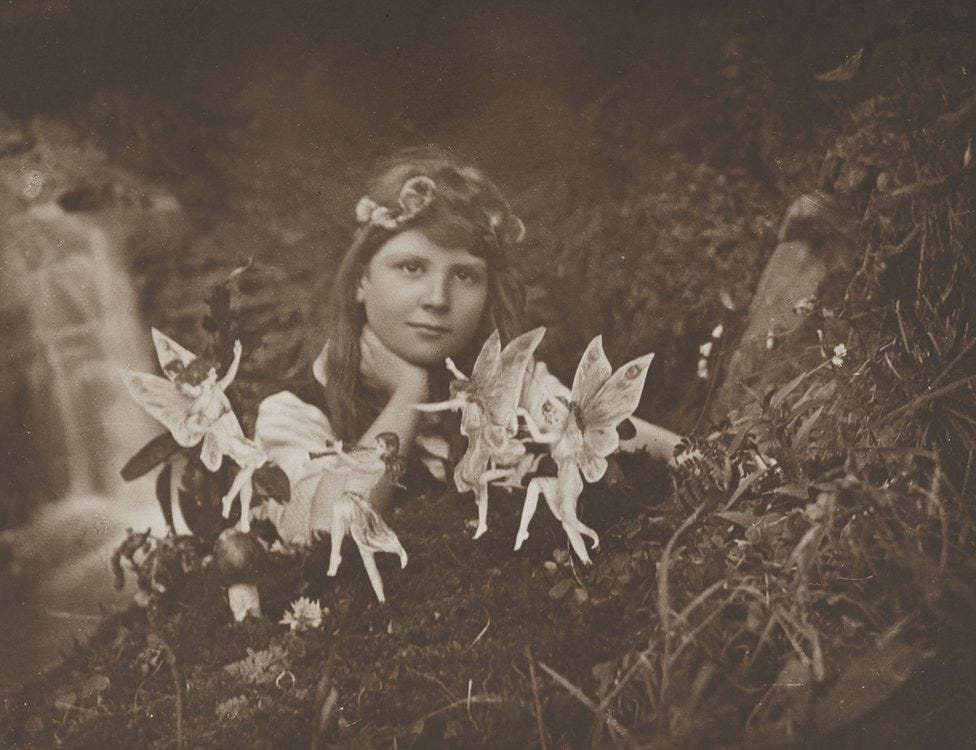
At the time, modern photography was still in its infancy and most people had little experience viewing manipulated images like these. Even the creator of the world’s most famous literary sleuth missed the clues and was taken in by the Cottingley Fairies. In December 1920, he published an article about fairies using the images in the The Strand magazine, which gave the photos a worldwide audience.
A few months ago, before the rapid rise of several increasingly capable AI image generators, it would have been easier to chuckle at the people who were captivated and convinced by the photos taken by Griffiths and Wright. However, in March, millions were fooled by AI-generated photos of the puffy pope, some admiring his style, others ridiculing the look, and all assuming the fake was real.
Any sufficiently advanced technology is indistinguishable from magic.
When I look at the sepia toned photo (above) of Francis Griffiths and four little fairies dancing around her, I see a knowing and mischievous look in her eyes. I imagine she’s holding back the urge to laugh along with the photographer, her accomplice, Elsie Wright. They probably had a lot of fun devising these images, which were meant to “prove” to disbelieving adults there really were fairies living in the forest where they played.
To my eye, there is playfulness in the imagery of Pope Francis, as well. Your Holiness, the heater in the Popemobile won’t be fixed until Monday, but don’t worry, we’ve found a way to keep you warm!
Play is one of the most effective ways human beings learn about ourselves, each other and the world. When we are playful, repetition is rarely tedious, failure is merely motivation to try again, and achievement of goals is rewarded simply and immediately with joy. Play is also a powerful way to manage and overcome fear, for example, when people play ice breaker games to ease the anxiety of meeting new people. Add in a sense of empathy and we can avoid harmful variants of play, like bullying.
A posture of playfulness when engaging with AI can help us gain familiarity and facility with these tools, as long as we also maintain a healthy respect for the potential dangers of this extremely powerful technology. Respect the climb! My rock climbing crew and I would often repeat this phrase to remind ourselves that even when having fun scaling boulders, to remember the possible harm that can arise from foolishness. The same goes for AI — let play augment our awareness, especially of any hubris.
A special thank you to Zoe Clark who I met at the Nonprofit Technology Conference 2023 in Denver, Colorado, who shared the delightful story of the Cottingley Fairies with me. Find her writing here.
Thanks for reading this edition of The Process. Please share and comment or you can email me at philip.deng@grantable.co
Philip Deng is the CEO of Grantable, a company building AI-powered grant writing software to empower mission-driven organizations to access grant funding they deserve.