


Oh hey, Polly here again 👋 — In case you missed it, I am joining Philip on our newly rebranded Substack, Still Human (previously known as Pillar 3). We are excited to bring you fresh perspectives on not only technology and AI, but culture, politics, life, and more. Our mission is to connect all of these seemingly disparate topics and ask what it means to stay grounded and human inside systems that often try to shape us.
If you’ve been craving a place to slow down, think deeply, and feel connected again, welcome.
Boy Mom
Before I start this article, I want to call something out — when I use the word “man” or “men,” I do not mean all men, or that if a man fits roughly within this demographic, with similar ideologies, “they do this exact thing.”
I think over-stereotyping individuals does more harm than good.
This is more meant to identify patterns, observations, and research I’ve gathered in my 37 years on this earth.
All men are capable of change, they are all truly unique, and our society needs to be accountable in supporting them… and that is what I hope to do. Not to point a finger at men — rather to ask: how can we support you in liberating yourself from the confines of masculinity?
This topic is also increasingly important to me as I now have a one-year-old son. I want him to grow up in a world where he does not feel censored by masculinity — rather, he embodies masculinity as merely a part of who he is — the yin and yang energy, mixed in all of us.
In this article I’ll go through how I identify performative masculinity, its impact on our men and boys, and what we can do to support each other in healing.

Wing Girl
I grew up surrounded by men. A single dad. A twin brother. The girl who was always hanging out with the guys in high school and college. I learned to throw a football in the front yard and mastered the art of being the “wing girl” on Friday nights. I loved it—the banter, the roughness, the jokes that went too far but somehow felt like truth. That world shaped me. It made me bold, quick-witted, unafraid to speak up.
But as I got older, I realized I needed to re-evaluate my relationship with masculinity. The version I grew up inside — funny, fearless, a little reckless — had its beauty, but it also came with rules about what you could and couldn’t do. I began to notice how much tenderness and originality were missing, how much silence sat under the humor. I started to wonder not just how men learn to move through the world, but how I do as well.
I realized I treated women like props, even though I was one myself. I began to look at the hyper-sexual — and frankly creepy — way our society viewed women in the early 2000s: think Girls Gone Wild, MTV Spring Break, and the fascination around Britney Spears’ growing breasts as a young teenager.
I began to see the false side of masculinity: one rooted in deep insecurities and a need to belittle others to feel powerful.
This is what I identify as false or performative masculinity. It masquerades as masculinity but is a far cry from the secure masculinity I see in my father, brother, husband, father-in-law, etc.
The men I respect most exude a kind of confidence in their masculinity. They carry themselves without fear that their masculinity could be ripped away from them at any moment. Their masculinity is intrinsic to who they are — without the need to continuously prove it to the world.
Policing Masculinity
From such a young age, boys grow up in a constant state of conformity and self-censorship. Rather than trusting that their masculinity is inherent, most are taught it is fleeting and can be ripped from them at any point, resulting in rejection from male peers and often the community as a whole.
This forces boys and men to constantly prove and perform their masculinity to others. This shows up in what they do, but almost more often in what they don’t do — cry, express emotion, eat a salad, stretch, drink water. The prescribed rules for each man/boy will be unique to their upbringing, but most will carry a distinct list of self-imposed restrictions and self-censorship to avoid the deeply ingrained wounds of rejection they may have felt at a younger age. It is survival for them.
In a recent podcast episode, Are Men OK? — Offline with John Favreau a clinical psychologist and leading researcher on male mental health — Zac Seidler says:
“Masculinity is purely a process of policing. It’s what not to do. It’s anti-feminization in many ways.
It’s this idea that if you are not a woman, that’s how we’re going to define ourselves. And that’s where homophobia blossoms in many ways.
And so you witness in those young boys the watching. You just witness them looking out and seeing the repercussions of intimacy. You see them watching how they can be cut off from the thing that they believe to be their lifeblood.”
He goes on to break down the far-too-common path of men in our society:
“You look at a five-year-old — their emotional spectrum is wild. It’s just as big as any girl’s. It’s this tantrum, it’s this love, it’s this connection, it’s this longing for peers around them.
That’s all that matters to them: having friends.
And then you watch over time.
They get to twelve — and suddenly they won’t hug their mates anymore.
They get to sixteen — they won’t say ‘I love you’ to anybody.
They get to eighteen — they leave school, they go to college — and there’s this idea of success and attainment and protective provider traditions, which are so strong and so at odds with being human.
Because they require you to put your head down — harden up — and find the way through this path because no one will help you.”
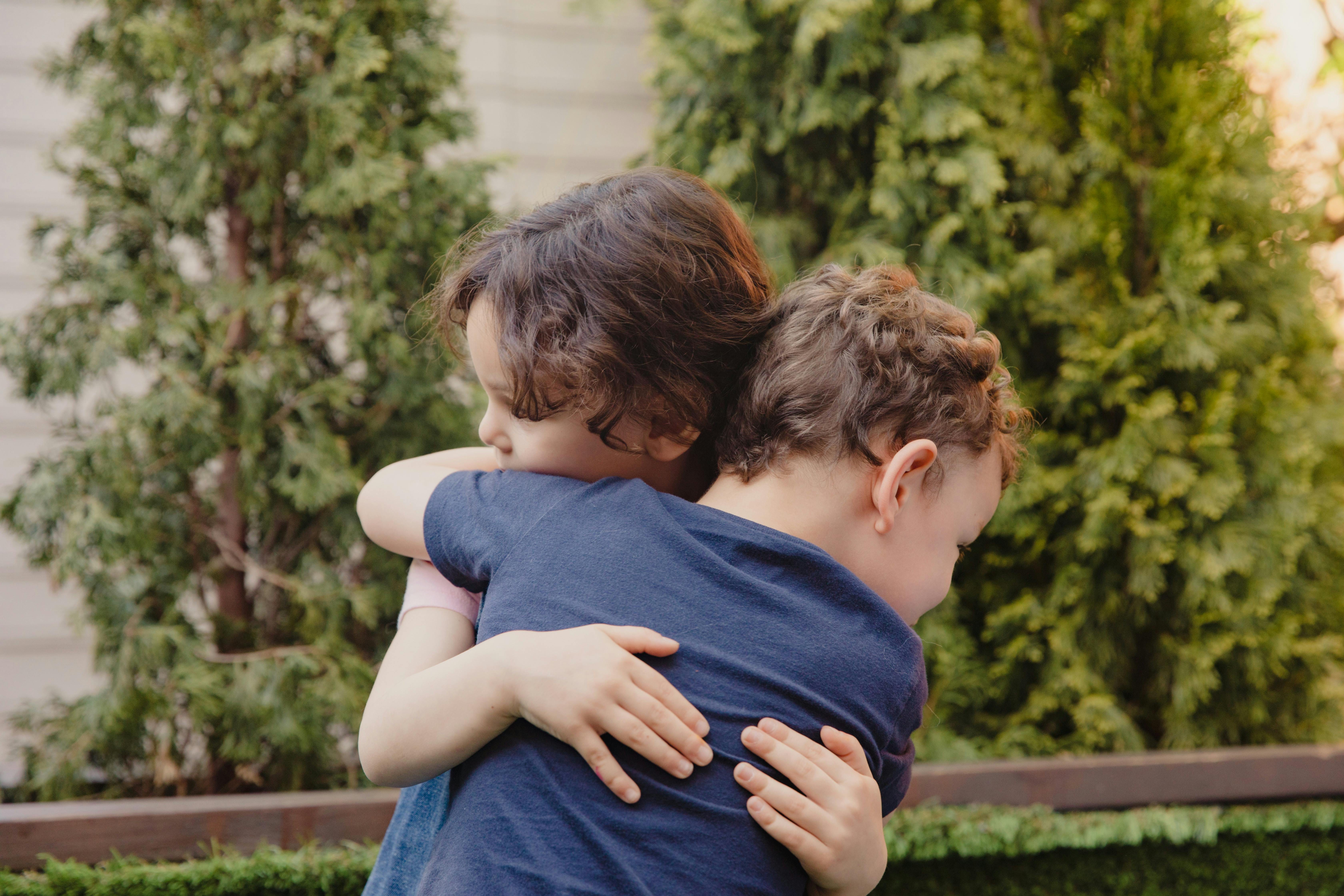
He goes on to say:
“Peers have the control. The power of ostracism is greater than anything [parents] can do. They simply want to fit in. That is so important.
It’s the same with girls, but there is far less aggression and violence at play here. Masculinity is purely a process of policing.”
No matter how our boys are raised, Western media often teaches them that intimacy, vulnerability, and emotions are weak and unmanly.
We use phrases like “man up”, “grow some balls”, “boys don’t cry”, “don’t be a pussy”, and “stop being so sensitive” as ways to communicate how men should treat their emotions — and therefore themselves.
The Cost of Male Censorship
The perceived safety and security of censorship and performative masculinity comes at a cost.
Let’s dive into the details…
1. Health (mental and physical)
Men are 3–4 times more likely to die by suicide than women in the U.S. despite being diagnosed with depression about half as often. Journal of Ethics+2PMC+2
When men are raised inside a definition of masculinity that rewards stoicism, dominance, self-reliance, they are conditioned to perform emotional control as a masculine requirement. This is “performative masculinity.”
Studies show that strong conformity to traditional masculine norms such as self-reliance and emotional suppression is significantly associated with increased suicidal ideation or death (e.g., men with high traditional masculinity were 2.4 times more likely to die by suicide in one systematic review). MDPI+1
Men get culturally praised for burying their feelings — not for metabolizing them or letting them move through their body. So when pain comes —job loss, relationship rupture, illness, fear, shame— men’s emotional tools are either underdeveloped or culturally forbidden. They have nowhere to place the emotion. They are left with nothing to do with the inside except repress it. Suicide, then, is not simply an individual act — it’s also the tragic end of this performance that our culture trains men to perfect, and never teaches them how to exit.
In the same podcast, Are Men Ok?, Seidler goes on to say,
“No one is paying attention to men in their middle years. That 45 to 55 year old age bracket. And as men age, across every racial and ethnic group, the suicide rate drops, except in white men. As they get into their 70s, it just it spikes.”
He goes on to point out that:
America is moving backwards. It used to be 23rd or 24th out of 31 on the OECD list when it came to to men’s health outcomes. Now it’s at 27th or so. And we use a really clear marker for that, which is premature death.
The Harvard longitudinal study shows this consistently. It doesn’t matter if you smoke — US Surgeon General spoke about this — obesity doesn’t matter — it is it is quality of friendships that keeps you alive.
When our boys are conditioned to believe that love, intimacy, and vulnerability - the key ingredients to deep friendship - are weak or unmanly, it becomes easier to understand why so many men are suffering. Connection and meaningful friendship aren’t just nice-to-haves; they’re vital to our survival as human beings.
2. Human Potential
Performative masculinity comes at the cost of human self-expression and therefore human potential.
When we limit what we eat, what we think, and what we do, we limit our unique human expression and therefore potential.
The thought of being on your deathbed and looking back and realizing that so much of your life was limited by false rules and expectations — and in a way, you never got to really know yourself — that is the great tragedy of censorship.
The inventions, the designs, the art, the books, the friendships.
Our ability to listen to our emotions and bring them forward into creation without the fear of what others think is often contingent on removing our own constraints. That is why we see many musicians, rock stars, and cultural figures pushing the boundaries of human self expression — think Elvis, Bowie, John Lennon.
Masculinity and femininity are just a few constraints that we tell ourselves over and over. When we practice removing constraints and seeing what’s on the other side of self-expression, we give ourselves a certain level of freedom. We say to ourselves:
“Wow, that wasn’t so scary after all. I didn’t die. I in fact didn’t lose my masculinity, and if anything, I got closer to my true identity.”
You begin to establish this kind of free-form thought in everything we do: our careers, parenting, relationships, human creations. None of it is bound by prescribed ways to do things, and that is a beautiful and innovative way to live.
Male or female, and anything in between, we all need to reconnect with the childhood versions of ourselves and ask what we are holding back for fear of rejection — the world will be a better place for it.
3. Anger and aggression
I would be remiss if I did not mention the violence that lifelong emotional repression causes — not just for our boys, but for society as a whole.
While women are often labeled as hysterical and unable to control their emotions, men, when trapped in the depths of performative masculinity, use anger and aggression as a final show of their manhood.
This anger and aggression comes in many forms: bar fights, domestic violence, road rage, and so on. It can range from seemingly harmless outbursts to truly horrific events, and everything in between.
**Note: Please skip this section if you might be triggered by sexual violence.**
More recently, I started reading — well, listening to — the audiobook Hunger by Roxane Gay. In it, she talks about her experience being raped by a group of boys when she was ten years old. “They treated me like nothing,” she writes. “They treated me like I was trash.” That section gutted me. It shook me—not because I was surprised, but because the story sounded so familiar. Most of my friends have been raped. I have been sexually assaulted. No matter what you look like, how you carry yourself—if you are a woman, especially a young woman — you are in danger of sexual violence.
Gay describes one moment in particular: one of the boys holding her down spits on her face while she is being raped. That detail— so horrifying, so humiliating —brought up a memory of a close friend’s story who experienced the exact. same. act. The combination of cruelty and casualness left me reeling, filled with the same disgust and horror I felt when I first heard my friend’s account.
But what shook me the most about Roxane’s story was not only her suffering, but what it revealed about the boys. I have a son now. I’ve known men were capable of this since I was twelve years old, but I cannot imagine a world where the young men and boys in my life could be capable of that kind of harm. It breaks my heart for the victims of sexual assault, but also for the conditions in which some boys completely lose their sense of humanity.
Researchers have written extensively about this loss.
Studies by Abbey et al. (2018) and Jewkes & Morrell (2012) find that this kind of violence often happens in environments where empathy is equated with weakness, and emotional suppression is a badge of belonging.
In other words, rape in these contexts isn’t about desire — it’s about performance. It’s about men proving their masculinity to each other by destroying the vulnerability in someone else.
*****Note: End of section on sexual violence*****
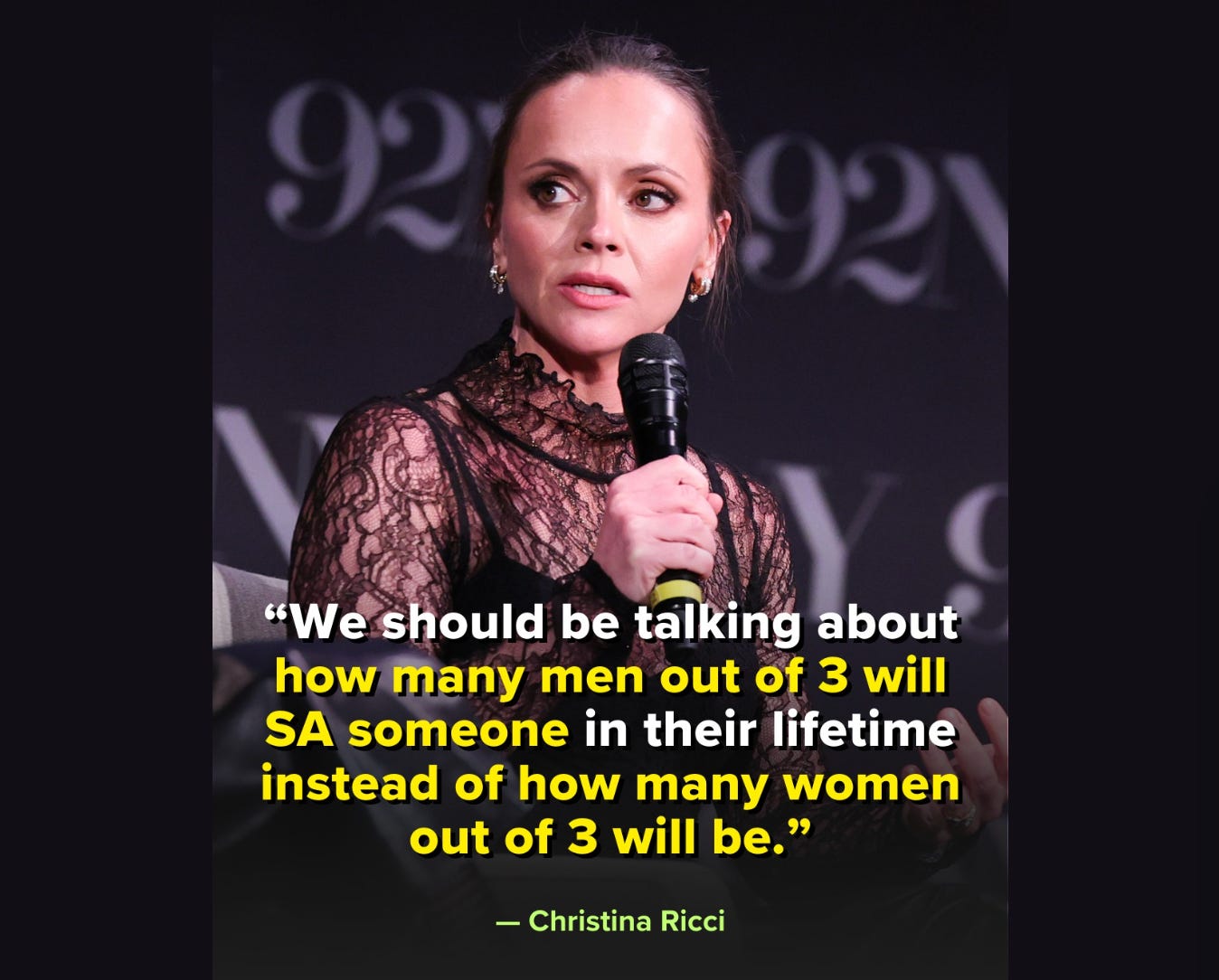
When men have been told their whole life, to act a certain way and suppress certain emotions, it can stir up feelings of anger and resentment when they see people in the world not following these rules, and in fact willfully opposing them.
There’s a sense of,
“I’ve had to play by these rules, my whole life and now you get to be free? This is unfair. This is unnatural.”
It messes with the very order in which they’ve been told to operate.
You see this anger, aggression, and lack of compassion manifest most clearly against gay, trans, and non-binary people.
Alok Vaid-Menon, a non-binary Indian-American writer, performance artist, and activist, names this dynamic powerfully:
“That’s why trans people are being targeted. It’s not because we lack, it’s because we love. — And we have the audacity to love the parts of ourselves that other people hate in themselves. You hate me because I template what it means to be alive. You hate me because I show you that you didn’t have to clip your own wings, that you didn’t have to live an abbreviated version of your joy.
The reason that you’re scapegoating these strangers you don’t know is because you have some unresolved pain in you. And the truth is, your hatred is not going to help you. It’s gonna premature your own death.”
All of this is not to say all men are inherently like this or biologically prone to hate or preform acts of violence.
On the contrary, I am saying our men are inherently good. Our boys are inherently good. But somewhere along the way, some men and boys lose their sense of humanity at varying levels — often harming not only themselves, but society as a whole. And that is a tragedy.
Women’s Liberation
Before I jump into ideas on how to heal, I want to contrast my lived experience as a female.
While I don’t think women are impervious to this kind of conditioning and self-censorship, ours is much more nuanced. Our definition of femininity has expanded significantly over the past 100 years.
Women, as a collective, fought for the right to vote. They fought for the right to wear pants. They fought for the ability to open their own bank account, get a higher education, and participate in professional sports. They fought for their own liberation — and no matter if you’re a self-identified trad-wife or not, that type of liberation is felt by young women growing up in the United States.
There’s a sense of affordance to break stereotypes. Once again, I cannot speak for all women, and I know many women still live in an oppressed state of dated femininity, but on the whole, the things we can do today are far less limited than in previous generations. There has been progress. — In some ways, this has made it even more difficult because now we are expected to do everything, but that’s a whole other article.
For now, I want to put this in contrast to men’s affordance to liberate themselves from the confines of masculinity. If you look at a similar span of time, little has been done to free men from dated societal expectations.
Freedom = Choice
I want to be clear when I say “freedom.” I do not mean that every woman needs to have a “girl boss” career and break out of the traditional roles of motherhood and femininity. Or every man needs to drop his career and gym membership.
What I mean is the freedom of choice.
If you want to be a full-time caregiver to your children, that is your choice. If you want your career, art, or research to be your focus, that is your choice. If you want any shade of all of these — it all comes back to choice — not telling people what they need to do or be based on their gender.
I’ll use myself as an example — I was never censored as a child to be any certain way (at least in my home). I got to be the sister who played video games and football on Tuesday and got to wear my favorite pink heart socks on Wednesday. I got to live with some of my best friends who were men in college, and date an amazing man who became my husband years later. I get to pursue career goals and take off a year to raise my son.
I was not caged by definition. — And I want this experience so deeply for our men.
How to heal: Women and Communities
Men are not the only ones who take part in the silencing of men’s emotions. Women, too, have been shaped by the same cultural forces that teach us which kinds of masculinity are acceptable—and which are not. We have to learn how to support our men differently.
In Untamed, Glennon Doyle shares a story about her friend Jason, who told her that throughout his entire childhood, he only cried in the bathroom because his tears upset his parents. As an adult, he and his wife wanted to raise their son differently—to show him that vulnerability was safe. But when Jason tried to be open about his fears or emotions, his wife struggled to receive it.
“She wants me to be sensitive, but the two times I’ve cried in front of her or admitted that I was afraid, I’ve felt her pull back.”
When Glennon later spoke with Jason’s wife about it, she was surprised but honest:
“I can’t believe he noticed that, but he’s right. When he cries, I feel weird. I am embarrassed to say that what I feel is kind of like disgust. Last month he admitted that he was afraid about money. I told him we would get through it together, but, on the inside, I felt myself thinking: Man up, dude. MAN UP? I’m a feminist, for God’s sake. It’s terrible. It doesn’t make any sense.”
And yet—it does make sense. Women are not immune to the same conditioning that traps men. We have been taught to fear men’s softness, to see it as weakness rather than courage. So when the men we love begin to open, we sometimes flinch. We pull back. Our discomfort sends them right back into silence. If we want something different—for our partners, our fathers, our sons—we have to choose it consciously. We have to decide whether we’d rather see them strong and alone, or free and held.
How to heal: Media
We also need to expect more from the media we consume.
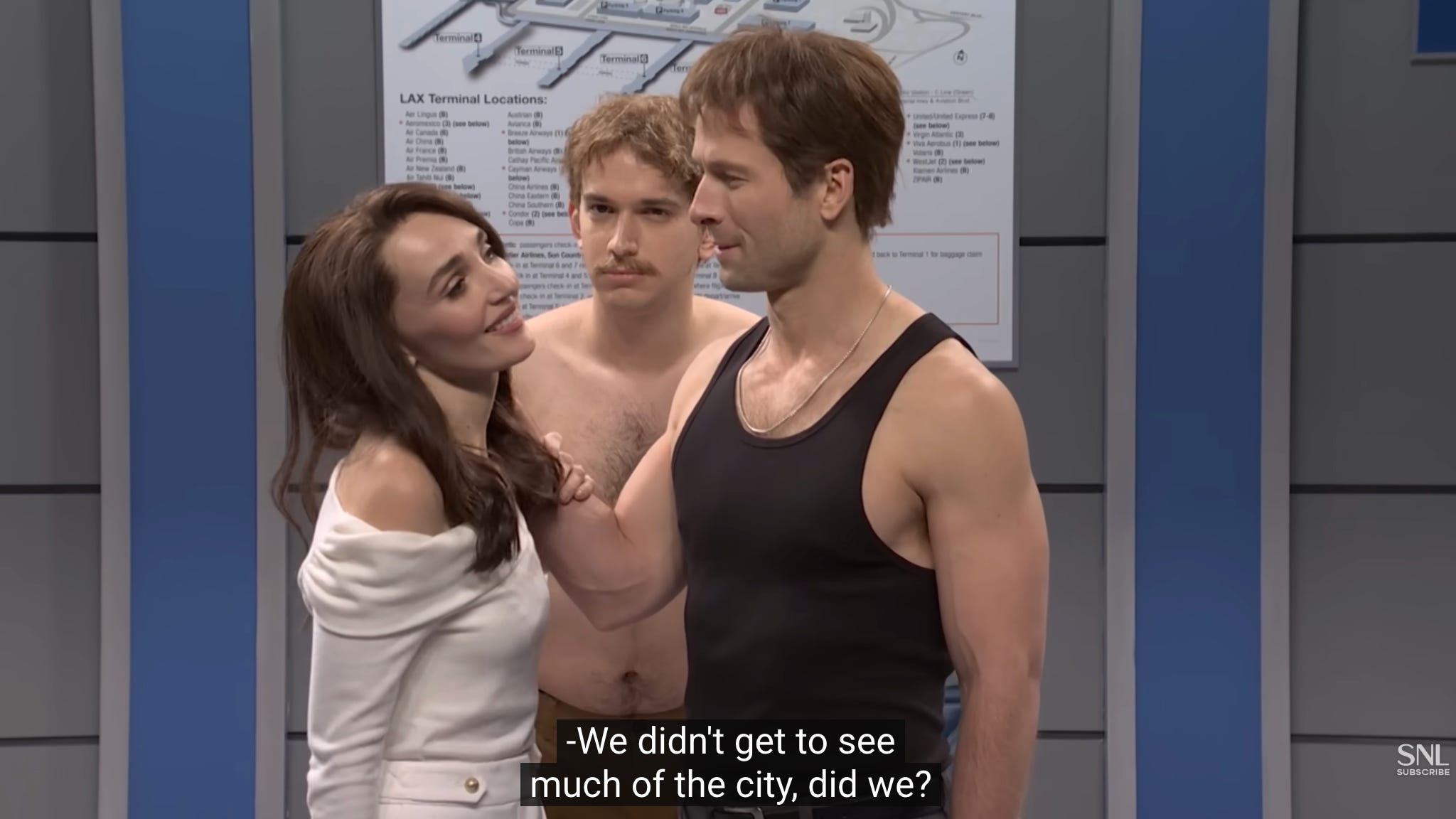
A recent SNL skit captured this dynamic perfectly. It portrays a woman’s current husband as weak and incompetent, contrasted with her ex-husband (played by Glen Powell) with a strong body and aggressive drive to protect her. The skit leans into childish humor to humiliate men who don’t fit the narrow masculine ideal. The current husband’s body, his lack of aggression, even his Starbucks order become punchlines. In the process, he’s not just portrayed as weak, but as unlikable and bitter.
This skit seems innocent, but it reinforces a distorted message about our culture: “Step outside the lines of idealized masculinity and you will be mocked. Your wife will leave. You’ll be humiliated.”
Watching it with my husband and father, I cringed. We laughed — because that’s what we do — but my heart broke a little. I wanted to turn to them and say: You are loved. You don’t need to be anything other than who you are to deserve that love.”
We need to recognize when media reinforces these false stereotypes. We need to stay vigilant—for our men and for our boys. We, myself included, need to be willing to break the forced laughter and say, “Well, that was fucking stupid.”
Women aren’t looking for aggression or emotionally stunted men. They’re looking for men who are emotionally intelligent and available. Men who carry a sense of security and confidence in their masculinity — the kind that lets their daughters paint their fingernails, even if only to share a special moment with her. The kind that allows beautiful moments to move them to tears. The kind that feels and experiences the full spectrum of life’s emotions, no matter how hard they may be to face.
How to heal: Yin and Yang Energy
We’re about to get philosophical…stay with me.
In order to heal, we need to release the idea that “this is manly” and “this is feminine.”
Rather than them being attributed to a male or female sexes, we need to see masculinity and femininity as an un-gendered axis of Yin and Yang energy that feels most at ease when in balance.
Here’s how Yin and Yang forces are often characterized in Chinese philosophy:
Yin is the receptive, inward, cool, dark, lunar energy. It’s associated with rest, intuition, softness, yielding, and the earth.
Yang is the active, outward, warm, bright, solar energy. It’s associated with action, drive, logic, heat, and the sky.
In this characterization, it’s easy to see why it’s so important for every human, regardless of gender, to have yin and yang energies in balance.
However, in much of Western culture, masculinity has been shaped as an overextension of yang: action without rest, control without surrender, strength without softness.
When men are taught that being masculine means suppressing yin qualities—intuition, receptivity, vulnerability—they are taught to live in imbalance.
The yin becomes buried, unexpressed, shamed. Over time, that imbalance hardens into emotional disconnection, rage, or despair. In Taoist thought, imbalance always seeks correction; nature will restore equilibrium one way or another. The tragedy is that many men only reach for the yin - only allow themselves to feel, to soften, to weep - when they have already been broken open by loss, illness, or crisis.
True wholeness, as Taoism teaches, doesn’t come from performing one half of the circle; it comes from remembering that yin and yang are not opposites but parts of one living current - both necessary, both sacred.
It’s important that we see these yin and yang forces as separate from gender to feel where we might be out of balance and to better empathize and understand the imbalance of others.
The woman at work who stays until 8 p.m. sending emails - she, a female, is too deep in her yang energy. In a patriarchal society, you can imagine that yang energy is rewarded over yin - meaning that no matter what gender you are, you’re probably living in imbalance.
So I’ll say this again, I’m not asking men to become more feminine, rather, I hope to give them permission to better balance these energies so they heal and can live in greater harmony with themselves and society as a whole.
Fear of the Slippery Slope
The fear goes like this:
“BUT, if I allow myself or another person to express themselves and do XYZ, where does it stop? What are the guardrails? What is to stop me from becoming gay, or trans? Are you trying to make all of us gay and trans?”
That is what is so sad about all of this. Many men have been living such a prescribed version of themselves for their entire lives that they don’t know who they are without it. When you are defined by what you are not — i.e., femininity — you think if you don’t have those definitions, the only option is feminine.
But no, that is not your only option. The other option for a hetero male is simply to be who you are. Like what you like. Do what you want to do. That’s it. Not a slippery slope to femininity — its a path to balance and self discovery.
Acknowledge the fear
With that said, I want to be sensitive to men’s fears of this kind of free-from-life.
The rules that they’ve played by their whole life — now we are saying: You are free from these constraints and self-imposed restrictions. And I think in many ways, that can be a scary and intimidating thing.
When you’ve lived your whole life bowing to a false god of masculinity, and that God is revealed to you as an illusion, there is a very real response to want to grasp onto it.
I should also call out here that that god of masculinity, has often served them well in a patriarchal society. Being aggressive may have protected them from bullying when they were young. Working late hours with no regard to emotional health may have gotten them the promotion. But it is killing them - both metaphorically and literally.
Benefits of resistance
For a fresh perspective, I’ve been reading When Boys Become Men by Judy Y. Chu.
In it, she discusses how men are often framed as passive participants in their own self-censorship. But she also highlights alternatives and explores the real-world benefits that resistance can have.
She cites Psychologist Carlos E. Santos, along with Way & Hughes, longitudinal research showing that when middle-school boys resist traditional masculine norms (like emotional stoicism, toughness, and extreme autonomy), they tend to fare better in several areas.
In a study of about 400 boys from 6th through 8th grade, Santos found that this kind of resistance was linked with higher academic engagement, greater self-esteem, and lower depression, as well as stronger performance on standardized math tests. Colby College+1
Their findings line up with broader research showing that rigid conformity to masculine norms is often harmful. A meta‑analysis of 78 samples (19,453 participants) found that adherence to masculine norms like self-reliance, dominance, and physical toughness is modestly but consistently associated with worse mental health, including higher distress and reduced likelihood of seeking psychological help. PubMed
Further, a systematic review of adolescent masculinity found that when boys strongly adhere to stereotypical masculine role norms (e.g., emotional restriction or dominance), they tend to experience more internalizing behavior problems (like anxiety or depression) and less social support. PMC+1
Taken together, these studies suggest a powerful insight: encouraging boys to resist or redefine limiting masculine norms isn’t just a matter of social justice — it can have real benefits for their mental health, academic success, and overall well-being.
Our men are fighting back
Many men fight back in unseen ways.
Unseen because they are often not big and bold rather deeply personal and healing.
Men fight back through:
Seeking help for mental health challenges
Connecting to loved ones and family members
Nurturing and deepening friendships
Seeking help for addiction
Exploring personal style
Recognizing anger as a form of repression
Practicing self-care, both mental and physical
When men heal and break free from self-imposed censorship, they give others’ permission to show up more authentically. And that is radical. There is a bravery and sense of security in one’s own masculinity needed to express themselves in this way.
It is an act that is steeped in both yin and yang energies — yin for the ability to surrender and yang for the bravery to overcome oppressive societal forces that seek to censor and limit them.
Only once you’ve taken care of yourself, can you begin to take care of others. In the episode Notes on Being a Man — A Live Conversation with Ben Stiller on the Prof G Podcast, Scott Galloway explains:
“You protect yourself, you get strong, you protect your family, then you start protecting your community.
And that’s the ultimate expression of masculinity — you plant trees whose shade of which you’ll never sit under.
And I don’t say that to be virtuous. I say that because it took me forever to get there. I was so focused on myself and taking care of myself and making money. I’m not a naturally philanthropic person, and I’m embarrassed to say that, but it’s true.
These were things I had to learn and I had to appreciate. But what you realize is that if you can get to that outer ring of protecting people you’ll never meet — that makes you feel like a man.”
We need to recognize healing and the deepening of relationships as an act of resistance because, like the women’s rights movement, it connects them to a larger goal and purpose.
Each small act of resistance to the flaws of performative masculinity helps break the cycle, and heals our men, our boys, and our society as a whole.
Great work Polly! So well researched and articulated. Cheers to the next generation of beautiful men 🩵