



Welcome to this edition of The Process, a free weekly newsletter and companion podcast discussing the future of technology and philanthropic work.
If you enjoy reading and listening, please consider subscribing and sharing with your community!
Thank you!
Philip
Last week’s post was meant to get a conversation started and I’m happy to say it did. Several readers found the scenarios thought-provoking, and I was glad to be challenged.
As a follow-up, let’s take a closer look at some of the issues folks raised about last week’s article, Is it Ethical to Use AI to Seek Grants?
Is it Ethical to Use AI to Seek Grants?

Welcome to this edition of The Process, a free weekly newsletter and companion podcast discussing the future of technology and philanthropic work. If you enjoy reading and listening, please consider subscribing and sharing with your community! Thank you!
What about the inaccuracy of AI data?
One reader was concerned, presumably, about the potential for harm caused by AI generating inaccurate data. This is a very important issue to highlight, and one I think is best mitigated by a deeper understanding of how these technologies operate.
Currently, large language models (LLMs), like GPT, are very good at pattern recognition and replication, which is what they do when we interact with them. Among the tasks they are not (yet) good at performing are calculations and assessing the truth and accuracy of their outputs.
Let’s say we prompt ChatGPT to, “Write a statistical overview of habitat loss in the Amazon rainforest”. From there, the language model takes in the text, analyzes its meaning across billions of parameters, extracts patterns, and then generates an output by replicating those patterns using complex calculations of probabilities. What comes out will be something that looks and sounds right, it will have the correct form, a paragraph reviewing habitat loss with various data points cited.
But notice there is no step in the process where the model is looking up information. That’s because the LLM is only trying to replicate mathematical patterns present in its training data. If the statistics that come out happen to be accurate, this is probably because a high volume of samples in its training data contained similar figures, so the probability is higher, and the pattern clearer for the model to follow.
Or, it may issue completely fictitious data because all it’s trying to do is follow a pattern that says, “a percentage probably goes here” or “a large number likely goes here followed by a smaller number”. When the signal in the training data is noisier, the outputs become less accurate. What comes out is like a prop from a movie set, it’s only made to look like the real thing.
One trend to keep your eye on will be how LLMs interact with real-world data present in other systems, which is a hot topic in technology. For instance, OpenAI, the company behind ChatGPT, is working on plug-ins for GPT4, which are protocols that allow the model to ask other systems for data.
If you’re curious about plug-ins, here’s a piece from a few weeks back called, Digital Native, which explores this topic further.
Digital Native

Welcome to this edition of The Process, a free weekly newsletter and companion podcast discussing the future of technology and philanthropic work. If you enjoy reading and listening, please consider subscribing and sharing with your community! Thank you!
How to ensure data accuracy
Once we understand how LLMs like GPT work, we gain more clarity about how to deploy them. They are not (yet) completely reliable tools for research and computation, so asking them to be a research assistant is not advisable at this time.
On the other hand, the models are great with words. Asking them for ideas, scaffolding, and reworking content is a great use case.
If you want the models to work with numbers, the best practice is to provide them with the data you wish for them to use and explicitly instruct the models to only use the content you provide.
What about the issues of intellectual property and copyright of what AI produces?
Another question raised was about the issues around intellectual property and ownership of AI-generated content. You can bet there are lawyers across the country looking at this issue, first, because it’s extremely interesting, and second, because many speculate the legal field may be one of those most dramatically transformed by generative AI.
I’m not qualified to speculate on how our legal system will evolve to address AI IP, but I think it’s useful to look at a recent high-profile case of copyright infringement involving musician, Ed Sheeran, to see what we can learn about how these issues may be looked at as they come up in the near future.
Sheeran was accused of copying elements of Marvin Gaye’s 1973 hit, Let’s Get It On, for his own 2014 hit, Thinking Out Loud. He ultimately won the case proving he devised his song independently and by making the point that the chord progressions used in both songs are “common build blocks” that appear repeatedly throughout the history of music.
In this case, quantitative analysis showed musical overlap between the songs, which used the same chords, and some listeners even heard a similar tune. Despite all of these concrete factors, the jury still found in favor of Sheeran. They seemed to recognize the need to preserve certain fundamental themes for all musicians to use, and to allow artists to build original works upon these foundations.
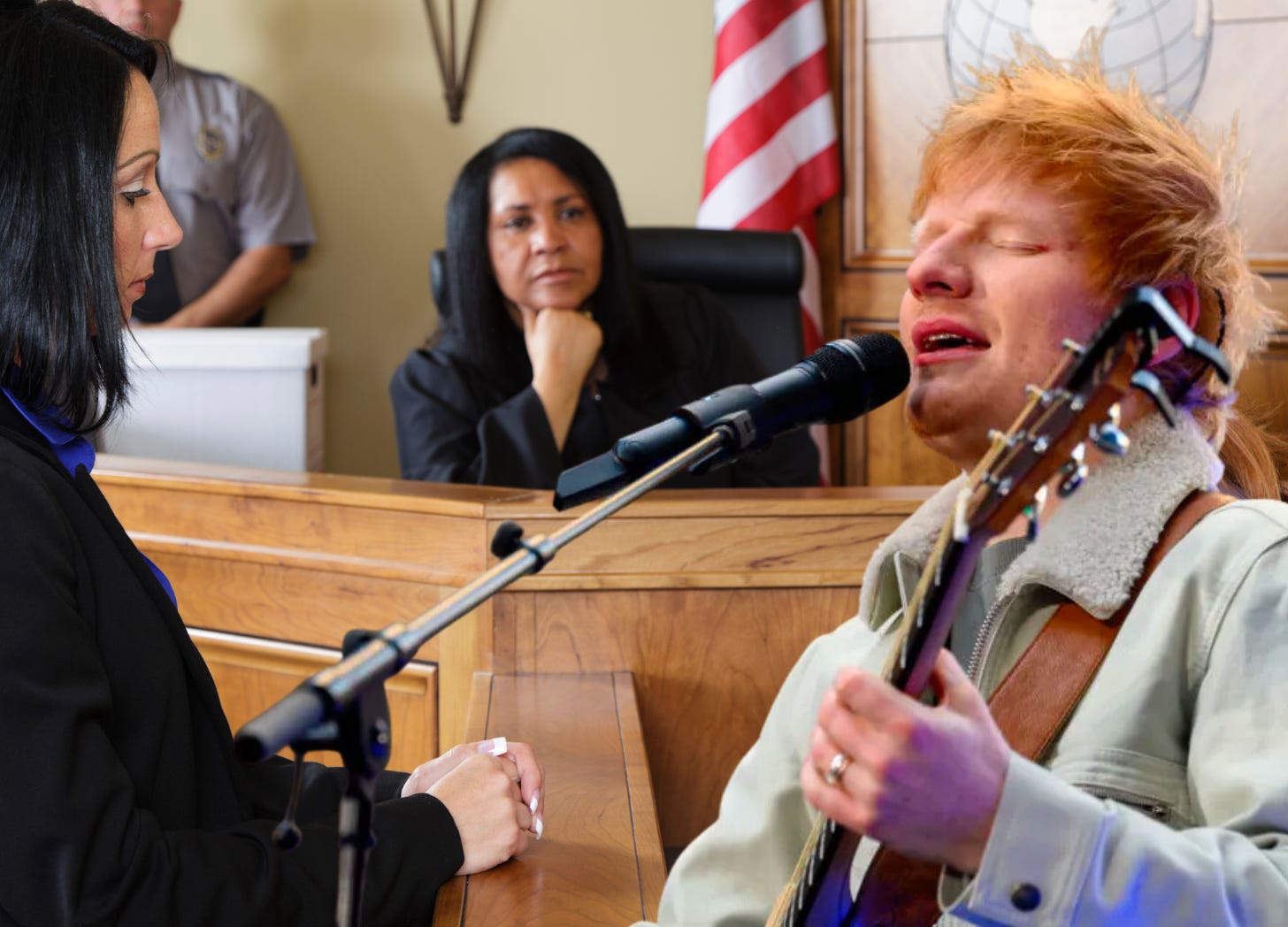
This makes me think about intellectual property a bit like real estate property. As in dense urban areas, if things are only going to get more crowded, we need rules to minimize serious conflict. As AI enables people to create content more quickly and inexpensively than ever, we must update our intellectual property practices to recognize this evolving reality. What do the “creative megacities” of the future look like? How do we optimize for inclusivity and collaboration, while minimizing conflict and harm?
Stay tuned to the music industry where I believe many interesting test cases will emerge. Already there is a fake Drake and The Weeknd song, Heart On My Sleeve, and Canadian pop star, Grimes, has invited her fans to make songs using AI versions of her voice and offered to split proceeds with them if any become a commercial success.
What about confidentiality? Will sharing entire organizational grants with an AI system, add it to the algorithm to produce other AI answers?
When we interact with systems like GPT, the data we send is temporarily stored on Microsoft Azure servers for 30 days. It’s used to fulfill the individual request we’re making and then deleted after a period of time.
Engineers in charge of building and maintaining the models are studying our interactions with the system and constantly making modifications to improve performance and safety. For most users, the way you interact with the model is likely more interesting to the companies building them, than what you’re inputting to them.
To achieve their amazing abilities, these models need to be trained first, before we can interact with them. The data sets used to train them have a scale nearly as large as the internet, itself, and the computational resources required are some of the most powerful in history. GPT4, the latest model from OpenAI has hundreds of billions, if not trillions, of parameters it uses to analyze and generate outputs.
To put this into perspective, if I were to add every word I’ve ever written in my entire life into GPT4’s training data set, it would be like pouring a cup of water into the ocean. Everything gets mixed, atomized, analyzed, and reassembled.
If another user’s GPT outputs happened to appear similar to something I’d written, it would be either a coincidence or because my writing is generic (like a four-chord pop song progression), not because the model has lifted my words verbatim. That’s just not how they work.

When a crowd of people all guess the number of gum balls in a large jar, the average of the guesses is often closest to the actual number of candies. This phenomenon is called the wisdom of the crowd, and something very similar is happening with large language models. The amazing abilities of GPT emerge only when enough data is processed with enough computing power, and something like an average result can be generated.
Let’s keep the dialogue going
I was very grateful to receive engagement with my post from last week and hope readers will continue to consider, challenge, and add to my thoughts as we journey together to learn how to live and do good work with AI.
I suspect nearly all viewpoints on AI are valuable. The only perspective I find problematic is disengagement. This technology is here, it’s improving by the hour, and it will soon be part of the foundational layers of infrastructure in our lives.
Let’s get our arms around it, especially those of us with wisdom gained from experience in our sector seeking human and planet-centered outcomes. Your participation is essential to guide this powerful new technology forward in the right direction.
Join me and Connective Impact for a FREE Interactive Workshop on

Using Artificial Intelligence (AI) in International Development Fundraising.
Learn how to incorporate AI in your proposal writing.
Thanks for reading this edition of The Process. Please share and comment or you can email me at philip.deng@grantable.co
Philip Deng is the CEO of Grantable, a company building AI-powered grant writing software to empower mission-driven organizations to access grant funding they deserve.
Thanks for responding to the concerns I have myself and have been hearing from colleagues. My points are really not to challenge you, although I am glad they did.
1. On accuracy- you verified that yes, we have reason to be concerned and should not rely solely on AI for any grant professional task. Even though it is getting better, and plug-ins are planned, I still need to double-check the sources (which are not provided by all LLM’s) to be sure what I do for my client is accurate.
2. As for IP and Copyright, the comparison to music and housing seems relevant to a point. To me, it is all about grant professionals LEGALLY using the information they acquire through LLM’s. If you follow the guidelines by APA, (apa.org), you will cite your sources, including the LLM. As for Copyright- the US Copyright Office is currently taking input around this topic- NewsNet Issue 1004 | U.S. Copyright Office. It seems like we would want to wait to see what they have to say.
3. As for the confidentiality, it is interesting that GPT only keeps what we put “in” for 30 days. What does Grantable do with the information it houses for clients who use prior grants to generate new or improved narratives through its’ AI?
I just think it is extremely important that we recognize that the latest “tools” are just that. We, as professionals, must still accurately represent information and data, remain devoted to keeping client information confidential and follow the laws and regulations. Again, back to the GPA Code of Ethics for me.