



Welcome to this edition of The Process, a free weekly newsletter and companion podcast discussing the future of technology and philanthropic work.
If you enjoy reading and listening, please consider subscribing and sharing with your community!
Thank you!
Philip
Suppose a local nonprofit animal shelter uses ChatGPT to refresh a 2022 grant proposal for use in a 2023 application to the same grantor. The shelter’s work and programs are largely unchanged and using AI helps to vary the prose, while preserving the core narrative and allowing the executive director to focus on updating important statistics and data. The proposal takes less than an hour to produce and submit, and the organization is awarded another grant.
Because of my work, I’m frequently asked to speculate on the ethical implications of a scenario like this. What are the cases for and against using generative AI technology to help with the grant-seeking process? Let’s begin with some of the cases against.
Using AI to obscure the truth is a bad idea
It is unethical and indefensible for a grant applicant to use AI to produce falsehoods for use in grant proposals, though it hardly requires using such a powerful tool as AI to make false claims or generate fictitious data.
In truth, it isn’t easy to find a gray area between ethical and unethical use, but stretching to find a dubious case might be to prompt an AI to use clever language to either inflate positive points or obscure unflattering aspects of a grant proposal.
In other words, to ask AI to help preserve technical truthfulness (cover your ass) while seeking to mislead the reader to draw a more favorable conclusion than they otherwise might. It’s hard to say this is clearly unethical, though I think it would be safe to call this a bad practice that would set an organization on a precarious path for the future.
Does less effort mean less value?
Leaving aside blatant lying, let’s imagine the grantor finds out the animal shelter’s 2023 grant proposal was mostly written by AI repurposing the previous year’s application and they have a problem with that. What might the grantor be upset about?
They might be underwhelmed if they realize the stories of the shelter’s impact are the same ones recycled from last year and they were hoping to read new narratives describing the outcomes of the work they fund. Or they might feel slighted knowing they are putting in just as much time and effort to carefully read and evaluate the application, while the team submitting the proposal spent far less time than they did before.
It’s worth noting, however, it’s easy to reframe both of these hypothetical criticisms as demonstrations of operational efficiency where the grantee effectively uses tools to minimize fundraising overhead, something most grantors value.
Authenticity over originality
Another point to consider is many grant proposals are cut-and-paste remixes of other proposals. Most organizations with mature grant-seeking programs develop answer banks or boilerplate documents to store frequently used text to ensure narrative consistency and to make responding to RFPs more efficient. In most cases, authenticity is more important than originality when writing grant proposals.
Is it then inauthentic to use AI to achieve a narrative style or voice that is different from how a human author would write? In this case I would point to the common practice of organizations hiring professional grant writers, which is often done because these skillful wordsmiths can actually improve the way an organization communicates the essence of its work.
Unfortunately, it is also the case that sometimes BIPOC-led organizations will hire outside help to write and “whitewash” their grant proposals because they understand writing in their vernacular would likely lower their chances of success, regardless of the underlying merits of their work. Authenticity, it seems, points to something deeper than style.
Efficiency makes funding go further
The cases for using AI to help streamline the grant-seeking process are, in many ways, the flip side of these same issues discussed above. Once an organization has a library of high-quality writing about its work, AI can efficiently generate variations of this text to help teams respond to repetitive inquiries, including similar prompts across grant applications.
It has been calculated that as much as 46% of all grant awards may actually cost more than they’re worth when the time and resources of all applicants are fully accounted for. Grant applicants who use AI to save time while maintaining the high quality of their grant proposals are being efficient operators maximizing their ROI.
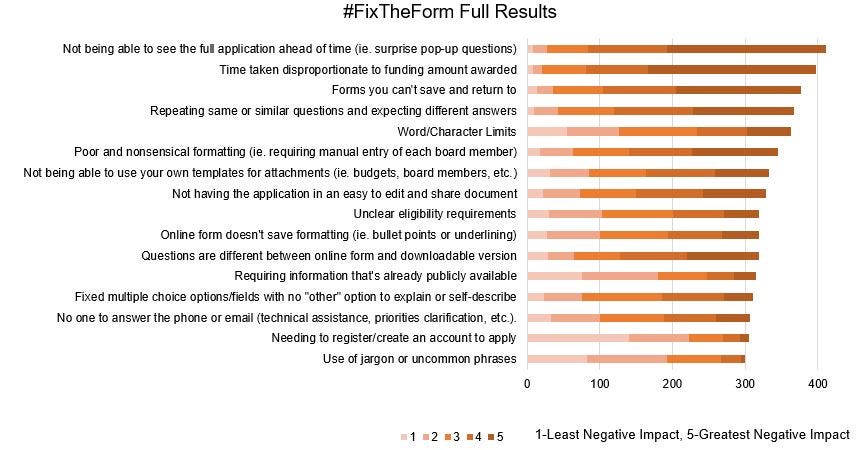
The #fixtheform movement led by GrantAdvisor.org attacks the same issue of what they call “technical time-wasters”, most of which are various time-consuming ways of reformatting the same basic information. In response, thousands of grantors took steps to open up various aspects of their application processes to make them more compatible and less onerous. AI could be a powerful tool to make more progress on these on-going efforts to save applicant time.
Improving grantor-applicant alignment
I’ve also spoken to many grantors who invest heavily in efforts to prevent misaligned or badly constructed grant proposals from being produced in the first place. They try to publicize funding criteria as clearly as they can, and conduct information sessions to guide prospective applicants. When mismatched or low-quality grant proposals are submitted, it wastes everybody’s time.
AI may also be able to help augment the efforts of grantors to improve this messy sorting process. Chatbot guides can answer questions and also help proposals to stay on course, like the lane assistance features in modern cars that alert a driver when they’re drifting outside of the lines. At scale, these kinds of features could save the sector as a whole, tens of millions of hours of staff capacity each year.
Translating meaning to create connection
Assuming an applicant organization is effectively doing good work and is well-aligned with the funding criteria of a grant-maker, every effort should be made to facilitate connection and understanding between these two sides. When AI can help to translate and overcome communication barriers that might otherwise inhibit collaboration, it’s hard to imagine reasons to oppose this use.
In conversations I’ve had with Joanne Sonenshine, Founder and CEO of Connective Impact, one of the areas of work we are most excited about tackling together is to help international NGOs operating in primary languages other than English to be able to confidently navigate the grant funding landscape in their native languages. Applying AI in this way can help to ensure opportunities to create positive impact are never lost in translation.
Summary
(created with GPT assistance)
Using AI to help with grant proposals can be a controversial topic, but there are valid arguments for its use. While it's important to avoid using AI to produce falsehoods, it can be a valuable tool for streamlining the grant-seeking process and improving grantor-applicant alignment. AI can also help in translating meaning to create connection, especially for international NGOs operating in primary languages other than English.
Key takeaways
(created with GPT assistance)
It's unethical to use AI to produce falsehoods in grant proposals.
Using AI to streamline the grant-seeking process can be a valuable tool for improving efficiency and maximizing ROI.
Authenticity is more important than originality when writing grant proposals with help from professional grant writers and AI assistants.
Grantors can use AI to help augment their efforts to prevent misaligned or badly constructed grant proposals from being produced.
AI can help to translate and overcome communication barriers, especially for international NGOs operating in primary languages other than English, to ensure opportunities to create positive impact are never lost in translation.
Thanks for reading this edition of The Process. Please share and comment or you can email me at philip.deng@grantable.co
Philip Deng is the CEO of Grantable, a company building AI-powered grant writing software to empower mission-driven organizations to access grant funding they deserve.
Producing falsehoods and research prospecting for mission alignment are basic business practices and professional standards for any reputable grant professional. I think your article misses several points, and as the CEO of Grantable, I would hope that you would issue a statement about the use of your AI product around ethics that is more applicable.
What about the inaccuracy of AI data? What about the issues of intellectual property and copyright of what AI produces? What about the confidentiality of sharing entire organizational grants with an AI system that then adds it to their algorithm to produce other AI answers?
AI tools are just that- TOOLS. The ethics around its' use within the grant profession go back to a grant professionals' Codes of Ethics. AFP and GPA both have codes of ethics that address being factual, not misrepresenting work, not violating confidentiality and citing work appropriately.
APA just came out with a standard for citing AI. Other leaders in our profession are slowly doing the same. The ethics of using AI in seeking grants always goes back to the leading experts in the field who are clear about the best practice, professional standards, and their own Code of Ethics. I hope anyone reading relies on those.