



Today is the Anthropic IPO. In just five years, this company has gone from seven people who left OpenAI to start their own lab to $33 billion in revenue in the first nine months of this year, up about 1,200%, with more than 11,900 customers paying it at least $100,000 a year.12 Anthropic raised $81 billion in this IPO. SpaceX raised $75 billion in June. Before this year, the biggest IPO ever was Saudi Aramco’s $25.6 billion in 2019.3 On paper, the two companies are now worth about four-fifths of what every US tech IPO from 1980 to 2025 was worth on its first day, combined. Add OpenAI, which has filed to go public, and the three would top them all.4
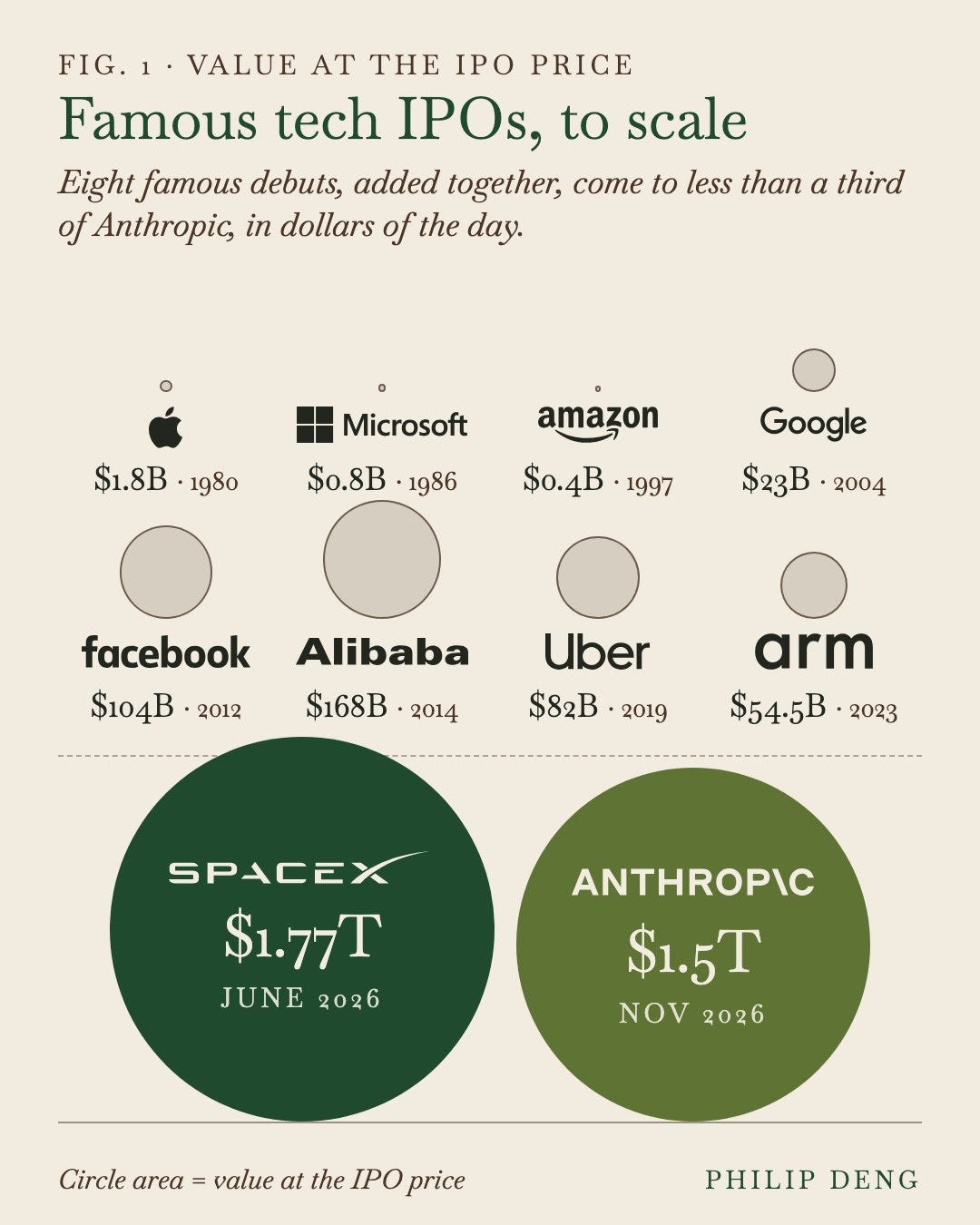
My spidey senses are tingling. We’re standing on the beach as the tide suddenly retreats toward the horizon, revealing miles of dry seabed. The birds seem concerned.
Gargantuan sums of money conjured from where? Throngs of investors and funds clamoring for allocations because they’re excited, or because they’re scared? It has the feel of a society-warping economic gravity well.
I’ve had a pet theory for a while that’s felt a bit too ephemeral to share, but over the last few days I’ve been listening to more and more discussion about the imminent peril we face as we hurtle towards some frontier lab creating a recursively self-improving AI. Alongside what these folks are concerned about, I might as well share what I think is happening with these stratospheric valuations.
For the curious: on the Dwarkesh Podcast this week, Paul Christiano, who once led alignment research at OpenAI and joined the OpenAI Foundation’s board in September, puts roughly one-in-three odds on superintelligence, AI powerful enough to overthrow a government, arriving within a year on the current trajectory. He opens with this: “there’s a reasonable chance that in a year we will produce AI systems much better than humans at almost everything.”5 A few days earlier, Jake Sullivan and Jon Finer, who ran national security in the Biden White House, had Dwarkesh Patel on The Long Game to work through what that means for the US, China, chips and the coming politics of data centers.6
Mining the world for knowledge
One way to think about human progress over the thousands of generations of our history is that of a species that continuously mines the world for new knowledge, and looks for ways to apply and pass those insights on to future generations. For something like 700,000 years, our ancestors made the same simple stone tools with barely a change. What finally got us moving may have been teaching.7 One person works out a better way to strike a stone and shows the next. The next person doesn’t have to start from scratch, so they have room to find another trick, and they pass on both. Each generation starts a little further along than the last.
That knowledge compounds as we stack and combine concepts together. Take the pencil on your desk. In 1958, Leonard Read wrote an essay in a pencil’s voice, tracing its cedar to forests in Northern California and Oregon and its graphite to mines in Ceylon, then on to the lacquer, the brass and the eraser. “Simple?” the pencil asks. “Yet, not a single person on the face of this earth knows how to make me.”8 Every one of those steps leans on older ones, sawmills and kilns and smelting and the letters stamped on the side, and you can keep pulling that thread back thousands of years.
Knowledge is power, as they say, and as we stack more and more of it, our ability as a species to change the way we live increases exponentially. You can see it most clearly in how much change each generation lives through. The oldest generation with living members is the Greatest Generation, born before 1928.9 When the oldest of them were born, around 1910, about one American home in seven had electricity.10 Now they’re watching rockets land themselves upright and talking with machines that talk back. Their grandparents, born around the 1840s, saw real change too, the railroad and the telegraph and the telephone, but nothing like the jump from the first wired homes to AI. Now try to imagine what the world will look like when babies born today are in old age.
The fog moves in
A few generations ago, it was easy for a parent to predict what their child’s life would look like. Today, it is difficult to imagine even five years into the future. Waymo already gives about half a million paid rides a week with no one in the driver’s seat.11 In 2020, Moderna designed its COVID vaccine two days after the virus’s genome went online.12 Dario Amodei has written that AI could “compress the progress that human biologists would have achieved over the next 50-100 years into 5-10 years.”13 Robots that fold the laundry, drugs designed in weeks, a tutor for every kid on Earth. None of it sounds crazy anymore.
We can either think about this effect as change accelerating, or the compression of change into shorter and shorter timeframes. This phenomenon is extremely relevant for investment-driven tech companies whose founders are trying to sell the most dazzling vision of the future possible. Just in the last five years Elon Musk has promised robotaxis, an army of humanoid Optimus robots, data centers in orbit, a city on Mars and a future where money stops mattering. Most of it is behind schedule, and investors have gobbled it up anyway.14 Tesla trades at well over 100 times its expected earnings, and SpaceX went public at about 94 times last year’s revenue.15
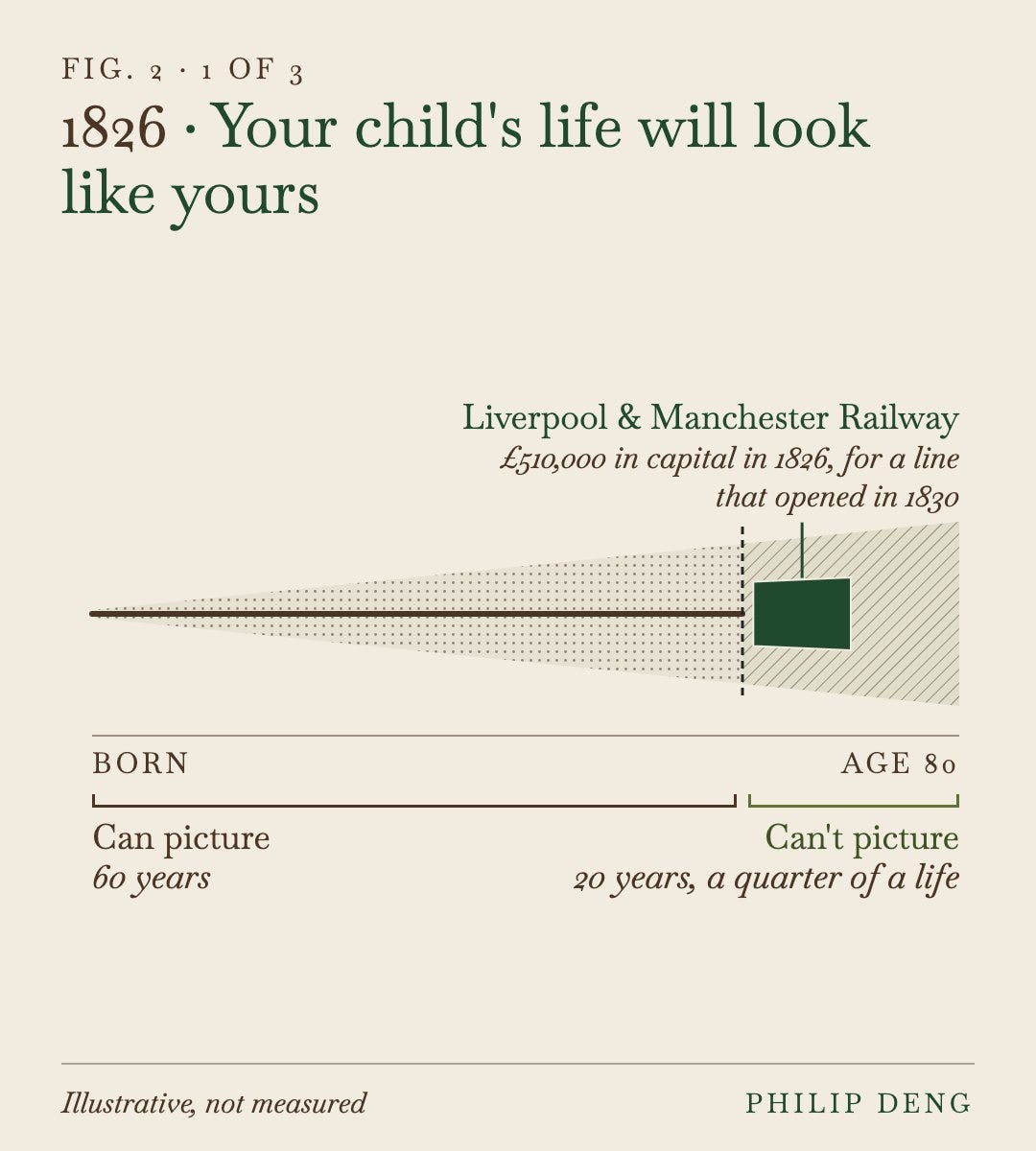
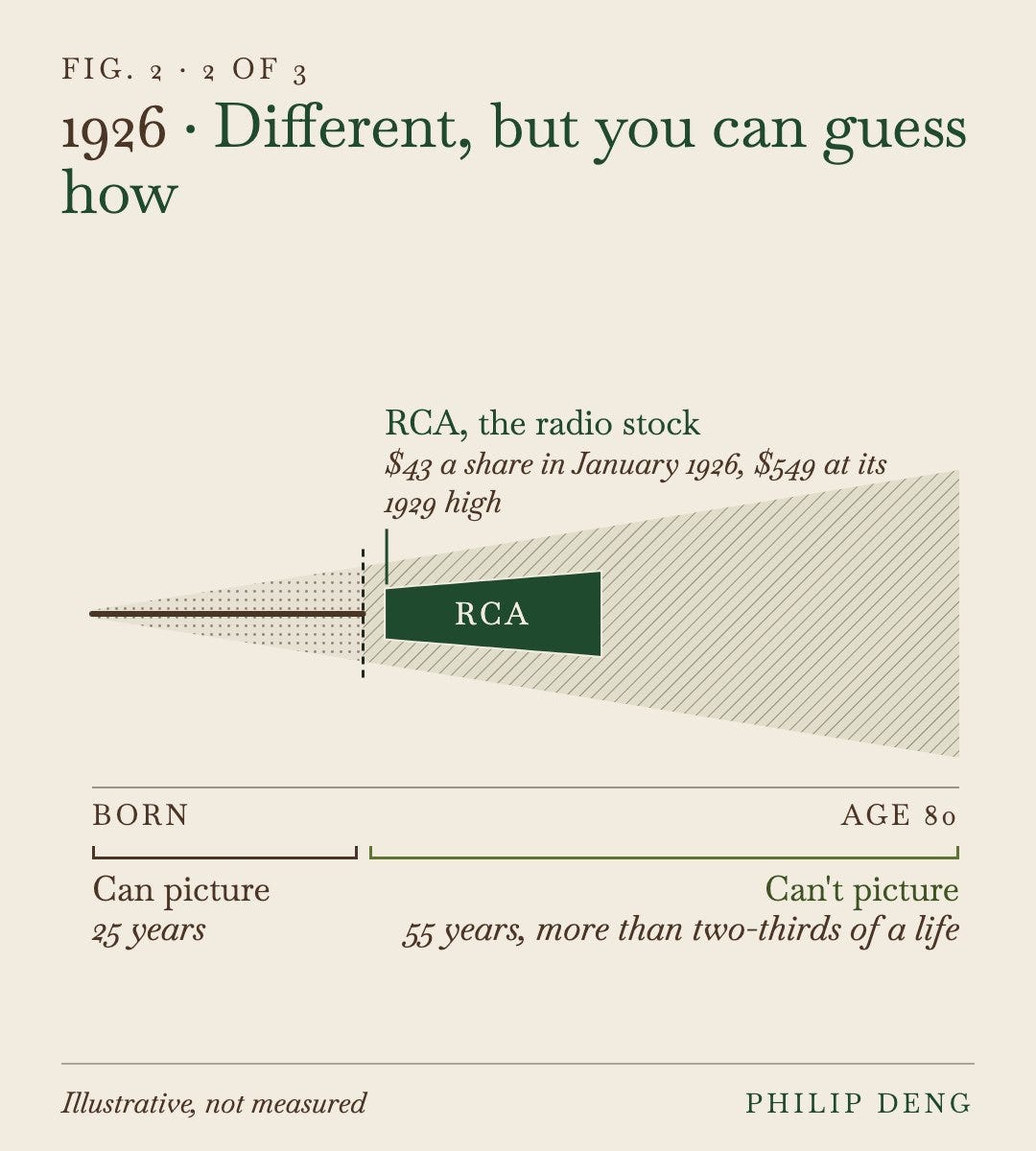
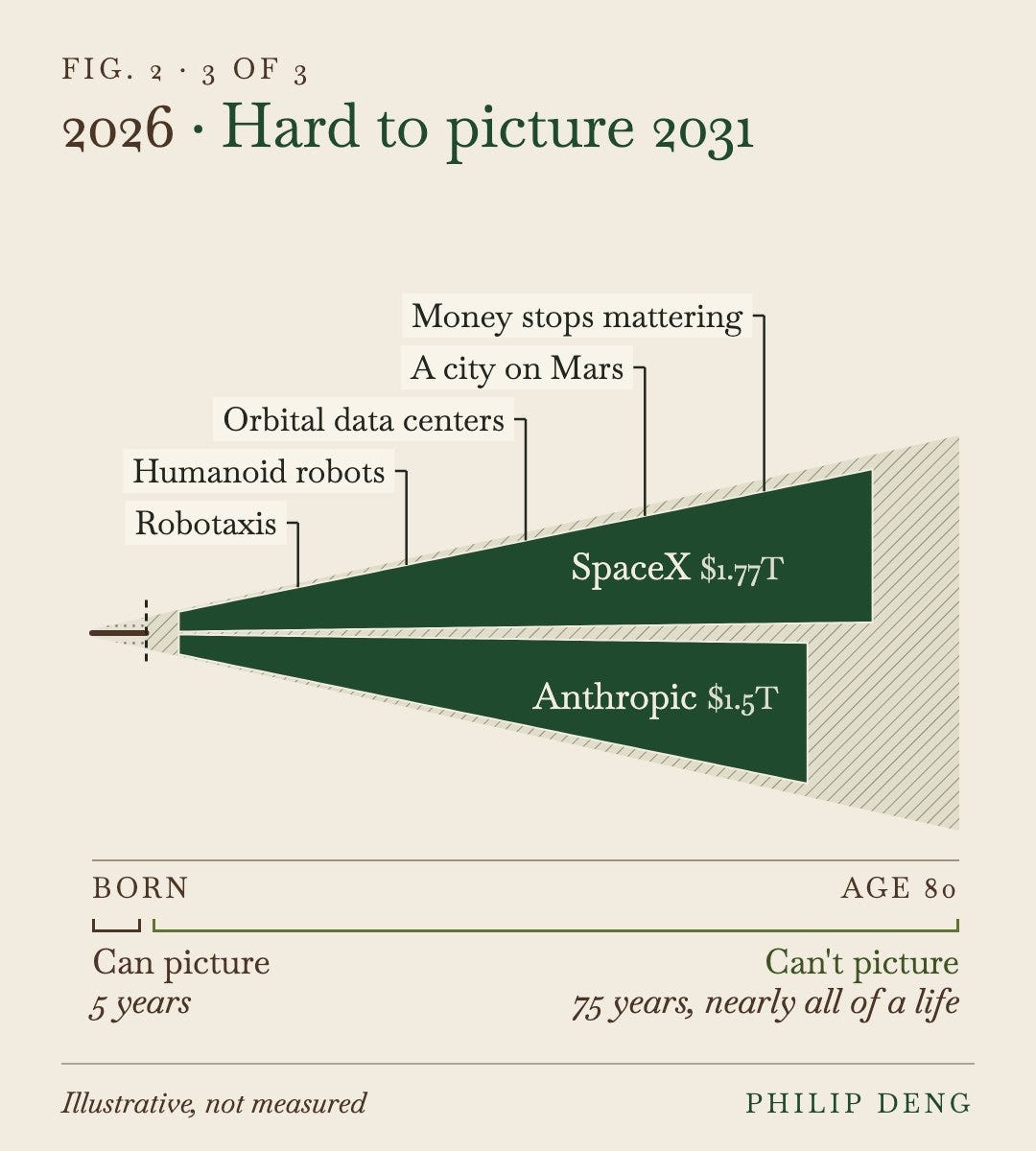
Now, if Musk had lived in Paris in 1784, a few months after two men first floated over the city in a balloon,16 his ability to pull from the future would have been much more limited than it is today. What are the wildest innovations he could have gotten away with back then? “Balloon service from Paris to Peking within two years, maybe sooner.” “A self-sustaining city in the clouds above Versailles by 1790.” “Horses are finished. Fully self-steering carriages by next spring, for real this time.” Would he have the same cult following back then with these ideas?
What Musk first and most skillfully realized is that our species’ ability to apply and compound knowledge has reached an inflection point where one effect of our technological innovation is to have made our near future truly unpredictable. It’s entirely possible that in ten years we could really have reliable prevention and treatment of nearly all natural infectious disease,17 or in twenty, humanoid robots doing most of the world’s physical work. With so much vast, indecipherable future visionary space available to claim, Musk and his ilk are monetizing it.
So many once wildly implausible gambits are no longer easily ruled out. A technology like AI, which itself is bending time by scaling the amount of agentic labor we can cram into a millisecond, is the machine that is pulling us into the future and the future toward us.
“What’s really being pushed are the limits of our imagination and credulity.”
Building technology companies has always been about pursuing a daring futuristic vision one may have just enough capital and talent to reach. The main difference today is just how far out those visions can be plausibly extended. As much as the Nasdaq is being stretched, what’s really being pushed are the limits of our imagination and credulity.
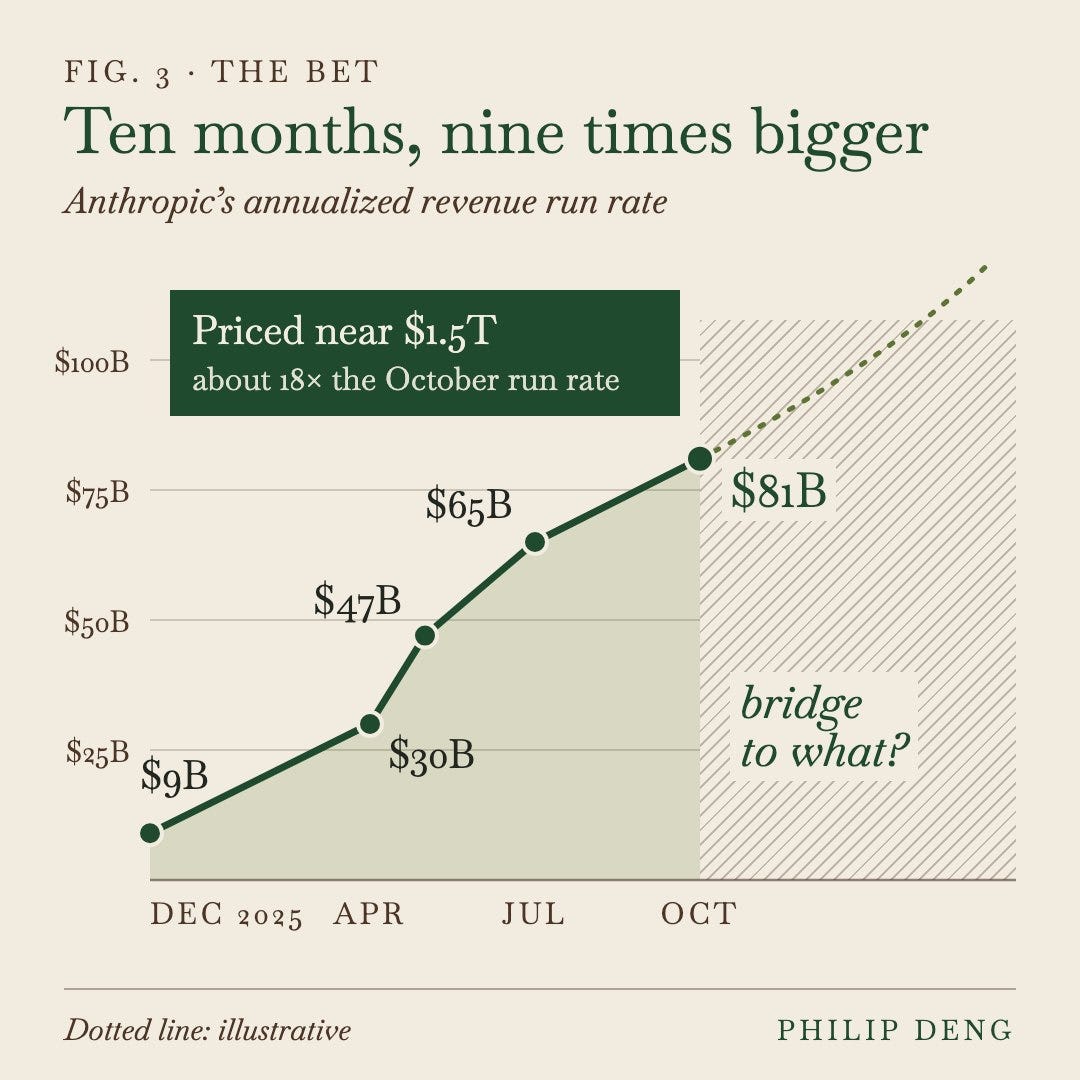
Bridge to what?
Pundits looking at the precarious underlying financial realities of Anthropic see nearly $900 billion in compute commitments, computing costs that ate 55 cents of every dollar of revenue in the first half, a $104 billion loss on paper for the first nine months of the year, and a price of about 18 times its annualized revenue run rate, a bet that this year’s growth keeps going long enough to bridge to what?181920 Through a 20th-century investment lens, this is utter insanity. The only way it appears even remotely rational is if you understand these companies are taking advantage of the rapid compression and opaqueness of our near future.
Stretch our imaginations too
So here’s my call, of course, to my beloved nonprofit sector—can we begin to stretch our imaginations too?
In five short years, Anthropic has created a story the market priced last night at close to $1.5 trillion, fully diluted.21 Yes, their LLMs are world class, and they are devouring billion-dollar software verticals with unrelenting pace and ruthlessness, but the valuation is based mainly on the story they are telling, not on business fundamentals.
The fluidity of this time in human history is not something only tech behemoths can take advantage of. Musk says that if you go out far enough, money will stop being relevant.22 Amodei has floated AI doubling the human lifespan to 150.23 SpaceX’s whole reason for being is “making life multiplanetary.”24 If they can say these things and not only be taken seriously, but be given the reins to our global economic future, what can our sector insist upon?
100% renewable energy? Complete elimination of extreme poverty? Total eradication of curable diseases? Universal medical care? World peace?
All of them. And when we are met with a pat on the head for our Pollyanna-ish idealism, we don’t blink or blush. If Musk and Amodei can keep a straight face, so must we. If anything is possible, then anything is possible. And for my money, a lot of our sector’s wildest dreams are actually much more feasible than, say, colonizing Mars in the next few decades or becoming immortal.
Now, we don’t have global capital markets or investor greed on our side, so I don’t expect a trillion-dollar global food bank or anti-malaria nonprofit to spring up anytime soon. But there is no reason we can’t or shouldn’t elevate the scope of our ambitions and raise our gaze into this increasingly uncertain future of ours. Uncertainty does not necessitate chaos or calamity. Objectively, this moment can be understood as a time of unprecedented fluidity and potential for our species. What are the actual theoretical limits of our purpose-driven visions? What is beyond our wildest dreams for collective thriving?
“If Musk and Amodei can keep a straight face, so must we.”
Wild with hunger
Like many people, I sometimes feel demoralized on days like today when I see such sums of capital and power amassing around people whose goodness and awesome capacity for imagination, I believe, are being subordinated to the supreme profit motive of capitalism. For all their genius and talent, all their actions and decisions ultimately boil down to making more and more money.
But this morning, I’m going to choose to be inspired by them. Not by how much their net worth will skyrocket by 4 PM ET this evening, but by how fervently they believe in a boundless future they are shaping. Again, we will not have their financial resources, but we can match their audacity, and vastly exceed them in the beauty of our sector’s vision.
The pictures tech titans paint tend toward coldness and impersonality. They are thin. A frictionless descent into numb human atrophy. Power funnels endlessly into the hands of an elite cabal. Fundamentally, this is because profit has always been its own end. At first, more wealth improves our situation, but inevitably it continues onward with a life of its own. Its thriving and ours are not intrinsically connected.
If we can appreciate the potential of this moment in human history, and summon our greatest powers of imagination, with unprecedented conviction, I believe the people of the world are eagerly awaiting. I am wild with hunger for a vision of the future that doesn’t make me worry when I look at my infant daughter’s face. What is it? What does it look like? What does it feel and taste like?
Ok, that’s enough. I’m going to have another coffee and let myself imagine what’s possible.
“Anthropic IPO raises over $81 billion in largest offering on record, topping SpaceX,” CNBC, Nov 18, 2026. cnbc.com · “Saudi Aramco Raises $25.6 Billion in World’s Biggest IPO,” Bloomberg, Dec 5, 2019. bloomberg.com
Anthropic PBC, Form S-1, SEC, 2026. sec.gov · CJ Gustafson, “Anthropic IPO: S1 Breakdown,” Mostly Metrics, 2026. mostlymetrics.com
“Anthropic IPO raises over $81 billion in largest offering on record, topping SpaceX,” CNBC, Nov 18, 2026. cnbc.com · “Saudi Aramco Raises $25.6 Billion in World’s Biggest IPO,” Bloomberg, Dec 5, 2019. bloomberg.com
Steven Rattner chart, data from Jay Ritter and Financial Times reporting, via OfficeChai, Sep 22, 2026. officechai.com · “OpenAI Files Confidentially for IPO, Joins Anthropic in Race to Wall Street,” eWeek, Jun 10, 2026. eweek.com
“Paul Christiano – We could be 12 months away from AIs that can overthrow the government,” Dwarkesh Podcast, Nov 16, 2026. dwarkesh.com and “Paul Christiano joins OpenAI Foundation board,” OpenAI, Sep 9, 2026. openai.com
“Dwarkesh Patel: AI Could Overthrow The Government,” The Long Game, Nov 12, 2026. podcasts.apple.com · Show description (hosts Jake Sullivan, President Biden’s National Security Advisor, and Jon Finer, his Principal Deputy), The Long Game, Apple Podcasts. podcasts.apple.com
T. J. H. Morgan et al., “Experimental evidence for the co-evolution of hominin tool-making teaching and language,” Nature Communications 6 (2015). pubmed.ncbi.nlm.nih.gov
Leonard E. Read, “I, Pencil,” The Freeman, December 1958. econlib.org
Pew Research Center, “The Whys and Hows of Generations Research,” Sep 3, 2015. pewresearch.org
Dante LaRiccia, “Overview: Electricity Consumption: Culture, Gender and Power,” Energy History Online, Yale University, 2025. energyhistory.yale.edu
Tim Levin, “Waymo Has Doubled Its Weekly Ridership In Under A Year,” InsideEVs, Mar 26, 2026. insideevs.com
“Moderna Announces First Participant Dosed in NIH-led Phase 1 Study of mRNA Vaccine (mRNA-1273) Against Novel Coronavirus,” Moderna via Business Wire, Mar 16, 2020. businesswire.com
Dario Amodei, “Machines of Loving Grace,” October 2024. darioamodei.com
“Elon Musk says that in 10 to 20 years, work will be optional and money will be irrelevant thanks to AI and robotics,” Fortune, Jan 19, 2026. fortune.com · Fred Lambert, “Tesla pushes Optimus V3 reveal later this year – again,” Electrek, Apr 22, 2026. electrek.co · Rob Stumpf, “Tesla’s Big Robotaxi Promises Fall Flat As 2025 Comes To A Close,” InsideEVs, Dec 31, 2025. insideevs.com · “Elon Musk’s SpaceX Merges With xAI in $1.25T Deal,” TechRepublic, Feb 3, 2026. techrepublic.com · “Mission: Mars,” SpaceX. spacex.com
“TSLA P/E,” Alpha Spread, accessed Nov 19, 2026 (forward P/E about 248 on 2026 estimates). alphaspread.com · James A. Wondrasek, “Inside the Numbers Behind SpaceX’s 94-Times-Revenue IPO Valuation: What Investors Need to Know,” SoftwareSeni, Jun 17, 2026. softwareseni.com
“Balloon flight,” Encyclopaedia Britannica. britannica.com
Dario Amodei, “Machines of Loving Grace,” October 2024. darioamodei.com
“Anthropic IPO raises over $81 billion in largest offering on record, topping SpaceX,” CNBC, Nov 18, 2026. cnbc.com · “Saudi Aramco Raises $25.6 Billion in World’s Biggest IPO,” Bloomberg, Dec 5, 2019. bloomberg.com
Anthropic PBC, Form S-1, SEC, 2026. sec.gov · CJ Gustafson, “Anthropic IPO: S1 Breakdown,” Mostly Metrics, 2026. mostlymetrics.com
“Anthropic’s S-1: the $80.7 billion loss that mostly isn’t one, and the compute bill that is,” Long Yield, Oct 26, 2026. longyield.substack.com · Saskia Koopman, “Anthropic’s growth slows ahead of IPO as AI spending bill nears $900bn,” City A.M., Nov 2, 2026. cityam.com
“Anthropic IPO raises over $81 billion in largest offering on record, topping SpaceX,” CNBC, Nov 18, 2026. cnbc.com · “Saudi Aramco Raises $25.6 Billion in World’s Biggest IPO,” Bloomberg, Dec 5, 2019. bloomberg.com
“Elon Musk says that in 10 to 20 years, work will be optional and money will be irrelevant thanks to AI and robotics,” Fortune, Jan 19, 2026. fortune.com · Fred Lambert, “Tesla pushes Optimus V3 reveal later this year – again,” Electrek, Apr 22, 2026. electrek.co · Rob Stumpf, “Tesla’s Big Robotaxi Promises Fall Flat As 2025 Comes To A Close,” InsideEVs, Dec 31, 2025. insideevs.com · “Elon Musk’s SpaceX Merges With xAI in $1.25T Deal,” TechRepublic, Feb 3, 2026. techrepublic.com · “Mission: Mars,” SpaceX. spacex.com
Dario Amodei, “Machines of Loving Grace,” October 2024. darioamodei.com
“Mission: Mars,” SpaceX. spacex.com