



Welcome to this edition of The Process, a free weekly newsletter and companion podcast discussing the future of technology and philanthropic work.
If you enjoy reading and listening, please consider subscribing and sharing with your community!
Thank you!
Philip
Almost on a weekly basis now, I speak with groups of mostly nonprofit professionals on the subject of incorporating AI tools into their work. I’m invited to join these panels, webinars, and presentations because of my 15-year background in the nonprofit sector, and my current role as CEO of a generative AI software company.
I have yet to encounter an audience that runs out of questions before the end of a session. People are extremely interested in the topic of artificial intelligence and I feel a great sense of responsibility and privilege to effectively share what I know in these spaces.
On that note, if you or someone you know is planning to host an AI + nonprofits conversation and is looking for panelists, please inquire below.
Some common topics of interest include data privacy, plagiarism risks, impact on jobs, and how large language models actually work. At the conclusion of these conversations, my refrain is to encourage attendees to lean into learning about AI, and to highlight the importance of the nonprofit sector’s participation and leadership in this new era of technology.
I’m genuinely upbeat about the positive potential for AI.
While I find these group discussions to be among the most fun and inspiring things I get to do in my job, I’m also mindful of another stark reality I see. In recent weeks, a compelling cohort of the world’s foremost AI experts has testified in Congress and signed onto various statements calling for urgent collective action to avoid catastrophe and I take them seriously.
“Mitigating the risk of extinction from AI should be a global priority alongside other societal-scale risks such as pandemics and nuclear war.”
This grim 22-word declaration was issued this week by the nonprofit Center for AI Safety and co-signed by dozens of leading figures in the field including Geoffrey Hinton, who pioneered the development of the neural networks and is often referred to as a the “godfather of AI”, Google DeepMind CEO, Demis Hassabis, and OpenAI CEO, Sam Altman.
How should we think about working with technology whose creators believe could cause extinction?
Can we opt out or shut this down?

I don’t think we can opt out or go backward, nor do most experts. Thousands of companies, including all the largest technology firms in the world, have made incorporating generative AI a top priority, and billions of people have already been exposed to the power and potential of these tools. Hundreds of billions of dollars are being invested directly in AI companies, and hundreds of billions more in adjacent industries.
Humanity has never been able to halt the pursuit of any form of knowledge. Where we have found some success, or at least avoided catastrophe thus far, is in coordinating policy and prohibitions of particularly harmful uses of powerful technology.

For example, in 2018 a scientist in China announced he had used CRISPR technology to genetically modify human embryos, for which he received condemnation from the scientific community worldwide, a large fine and was sentenced to three years in prison. Yet the same gene editing technology continues to be refined and is yielding important breakthroughs in medicine, showing that with diligence, we can limit bad actors and outcomes while focusing on beneficial uses.
The on-going work to de-escalate and disarm the world’s nuclear powers, and to prevent nuclear proliferation has also been effective in the sense that the two atomic bombs dropped on Hiroshima and Nagasaki in World War II remain the only two instances of this devastating weapon’s use. Almost 80 years later, despite nuclear stockpiles numbering in excess of 13,000 warheads, and the dogged pursuit of these weapons by a number of countries trying to seize geopolitical power — our precarious arrangements hold while nuclear technology continues to advance and may even play a role in mitigating climate change.
Coordination is key.
I found a recent interview with Tristan Harris, co-founder of the Center for Humane Technology, held several insightful frameworks that help me to better grasp our situation.
3 Rules of Technology
When you invent a new technology, you create a new class of responsibilities.
If the new technology you invent confers power, it will start a race.
If you do not coordinate that race, the race will end in tragedy.
Tristan Harris
With regard to AI, the race is definitely on, and we are still within the limited window in which we have the opportunity to determine whether it’s a race to the bottom, or to the top.
Many of us are familiar with the prisoners dilemma where individuals acting in self-interest do not arrive at the optimal outcome, which can only be reached through cooperation. If major AI firms and nations act primarily from self-interest, we will find ourselves in a race to the bottom at speeds never before seen in history.
Conversely, if leading technology companies and governments can coordinate an approach to AI development and deployment, there is reason to believe a race to the top could yield magnificent breakthroughs to alleviate certain global-scale afflictions more quickly than any of us could ever have imagined.
One major advantage.
One way in which AI differs from, say, nuclear or gene editing technology, is that regular people have direct access to it. You can, right now, go engage directly with one of the most powerful AI systems ever developed. Multiple U.S. Senators used ChatGPT to create parts of their opening remarks in a recent hearing on AI, and because these lawmakers were able to experience, first-hand, the power of this technology, we are seeing early activity at these high levels of our government.
Understanding is a precursor for cooperation, and the fact that anyone with an open internet connection can experience the awesome abilities of large language models and immediately grasp their significance, is a major advantage in this challenge we face. Whereas issues like climate change and nuclear war require considerable effort to rouse the levels of attention they deserve, fortunately we don’t have to work as hard when it comes to AI.
Pre-tragic, tragic, and post-tragic.
We all have the opportunity to engage with and understand what we’re dealing with in AI, and once we do, the most difficult work of building consensus can begin. In the same interview I referenced above, Harris shared another useful construct that organizes an emotional dimension of the AI challenge, which I paraphrase here.
Pre-tragic: Someone who denies tragedy and stays in naive optimism.
Tragic: Someone stuck in tragedy who becomes depressed, nihilistic, and suffers.
Post-tragic: Someone who has accepted and grieves a tragedy and is ready act upon reality.
When confronted with the realities we face as humanity enters the AI age Harris describes how people can move between these three categories of emotional experience. The poet Robert Frost famously addressed the subject of tragedy writing, “The best way out is always through.” I agree, the way is through.
This is how I think about my role and responsibility, not only as a career nonprofit professional and AI entrepreneur, but as a member of myriad communities we are all part of. I seek opportunities to get my hands on the stuff, trying out all kinds of different AI applications to increase my familiarity with them. I read and listen to experts like Gary Marcus, rely on journalists like Ezra Klein and Kara Swisher to bring me into the room with key players. Finally, I contemplate criticism, including that which is directed at me and my company, which my ego would often prefer I ignore.
This describes my process to build self-awareness to continually clear away pre-tragic or tragic narratives I may fall into from time to time. When I’ve reached a place of acceptance and grounding in reality, I try my best to share what I have learned, and to offer a hand to others on the same journey to find our way through.
Thanks for reading this edition of The Process. Please share and comment or you can email me at philip.deng@grantable.co
Philip Deng is the CEO of Grantable, a company building AI-powered grant writing software to empower mission-driven organizations to access grant funding they deserve.
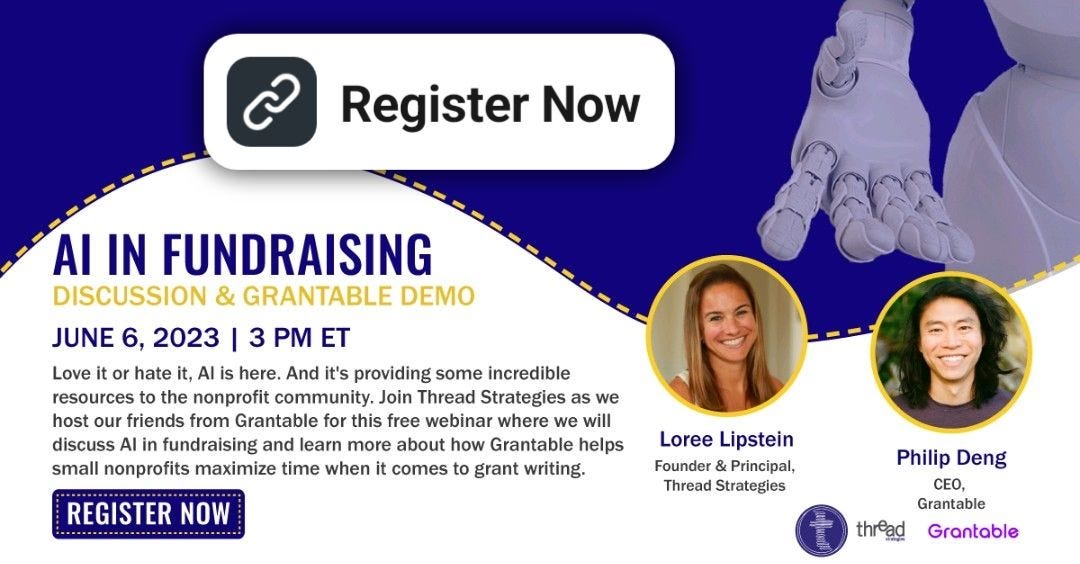
I’m very excited to join Thread Strategies and Loree Lipstein for a conversation about #ai and #fundraising.
These opportunities are where I regularly encounter the most thought-provoking questions. Please join us!