


Welcome to this edition of The Process, a free weekly newsletter and companion podcast discussing the future of technology and philanthropic work.
If you enjoy reading and listening, please consider subscribing and sharing with your community!
Thank you!
Philip
The debate between AI optimism and pessimism misses the point. Our imperative is to be collaborative and proactive to guide artificial intelligence toward positive human and planet-centered outcomes. Ideally, those of us who are giddy with excitement and others watching this technology with dread, can merge our viewpoints into a panoramic horizon of threats and opportunities to address, together. And, we must do so now.
Why isn’t it an option to sit this one out? One word — speed. As a function of virality (ChatGPT is, by far, the fastest growing app in history) generative AI technology is moving much more quickly than any technology humans have ever created. The speed of its spread will mean the impact of AI technology will soon be unavoidable.

The AI gold rush is on. I see it from my seat leading an AI startup company as investors who, prior to ChatGPT, weren’t grasping our value proposition, and are now coming forward with renewed interest. We’re one of tens of thousands of companies pursuing ways to harness the abilities of large language models (LLMs). This includes all of the largest firms like Microsoft ($10B investment in ChatGPT-makers, OpenAI), Google, Meta, Amazon, and Apple. There is a tidal wave of hundreds of billions of dollars of investment that will wash into this sector over the next few years to accelerate innovation and deployment of generative AI products.
AI’s rapid rate of adoption is only one dimension of speed we need to pay attention to. The other, arguably much more important factor is the speed with which AI is improving and expanding its capabilities. Powering the forward blur of proliferating AI skills is the ability of modern AI systems to improve by learning and generating new iterations of themselves.
Ask yourself, what happens when a machine dedicates the effort of trillions of calculations per second to continuous self-improvement? Remove any limits you may have in your imagination because the answer will likely blow past all of them.
One axis upon which to plot AI’s functional gains is by the information density of its generative outputs. Tracing this line helps to indicate in rough terms where generative AI is headed and where it may be most disruptive. To explain what I mean by information density, consider the saying, “A picture is worth a thousand words.”
Next, read this description from a listing on AirBnb.
The spacious bungalow for up to 4-6 people, surrounded by tropical vegetation, has a bedroom with a large double bed. The light-filled living room with fully equipped kitchen and access to the private bathroom also has a comfortable sofa bed for two people. A ladder leads to the gallery, where two mattresses can be placed on request as sleeping arrangements for two more persons. The large balcony with a great view of the jungle invites you to relax.
Now consider the same listing along with some of its pictures.


Images have much higher information density than text alone. Videos, which add sound, movement, and a temporal dimension, have even higher information density than images. Generative AI is making rapid progress along this axis, creating ever more realistic forms of content. This will likely continue with more immersive forms of digital content including augmented reality, virtual reality, and someday potentially content we receive through direct neural linkage.
Even without a Vulcan mind meld or funky VR goggles, this direction is important to note because when information density is high-enough — I saw it with my own eyes! — our brains tend to recognize this as reliable information about the world around us. We’ve never had serious reasons to believe otherwise.
As generative AI creates images, voices, and videos that are indistinguishable from reality, we will need to reinvest in ways of anchoring ourselves to offline sources of truth and community, and also create new tools, policies, and norms for our digital lives, as well.
Finally, to give you an idea of where we are right now, last week, OpenAI released GPT4, which in addition to being much better at writing, is also purported to be capable of “multi-modal” functionality, meaning it can operate between content types.
In a live demonstration of this technology at SXSW last week, GPT4 took a rudimentary hand-drawn picture of a website — a sketch you might draw on a napkin to show a friend — and almost instantaneously transformed it into a real functioning website.

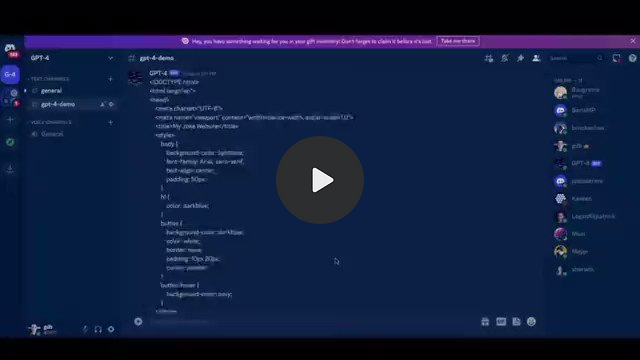
To breakdown the profundity of what is happening here, the model recognized the artist’s intent despite the vagueness of the rudimentary hand drawing, it correctly identified the elements of the site and the implied functionality, and then wrote HTML to produce the desired page.
Like many of you, I’m still catching my breath from ChatGPT and now we’re confronted with GPT4 crossing between multiple formats of digital input and output. It may soon be possible for someone to sketch a hit pop song or sing an impressionist painting.
This week’s post is intentionally high-level because that is the vantage point needed to comprehend the implications of technology moving so quickly, both in terms of adoption and capability. Over the weekend, Ezra Klein shared a special episode on his podcast where he addressed the hazard of such haste, and the weirdness we’re beginning to perceive as reality bends to incorporate emergent AI.
I think one of two things must happen or should happen. Humanity needs to accelerate our adaptation of these technologies or governance to them or of them, or a collective enforceable decision has to be made to slow them down. And even doing both may not be enough. What I don't think we can do is put these systems out of our mind, mistaking the feeling of normalcy for the fact of it.
Ezra Klein
While AI is not inherently good or evil, we know human beings will use it as a means to both ends. We will create new crises with this technology, and we will also create tools and techniques to solve them.
Unlike the climate crisis, which is unfolding on a timescale of decades, AI calamities will take place over mere weeks and months because of how fast-paced and interconnected the digital world is. Could the immediacy and frequency of these problems act like a defibrillator to shock increasingly self-interested nations back into rhythms of global collaboration?
That is my hope, but admittedly it’s a long shot. Each of these inevitable disruptive AI events will be a problem that can only be solved through coordinated global action, each one will be an opportunity to seize or a failure to learn from, and our greatest test will be to come together before it’s too late.
If we succeed, the amount of human potential that could be realized is likely the only thing that can make the awesome power of AI seem small by comparison. Our brains are still vastly more sophisticated than even the most powerful large language models and there are 8 billion human brains on this planet, each with the ability to limitlessly amplify the potential of others. That’s a lot of reasons to keep going, to find a way forward, together.
Thanks for reading this edition of The Process. Please share and comment or you can email me at philip.deng@grantable.co
Philip Deng is the CEO of Grantable, a company building AI-powered grant writing software to empower mission-driven organizations to access grant funding they deserve.

Webinar REPLAY: Unlocking the Potential of AI for Nonprofits: Overcoming Fear with Curiosity
As Artificial Intelligence grows in usage in society, what does it mean for nonprofit and philanthropy? How should we feel about it? How would we use it? Can it take on some tasks like grant applications? What are the ethical and equity considerations? Will it take over our jobs?
Watch this conversation with Beth Kanter and Allison Fine, authors of The Smart Nonprofit, Philip Deng the creator of Grantable (an AI-supported grantwriting platform), and Vu Le of NonprofitAF.com
Transcript enabled
Air date: Mar 14, 2023 09:30 AM PT / 12:30 PM ET