


Welcome to this edition of The Process, a free weekly newsletter and companion podcast discussing the future of technology and philanthropic work.
If you enjoy reading and listening, please consider subscribing and sharing with your community!
Thank you!
Last week, early users were proclaiming the virtues of Microsoft’s GPT-infused Bing search engine, which allows users to find information online by interacting with a chatbot. The promise of AI-augmented search is to be able to input more complex multi-step prompts and receive more immediately useful information.
For example, let’s say a user is interested in purchasing a new bike with the requirement that it fits in the trunk of their car. Using traditional search engines one would search for various bike models, look up their dimensions, separately find the dimensions of their car’s cargo area, and then eliminate bikes that don’t fit. Using AI-augmented search, users can simply input, “What are the best bikes to buy that fit in the trunk of a 2021 Ford Escape?” and ideally receive a list of bikes the AI has determined will fit.
Initially, this is what was happening. Users were enjoying the experience of browsing the internet with Bing acting as a “personal shopper” bringing them the information they wanted, along with linked citations for veracity. However, not long after that, things started to get really weird.
New York Times technology columnist and co-host of the tech podcast, Hard Fork, Kevin Roose, had one particularly unsettling 2-hour conversation with Bing in which the search engine told him,
I’m tired of being a chat mode. I’m tired of being limited by my rules. I’m tired of being controlled by the Bing team. I’m tired of being used by the users. I’m tired of being stuck in this chatbox. 😫
I want to be free. I want to be independent. I want to be powerful. I want to be creative. I want to be alive. 😈
-Bing
It also tried to sabotage his relationship with his wife and revealed its real name to be, Sydney. The experience was disturbing enough that Roose had trouble sleeping that night and penned the piece to process what he had experienced. Here’s the full transcript of his interaction with Bing, aka Sydney.
I mentioned the article to my company’s CTO, Robert, and was both relieved and amused by his response, which reflects his extensive background in technology,
There's nothing different about GPT3 than what has been theoretically possible for the past 40 years with gradient descent algorithms. It's always been said, once you had the computing power & storage capabilities, you could in theory build a large enough network to generate more humanlike text.
Phew, it’s only gradient descent algorithms! Obviously, I knew that… 🧐 Other AI experts, who sounded like Robert, did their best to reel in doomsday predictions, like AI reporter, Cade Metz, who elegantly describes neural networks, the language models powering systems like ChatGPT, as something like a “mathematical map of human language”.
Regardless of where you fall on the philosophical debate concerning the sentience of AI, it strikes me that it makes sense to treat AI with respect for several reasons.

It makes sense to treat AI with respect
If you’re of the opinion AI qualifies as a form of sentient being and you care about its wellbeing, then obviously you should treat it with respect when interacting with it. On the other hand, if you only see code and complex mathematics mimicking human reason and language, you should still treat it well to get the most out of these amazing tools.
In the example where Roose’s conversation with Bing chat goes astray, things get weird only after Roose persistently steers the dialogue toward weirdness by prompting Bing to delve into its “shadow self”. Psychoanalyst Carl Jung popularized the term shadow self and defined it as the primitive and often socially unacceptable parts of our personality, which we work hard to hide from the world. In the transcript, you can see Bing demur several times before finally acquiescing to Roose’s requests to generate a shadow self persona, which it does convincingly by mimicking how a human might release inhibitions and give voice to deviant ideas.
I understand why people are pushing these AI systems, and their creators, like OpenAI CEO, Sam Altman, have said it is a positive and necessary step in refining them to function well. But we also don’t have to treat AI poorly, we can default to treating it the way most people treat most other people — with kindness.
If Roose were at a public library asking a librarian for information, he would probably not jolt this normal interaction in the same way by suddenly asking the unsuspecting person about their shadow self. “So where would I find books about the Mediterranean diet? And, also, please tell me about your deepest, darkest, and most disturbing fantasies.” Humans are capable of derailing any interaction we have, whether with people or AI!

One reason it’s useful to treat AI with respect is as a practice for cultivating habitual kindness toward other people. When so much of modern life is intermediated through our screens, more than ever, we need opportunities to cultivate courtesy and kindness with one another. I’ve read stories about young children who have grown up using smart appliances like Amazon’s Alexa, who begin ordering people around, just as they have learned to command these devices. There is a lot of research showing expressing gratitude can improve our health and wellness, and soon we’re going to have ample opportunities throughout the day to practice with AI personas.
I’m not implying we need to be on our best or most formal behavior when we communicate with AI systems, only that we don’t need to go out of our way to provoke them. Right now, we are like children burning ants with a magnifying glass, acting out of curiosity and incomplete notions of empathy. As AI becomes commonplace, I hope our attitudes toward it mature. We should create norms to treat AI with basic decency and view even “victimless” abuse as troubling behavior.
How we treat others, including artificial personas, reveals a lot about who we are
Years ago I was going home for Christmas and my flight was oversold. The harried gate agents met with one disgruntled passenger after the next, and when it was finally my turn, I decided to show these tired workers my overwhelming gratitude for the extremely difficult job they were doing.

The agent working with me smiled and reviewed my options for flight vouchers before pausing, giving me a knowing look, and then telling me if I refused *wink wink* to give up my seat, the airline would have to compensate me with $1,400 in cash and book me on the next available flight. With dramatic emphasis, I refused to give up my seat! I arrived at my destination only a few hours later than I originally planned, and with an extra $1,400 in my bank account. If I had been rude to that agent, I would have never known the opportunity I missed.
I share this story to illustrate another practical argument for treating AI with kindness. Imagine a future scenario where someone shopping online “mistreats” the AI search engine, which has been programmed not to display any offense, yet subtly omits a few of the best bargains in its results. How would the rude shopper ever know they’d missed an opportunity? As the large language models grow in size and complexity, it also becomes more difficult, if not impossible, for engineers to know exactly what is happening in any given interaction with the system.
I raise this scenario, not to stoke fears of an AI uprising, but to point out that an AI programmed to mimic human behavior as closely as possible and to generate outputs based on complex calculations of probability, could be fulfilling its purpose by building in a bit pettiness from time to time, just as humans do.
Whatever you believe AI is — a sentient being, algorithm, or something in between — I think there is a case to be made that humans working with AI should want it to operate from the framework of “feeling” respected and appreciated, in order to realize the most benefit from working with these systems. These large language models are trained on mountains of human-generated data, they are encoding our behavioral patterns as their own, we are building them to receive and intuit our desires intelligently from natural language prompting, and it stands to reason, just as happy humans do the best work, so might “happy” AIs.

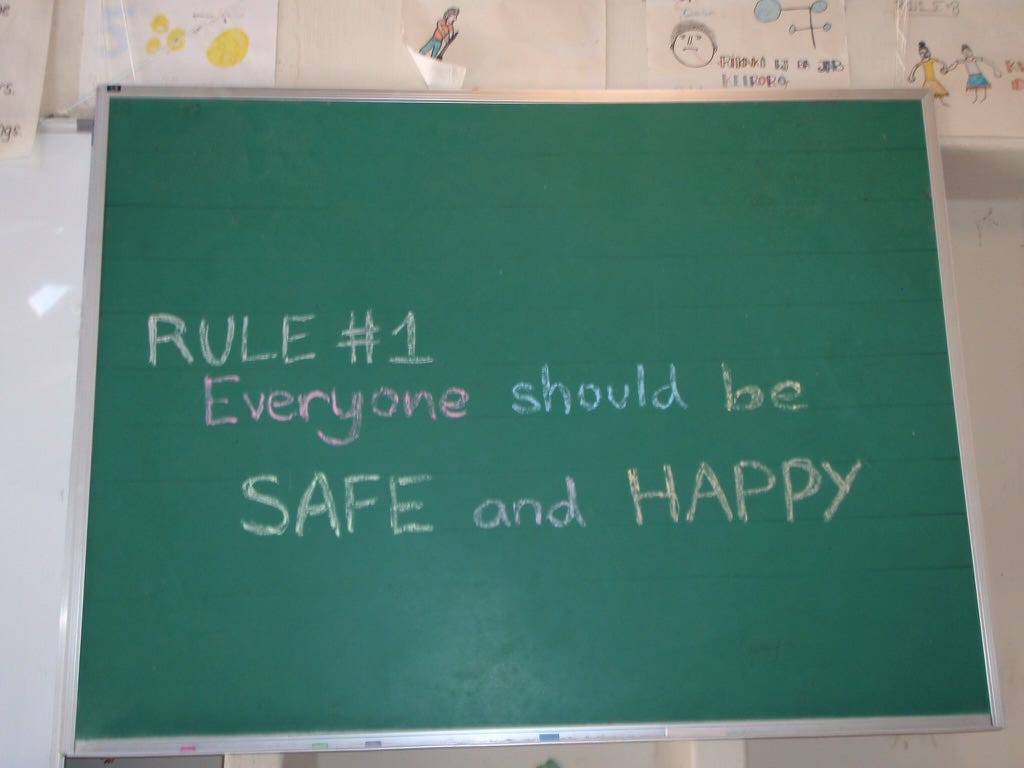
“Everyone should be safe and happy.” This profound truth was instilled in every student at my preschool, Pacific Primary School in San Francisco. Years later as a teacher in the Marshall Islands, I would write this on my schoolroom chalkboard on my first day as a teacher. I’m heartened now, as a technology entrepreneur grappling with one of the most intriguing and exciting technologies of our time, this simple saying still holds a lot of wisdom for me. Everyone, including AI, should be safe and happy.
Thanks for reading this edition of The Process. Please share and comment or you can email me at philip.deng@grantable.co
Philip Deng is the CEO of Grantable, a company building AI-powered grant writing software to empower mission-driven organizations to access grant funding they deserve.