



Welcome to this edition of The Process, a free weekly newsletter and companion podcast discussing the future of technology and philanthropic work.
If you enjoy reading and listening, please consider subscribing and sharing with your community!
Thank you!
Philip
I foolishly believed the recency of GPT4’s release, OpenAI’s latest and most powerful large language model (LLM), meant I had a window of opportunity to work on a non-AI post before needing to address the next major development in the world of artificial intelligence.
Oops.
Last week, I highlighted two dimensions of speed we should pay attention to as we track the progress of generative AI systems like ChatGPT — the rate of increasing capability and the rate of adoption. The announcement of GPT4, a model vastly larger and more capable than its predecessor, GPT3, is an illustration of the speed at which AI capabilities are improving.

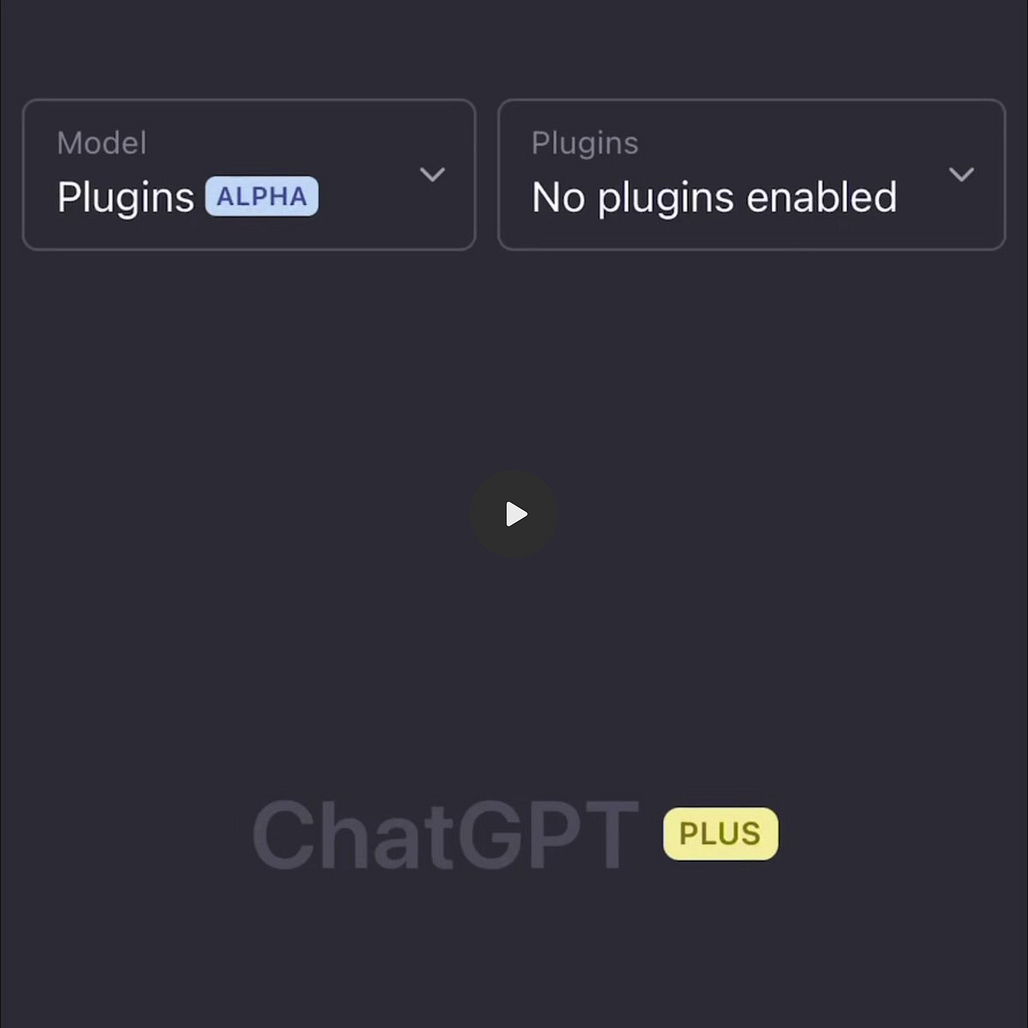
Also last week, OpenAI announced the release of plugins for ChatGPT, a feature allowing the chatbot to connect and interact with other software systems. This development captures the second form of speed, which is just how quickly the world is adding generative AI technology to all of our existing systems.
Here is how OpenAI describes how plugins work,
Though not a perfect analogy, plugins can be “eyes and ears” for language models, giving them access to information that is too recent, too personal, or too specific to be included in the training data. In response to a user’s explicit request, plugins can also enable language models to perform safe, constrained actions on their behalf, increasing the usefulness of the system overall.
In the first cohort of plugins are household names like Expedia, Instacart, and OpenTable. Wolfram Alpha, a powerful online computational resource known for helping users answer complex mathematical and scientific queries, is a notable connection because this seems to solve one of ChatGPT’s most glaring prior shortcomings — the inability to do math. Plugins combine GPT linguistic abilities with the real world functional and factual assets from these other companies and datasets.
In the one-minute demo below, Greg Brockman, Co-founder and President of OpenAI, the makers of ChatGPT, demonstrates how to use and combine plugins. He asks the chatbot for vegan dining advice for a weekend in San Francisco and instantly receives a restaurant recommendation from OpenTable, a recipe likely generated by ChatGPT, itself, which is then broken down by caloric content by Wolfram Alpha, and, finally, the entire shopping list is assembled (for real) in Instacart, leaving Brockman one click away from placing his grocery delivery order for the ingredients required to make the dish.

Many are comparing this moment to the unveiling of Apple’s App Store in 2008. While the App Store is undoubtedly one of Apple’s most strategic and world-shaping creations, I think this milestone may represent something even more profound.
While the App Store along with the iPhone expanded my ability to operate online, ChatGPT plugins, first and foremost, increase the AI’s ability to operate online. The amplification of ability is occurring far upstream of where humans interact with the software, within the software itself, meaning the downstream implications for us are likely far greater.
To me, the most significant piece of information getting somewhat lost in the hype around all these tantalizing new functions is the way in which plugins are created — which is, of course, you just tell ChatGPT to create them.
Using natural language, simply describe the architecture and protocols of a particular system and the AI figures out how to navigate and handle information. The profundity of this is still sinking in for me. It’s as if the native speaker of the world’s programming languages has finally arrived on earth in the form of these large language models.
It’s as if the native speaker of the world’s programming languages has finally arrived on earth in the form of these large language models.
Despite being the authors of the world’s digital infrastructure, the world’s best software engineers are, in many respects, no longer the most fluent operators in their preferred programming languages. Until now, the term digital native was used to describe people who have grown up in the information age, and now I’m not so sure that term is best applied to humans at all.
Let’s remind ourselves what GPT and other similar large language models really are — super powerful digital pattern recognizers (and synthesizers). Programming languages are strictly rules-based, which is what makes them so suitable for these models to understand. Unlike, say, human language, which is full of quirks and idioms and is constantly evolving, code is much more rigidly structured and logical, meaning the patterns are vivid and reliable. This helps to explain why with just a few basic instructions, ChatGPT is almost instantly able to navigate and leverage plugin-connected data.
The ability to command cohorts of powerful software systems with simple prompts presents us with the classic choice between convenience and control, only this time the stakes are unprecedented. We will gain unfathomable new abilities while losing control over our data in ways that are extremely difficult to anticipate or measure.
Observing the boundary between the analog and digital world has never been more important because the moment we create digital data, we must understand it now exists in a space where humans are at an inherent disadvantage compared to the new digital natives. Agency will increasingly be a question of attention, of whether or not we realize when we are crossing over the line.
Thanks for reading this edition of The Process. Please share and comment or you can email me at philip.deng@grantable.co
Philip Deng is the CEO of Grantable, a company building AI-powered grant writing software to empower mission-driven organizations to access grant funding they deserve.

Webinar REPLAY: Unlocking the Potential of AI for Nonprofits: Overcoming Fear with Curiosity
As Artificial Intelligence grows in usage in society, what does it mean for nonprofit and philanthropy? How should we feel about it? How would we use it? Can it take on some tasks like grant applications? What are the ethical and equity considerations? Will it take over our jobs?
Watch this conversation with Beth Kanter and Allison Fine, authors of The Smart Nonprofit, Philip Deng the creator of Grantable (an AI-supported grantwriting platform), and Vu Le of NonprofitAF.com
Transcript enabled
Air date: Mar 14, 2023 09:30 AM PT / 12:30 PM ET