



Welcome to this edition of The Process, a free weekly newsletter and companion podcast discussing the future of technology and philanthropic work.
If you enjoy reading and listening, please consider subscribing and sharing with your community!
Thank you!
Philip
Negativity bias
Human beings come equipped with strong threat detection systems, which have been key to our survival throughout the ages. Just because lions no longer lurk behind the bushes in most of our neighborhoods, doesn’t mean our brains have stopped scanning our surroundings for signals of danger. Given its power, reacting to generative AI technology with any combination of suspicion, hesitance, or concern is a very reasonable instinctual response.
Our modern media environment is also increasingly tuned to exploit negativity bias to generate clicks and profit. When Goldman Sachs first issued this report the statistic outlets latched onto was the prediction that 300 million jobs could be impacted or replaced. If it bleeds (jobs) it leads.
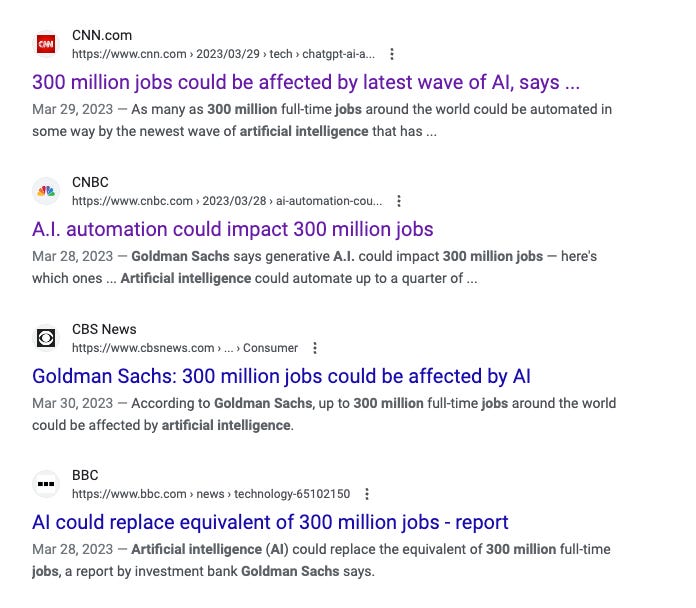
When we look at AI, negativity bias shows up as a tendency to focus on potential harm caused by familiar things being taken away, and greater difficulty imagining new opportunities.
Positive thinking
Now, six months since ChatGPT took the world by storm, I’m beginning to sense a subtle shift in the narrative, which is to consider the possibility that generative AI could end up creating more jobs than it will replace. In the same report from Goldman Sachs, one statistic in particular jumped out to me,
60% of today’s workers are employed in occupations that didn’t exist in 1940
The report goes on to extrapolate, “85% of employment growth over the last 80 years is explained by the technology-driven creation of new positions.” Furthermore, world population has roughly tripled in that time, which likely underscores the importance of continually creating new job types to accommodate the rapidly expanding global workforce.
It’s possible AI could result in net job losses, but that seems unlikely given longstanding historical trends. We have many examples — from the sewing machine to the computer — where inventions people feared would destroy jobs actually launched new industries. For millennia, humans have invented technologies, that reshape our economic systems, to which we adapt. I suspect this is the same cycle taking place now.
The ChatGPT of the 1800s

Welcome to this edition of The Process, a free weekly newsletter discussing the future of technology and philanthropic work. If you enjoy the writing, please consider subscribing and sharing with your community! Thank you for reading!
The bigger picture
Trying to predict which jobs will disappear and which new ones will emerge is useful in so far as it can help people whose roles are most vulnerable to AI disruption to adapt.
However, lingering on this debate for too long risks losing the forest for the trees. Another very likely outcome of AI innovation will be the creation of an enormous amount of wealth. Whatever the final equation of jobs created - jobs lost is, its sum will be trillions of dollars, most of which will flow to powerful people and organizations.
Creating new tools and technology is comparatively simple and, frankly, more fun than changing the systems and policies we use to capture and allocate the wealth they create. As the author, Ted Chiang, writes in this brilliant New Yorker essay,
The tendency to think of A.I. as a magical problem solver is indicative of a desire to avoid the hard work that building a better world requires. That hard work will involve things like addressing wealth inequality and taming capitalism. For technologists, the hardest work of all—the task that they most want to avoid—will be questioning the assumption that more technology is always better, and the belief that they can continue with business as usual and everything will simply work itself out.
Ted Chiang
The nonprofit sector is dedicated to, as Chiang puts it, “the hard work that building a better world requires.” He calls on technologists to interrogate their assumptions and to enrich their thinking by adding perspectives that are already commonly held in our sector. I agree this would be an extremely positive shift for silicon culture to make.
Just in case that doesn’t happen quickly enough, those of us dedicated to human and planet-centered work, who already have our hands in the hard work, can reciprocally begin to think more like technologists.
I often chuckle politely when people joke about how notoriously un-tech-savvy the nonprofit sector is, but this stereotype grows less funny to me by the day. The work we’re engaged in is too important for this characterization of our methods to be even remotely accurate.
I’ve known hundreds of people who have moved from nonprofit sector roles into the private sector and none of them has had trouble adapting to the work, or the tech for that matter. If anything, they find the transition easy going from working on solving overlooked, unsexy, and intractable problems with insufficient resources, to the opposite. The nonprofit sector is gritty, resourceful, and fully capable of realizing the benefits of technology. As Chiang notes, AI is not a magical problem solver. We are the problem solvers — AI and other technologies are kinds of magic we can use to help us get the hard work done.
Join me and Connective Impact for a FREE Interactive Workshop on June 28, 2023 at 8 AM PT / 11 AM ET

Using Artificial Intelligence (AI) in International Development Fundraising.
Learn how to incorporate AI in your proposal writing.
Thanks for reading this edition of The Process. Please share and comment or you can email me at philip.deng@grantable.co
Philip Deng is the CEO of Grantable, a company building AI-powered grant writing software to empower mission-driven organizations to access grant funding they deserve.
Really interesting observation on the need to create new tools and technologies (wealth creation) vs evolving the systems and policies (wealth distribution).
To contrast this with the the US observation you illustrate - some small first world economies (i.e. Singapore) can only monetize wealth creation through global markets and have chosen to glamorize the systems and policies aspects through strong public sector roles.