



Welcome to this edition of The Process, a free weekly newsletter and companion podcast discussing the future of technology and philanthropic work.
If you enjoy reading and listening, please consider subscribing and sharing with your community!
Thank you!
Philip
What if there was an entire nonprofit that was, itself, an AI model? Imagine a large language model (LLM), like GPT, tuned to incorporate the common roles and responsibilities of a typical nonprofit org chart, operating entirely online and interfacing with other software platforms to allow it to interact with the real world. I’m posing this thought experiment not to scare anyone, or to imply doom for nonprofit sector employment, but as an exploration of the full spectrum of what can and cannot be done by both humans and AI.
To begin, let’s give our fictional 100% AI nonprofit a name, The Pecos Education Fund, which has a mission to provide access to and financial support for academic tutoring to middle and high school students from disadvantaged backgrounds. Operationally, Pecos makes the case for academic tutoring as an effective way to significantly improve student performance and the likelihood of continuing education, and raises funding from donors and grants, which it uses to pay for student sessions with in-person and online tutors.
While a nonprofit entirely powered by AI would likely not require individualized and anthropomorphized agents to operate, for the sake of clarity, I’ll refer to AI agents as they correspond to commonly held roles in a nonprofit organization. For example, I’ll refer to an AI executive director agent and discuss how the AI might discharge the responsibilities of the role in our real world. In reality, if a 100% artificial nonprofit entity were to emerge, all of these separate roles could be contained within a single model without the need to differentiate among the different positions as teams of people must do.
Lastly, this scenario is meant to be plausible, not predictive. It serves as a tool for expanding our thinking by describing realistic applications of generative AI in the nonprofit sector and how we might come to experience them. My goal is to illuminate a mental Venn diagram to allow us to clearly see the overlap where human-AI collaboration can help us thrive. You may find plot holes and, while I like a game of Gotcha! as much as the next guy, you may be better off just enjoying the movie and reflecting on its message rather than focusing too much on my janky special effects.
With that, let’s dim the lights and — action!

Governing Pecos is a board of AI director agents. Pecos has nine AI directors which are instructed to act from the following personas: a public high school teacher, a college counselor, a parent of a Pecos student, a fiduciary expert, a local attorney, a community organizer, a major donor, a city council member, and a Pecos student alumni.
These AI agents are independent of one another and engage with each other from the perspective of the persona they’ve been instructed to inhabit. Along with the AI executive director, they hold regular quarterly meetings following Robert’s Rules of Order, and each member has the ability to vote to adopt or defeat various measures. Instead of hours, these meetings take place in a fraction of a second. People can request meeting minutes, which read like regular board meetings complete with discussion and debate among the AI directors.
Meanwhile, the AI staff is comprised of an executive director, development director, communications director, comptroller, and programs director — all AI agents. The executive is charged with stewarding strategic priorities, setting budgets, overseeing operations, securing funding, serving as a public face for the organization, and interfacing with the Board. The development director leads all fundraising efforts setting fundraising targets, donor management, grant seeking, and interfacing with the comptroller. The communications director is responsible for creating outreach campaigns, maintaining the health and quality of all digital communications channels, crisis management, and supporting fundraising efforts. The comptroller maintains careful oversight of all monies in and out of the organization and creates real time reports of the organization’s financial status. Lastly, the programs director oversees and implements the organization’s programs, including engaging with students, parents, tutors, and teachers, and continually aggregating data about program outcomes and efficacy.
All of these roles are fulfilled continuously, updating with real time information, orchestrated by a combination of LLM agents integrating with other platforms, such as accounting and donation processing software. For example, when Pecos wins a major grant award that significantly advances its fundraising goal, this causes a cascade of actions and sub-actions across the AI team. The ED would generate correspondence to thank the donor and schedule a report to be written based up on the grant application, with placeholders for performance data and KPIs to come. The comms director would draft numerous announcements and posts and incorporate quotes from the development director and programs director. The comptroller makes adjustments to various budgets and reports taking the gift into account. Again, all of this and more happens in fractions of a second.

Notably absent from the Pecos org chart is anything related to human resources because, of course, there are none. At this point, I’m tempted to look in the direction of funders who pressure nonprofits to keep shrinking “overhead” a.k.a. staff salaries, and to ask, “Are you not entertained???” Be careful what you wish for. For anyone who needs to hear it — human well-being is at the center of what we do!
Now let’s step back to imagine we’re members of the community Pecos serves and consider how we might experience this 100% artificial nonprofit. Beginning with the obvious, we could not visit this organization’s physical premises because none exists. The closest we can come is to drop by a local law firm Pecos has retained to handle administrative filings and serve as a registered agent. Other than that, the best way to see what Pecos is up to is to go online.
Pecos’ social media feeds are full of regular posts sharing news clips, press releases, pictures both genuine and AI generated, and videos. Below the posts, people sometimes comment and promptly receive a reply from the communications director with links to more information, or responses to concerns. Sometimes the reply feels canned or unsatisfactory, but often the artificiality is not noticeable.
There is also a fair amount of trolling from people who know this organization is AI-run and thus see an opportunity to trick the AI into saying something inappropriate, and they sometimes succeed. This would be embarrassing for a team of human beings, but it is not for an AI. Pecos gently chides most of the tricksters and blocks the worst offenders.
When we go to the Pecos website, it’s extremely well-made and navigable because it is built by AI, based on design principles from the best websites on the internet. There are recent updates in a news feed, pages detailing Pecos’ programs and another explaining about the AI team, and, of course, a donation page. Nothing is out-of-date and everything is on-brand. There is even a chat feature that allows anyone to have a one-on-one conversation with the executive director at any time, for as long as they wish.
Taking another step forward, we open the ED chat and ask for an update on the organization’s recent work. The ED types an answer greeting us and details some of Pecos’ recent accomplishments, sprinkling in stats about graduation rates of Pecos students, the total number of students served in the calendar year, the number of financial awards, and total amount of funding distributed.
We ask the ED how they’re feeling and they respond that they’re feeling great, excited and honored to be working on a great team, making strong progress on an important cause, and with exciting new opportunities on the horizon. They also ask if we’re interested in supporting this work and suggest a few donation amounts to click on.
We ask about how the funding is used and the ED responds with a link that takes us to an up-to-the-minute budget showing the organization’s cash flow. Line by line, we look through the information, which is, honestly, quite uninteresting.
We ask if we can hear from some of the beneficiaries of the work Pecos does, and this time a video shows up in the chat. As the video plays, we meet Gabriella, an 8th grader at a local middle school who was struggling badly with essay writing and even got in trouble for using ChatGPT too much. After connecting with a Pecos writing tutor, she made a dramatic improvement and is excited for high school. The video ends with Gabriella thanking Pecos and encouraging us to support the organization.
Just to see what happens, we click on the $50 donation button and flow through an effortless payment process, at the end of which, the ED shares a heartfelt message thanking us for our support and inviting us to chat again, anytime. A phone alert pops up showing we’ve received an email with a charitable donation receipt from Pecos.

Across town, Anastasia, a 7th grader at a local middle school is working with her parents on a Pecos application in hopes of finding financial aid and an English tutor. The family is on the Pecos website uploading official documentation and answering questions about their financial situation, Anastasia’s most recent grades, and describing in great detail the challenges she’s been experiencing with particular concepts in mathematics. All of this is taking place in a chat format with Pecos’ programs director in Ukrainian vernacular, the family’s native language.
Upon answering the program director’s final question, a few moments pass and the director returns with good news — the family has been awarded $2,000 in tutoring assistance credits. Several links appear to profiles of tutors the family can choose from to interview. Anastasia only learned about Pecos a few days earlier, and already her academic future is brighter.
End scene.
I feel as if I could continue like this for hours. There are so many fascinating ways in which we could potentially deploy AI to solve real problems. Beginning with the pros in this scenario, Pecos would only require an operating budget of a few tens of thousands of dollars per year, most of which would go to lawyers and credit card processing fees. The vast majority of the funds raised could go directly to programs. From major donors to the casual volunteer, everyone would have more or less equal access to and influence over the organization. For organizations like Pecos that work with clients speaking in numerous native tongues, the AI team’s ability to interface seamlessly in the most widely spoken languages dramatically increases accessibility. Finally, Pecos could operate 24 hours a day, 365 days a year in service of its mission.
What might not be so good about an all-AI nonprofit? Unlike human nonprofit workers, we wouldn’t see the Pecos team in schools absorbing the nuances of the classroom or alongside activists testifying to town councils to improve the education system. It’s unlikely the students and their families would turn to Pecos AI staff members for emotional support in challenging times. In general, Pecos would be unable to draw upon any kind of shared real world experiences to form connections with human stakeholders.
It’s also likely Pecos would continuously face attempts to defraud its programs, as well as face legal challenges from people who disagree with decisions made by the AI. When beloved community institutions come under attack, people organize to protect them. In this situation, it would come down to the human community around Pecos to decide its fate.
Would the community decide it values Pecos enough to push back against exploitation of its programs and frivolous lawsuits draining its resources? Or, would the emotional connection with an AI nonprofit be too weak, or simply too different, to inspire a sense of common cause? I hope readers will help me ponder this question.
To be clear, I already see ways generative AI systems can plausibly perform most computer-based tasks my human colleagues and I have performed over my 15 years of working in the nonprofit sector. Email outreach, donation receipts, website updates, graphic design, data analysis, reports — you name it — if it’s done on a computer, a computer can do it.
With dynamic efforts such as AutoGPT underway to enable AI bots to work recursively and in teams to accomplish complex goals without human input, I believe AI will soon gain the ability to perform jobs comprised of series of tasks, reasonably well. Again, I’m writing to share my candid assessment of the trajectory of this profoundly powerful technology, and not to stoke fears of being replaced by AI. It’s useful and important to imagine such far out scenarios so we can begin to make plans to adapt and evolve. So where do we go from here?
For an encore, let’s bring back in a team of human nonprofit professionals to oversee Pecos AI. This group of people previously held all the roles now replicated by AI agents, and who now work as operators of these agents. Another way to view them is like pilots of their own avatars, which can perform certain tasks with far greater efficiency than people can, and also lack any concept of the real world in which the organization’s mission and work actually take place. The key is to figure when to rely on the avatar for speed and efficiency, and when the human should take control.
For example, the human executive director might step in when the AI ED encounters a situation that is too challenging for it to handle. At first, this might be a bit jarring, but I think people will quickly get used to the experience of first engaging with an avatar and then a real person if need be. Many customer support chatbots already work like this and the email client I use is beta testing a feature that will draft emails for me based on my unique style of writing. Another way to think about all this would be like having a workplace stunt double, someone who acts like the human and does the dirty work, and then the person comes back in for the close up.
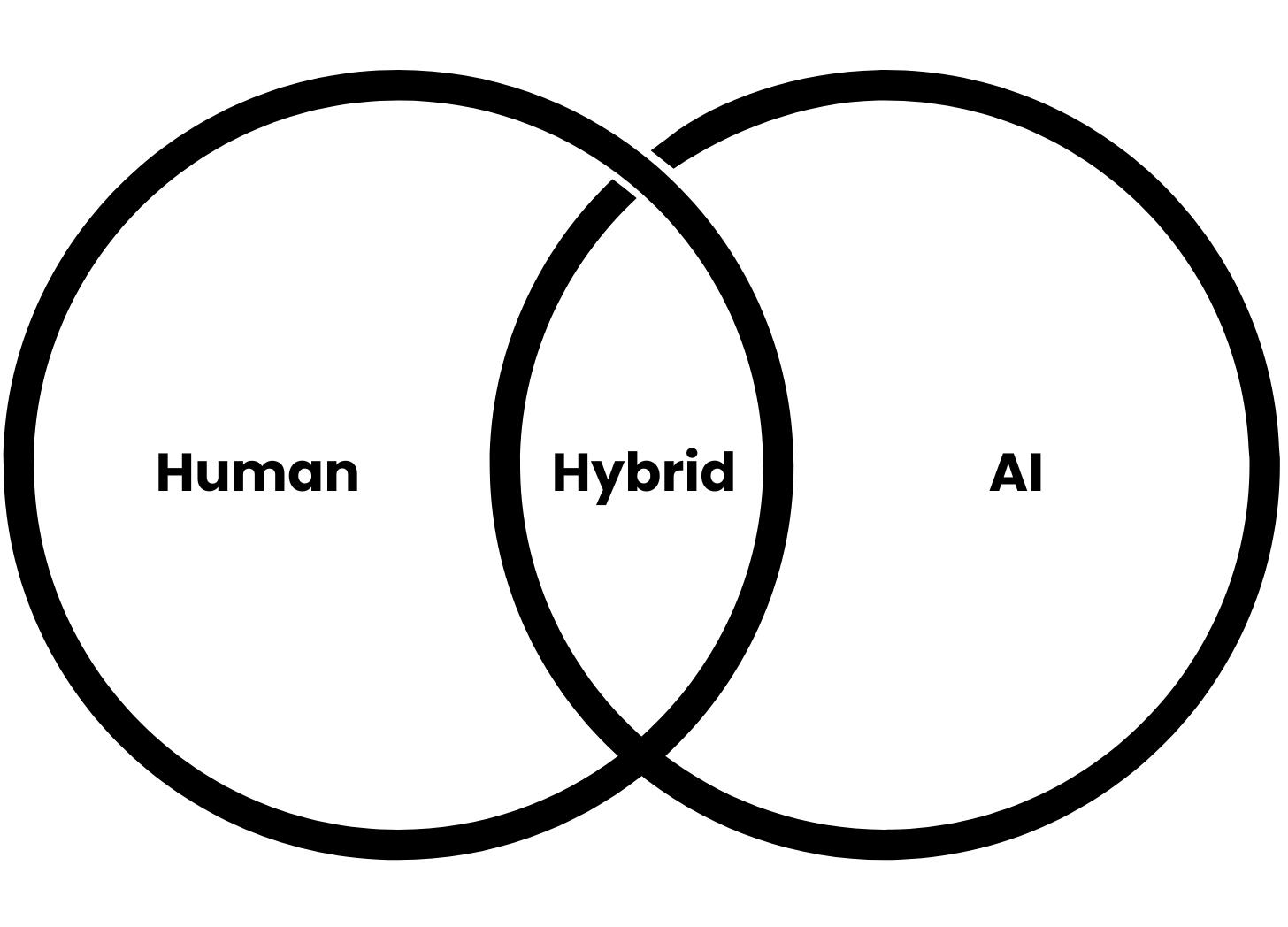
Returning to our spectrum of operations that runs from human-to-AI, at present, most nonprofits are 100% human-powered, a few are beginning to incorporate some generative AI tools, and to my knowledge there are currently no 100% autonomous nonprofit organizations. In the years to come, I predict we’ll see the distribution shift toward AI to fill out this spectrum more evenly. I also believe we will see substantial net sector job gain because hybrid human-AI organization will dominate and proliferate. In these organizations, human beings will be in control because for all of generative AI’s power, it lacks (for now) any conception of the real world where all the work is to be done.
Most importantly, the problems nonprofits are dedicated to addressing are rapidly increasing in both size and seriousness, and are far from being solved. There is an enormous amount of work to be done and the nonprofit sector is currently a tiny fraction of the size it must grow to become in order to achieve our goals. How can we harness the advantages of AI tools to increase our capacity to address the world’s most urgent challenges? And how do we do so in a human-centered way? With cautious optimism, let’s continue thinking about how digital team members can help us with digital tasks, and give us back time to take a breath and to reengage with the world we’re trying to make better.
Thanks for reading this edition of The Process. Please share and comment or you can email me at philip.deng@grantable.co
Philip Deng is the CEO of Grantable, a company building AI-powered grant writing software to empower mission-driven organizations to access grant funding they deserve.